When should you adjust the mirrors for a ride with a passenger?
BC Class 6 / 8 Motorcycle overview
BC Class 6 / 8 Motorcycle Practice Test 3
40 questions on carrying a passenger, emergency vehicles, work zones, trains and horses, lanes, turns, passing and parking, warning, construction and railway signs, pedestrians, cyclists, trucks and buses and more.
- No sign-up
- Every answer explained
- Independent · not a government site
- Set 3 of 8
- 40 questions
- Instant feedback
0/40
All 40 questions in this test
Every question and its answer choices. The correct answers and explanations appear when you take the test above.
When should you adjust the mirrors for a ride with a passenger?
- After you and the passenger are seated
- Only when you ride at night
- Only if the passenger is taller than you
- Before the passenger arrives at the bike
What happens to traffic fines in construction zones?
- They stay the same
- They are replaced by warnings
- They are reduced
- They are doubled
Why is the centre lane of a three-lane road a little riskier than the right lane?
- It has a slippery grease strip down the middle of it
- Traffic can move into it from both sides
- It has more potholes
- It is closer to oncoming traffic
On a B.C. destination sign, what unit are the distances in?
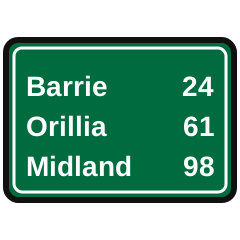
- Kilometres
- Minutes of travel
- Metres
- Miles
When do posted construction zone speed limits apply?
- Only on weekdays
- Only when workers can be seen on the road
- Only during daylight
- 24 hours a day, workers or not
May you carry a passenger with a Class 6L or 8L learner's licence?
- No
- Yes, if they are over 19
- Yes, after the skills test
- Yes, in daylight only
When does a 30 km/h school zone end?
- At the next intersection you reach
- At the back of the sign on the other side
- After exactly 100 metres of road
- When you no longer see any children
What does a steady yellow light mean?
- Speed up to clear the intersection
- Go on if no pedestrians are crossing
- Stop only if you are turning left
- Stop unless you can't stop safely
Friends in your group push you to ride faster than you are comfortable with. What should you do?
- Ride side by side with them
- Take the lead to set the pace
- Leave the group as soon as you safely can
- Keep up with them so you don't hold the group back
What is the main benefit of high-visibility gear like a fluorescent vest?
- It replaces the need for a helmet on short trips
- It keeps you warmer in wind
- Other road users see you more easily
- It lets you ride in bus lanes
About how much of your stopping power comes from the front brake?
- About 30 per cent
- About 70 per cent
- About 90 per cent
- About 50 per cent
When should you do a mirror and shoulder check?
- Only when a car is close behind you in traffic
- Only at night, when mirrors are harder to use
- Before pulling out, changing lanes or position, or turning
- Only before changing lanes on a freeway or highway
Unless signs say otherwise, what is the speed limit in B.C. cities and towns?
- 70 km/h
- 50 km/h
- 40 km/h
- 60 km/h
What speed should a group ride at?
- A speed comfortable for the least experienced rider
- The posted speed limit at all times
- The speed of the group's fastest rider
- The speed the leader likes best
You are leaving a parking lot onto a street. Where should you first stop?
- At the edge of the traffic lane
- Only if a car is coming
- In the bicycle lane
- Before the sidewalk or pedestrian area
How should you check tire pressure?
- With a gauge while the tires are cool
- By looking at the tire bulge
- With a gauge right after a long, hot ride
- By kicking the tire
When is a tinted face shield unsafe?
- In tunnels with lights
- At night or in rain
- On sunny highways
- When riding with a passenger
Your front tire goes flat. Which brake should you use if you must brake?
- Both brakes hard
- The front brake
- The rear brake
- Neither; downshift sharply
Why shouldn't you ride beside a truck in a roundabout?
- Its exhaust blinds you
- It must exit before you
- It may need more than one lane
- Trucks have the right-of-way only in roundabouts
What is the engine cut-off switch for?
- Switching between high and low beam
- Stopping the engine at once in an emergency
- Locking the steering for parking
- Turning on the hazard lights
What does the law allow a Class 8L or 8N rider to do with a phone while riding?
- Use GPS voice directions on the go
- Use a hands-free headset for calls
- Call 9-1-1 to report an emergency
- Send short texts using voice commands
If you double your speed, how does your braking distance change?
- It stays about the same
- About three times longer
- About twice as long
- About four times longer
What is the acceleration lane of a freeway entrance for?
- Stopping to wait for a safe gap
- Parking briefly in an emergency
- Matching your speed to freeway traffic
- Passing slower traffic while still on the ramp
What are the three main causes of a skid?
- Riding upright, braking gently, low speed
- Riding in the left position, slowing early, scanning
- Braking too hard, accelerating suddenly or turning too sharply
- Using both brakes, shifting down, signalling
Which helps you stay alert on a long ride?
- Taking breaks and walking around
- Drinking strong coffee
- Eating a large meal
- Riding faster so you finish the trip sooner
Which part of a road usually ices up first?
- Bridges and overpasses
- Gravel shoulders
- Roads beside buildings
- Sunny straight sections
A sign warns of construction ahead, but the road looks clear. What should you do?
- Keep your speed until you see workers
- Move onto the shoulder right away
- Slow down and be ready for hazards
- Speed up to get through it quickly
How far back should you look when doing a shoulder check?
- Just at your mirror
- All the way behind you for several seconds
- At least 45 degrees behind your shoulder
- Straight to the side
How should you pass another motorcyclist?
- Share their lane and ride past beside them
- As you would pass a car, changing lanes legally
- Pass them on the shoulder on the right side
- Flash your lights at them until they move over for you
When does the guide suggest turning off your engine to save fuel?
- When stopped more than 60 seconds
- Whenever you coast down a long hill
- Only when parked overnight outdoors
- At every red light, however short
What does this sign mean?

- Passing is allowed on the right side
- Keep to the right of the island or divider
- The right lane is for turning only
- Two-way traffic is coming toward you from the right
Why shouldn't you rely only on your horn in an emergency?
- Honking is illegal in towns
- It only works at low speeds
- It is quieter than a car horn
- It turns off the brake light when pressed
You hold a full Class 5 and now have a Class 6L. What is the minimum age of your riding supervisor?
- At least 25
- At least 21
- At least 16
- At least 19
What does this sign tell you about the cross street?

- The right lane ends just ahead
- A detour starts in the arrow's direction
- You must turn the way the arrow points
- Traffic on it moves only in the arrow's direction
You fail a motorcycle road test for the first time. How long must you wait to retake it?
- 24 hours
- 7 days
- 14 days
- 30 days
What is the 'load triangle'?
- The triangle reflector fixed to cargo
- The rack behind the passenger's seat
- The area between the two axles and your head
- The space under the fuel tank and seat
How might a truck slow down without its brake lights coming on?
- Trucks can't slow without brake lights
- By turning off its headlights
- By using an engine retarder or gears
- By using the parking brake
The centre line is a double solid yellow line. What does it mean?
- No passing
- Pass only on motorcycles
- The lane is reversible
- Pass with extra caution
What colour is a school crosswalk sign in B.C.?
- Blue with white symbols
- White with a red border
- Fluorescent yellow-green
- Orange with black symbols
Is it legal to ride over a fire hose?
- No, it is illegal
- Yes, if no firefighters are near
- Yes, at low speed
- Only if it is not charged with water
All BC Class 6 / 8 Motorcycle practice tests
- BC Class 6 / 8 Motorcycle Mock Exam 1 – 40 QuestionsTimed practice · 45 minutes · answers explained
- BC Class 6 / 8 Motorcycle Mock Exam 2 – 40 QuestionsTimed practice · 45 minutes · answers explained
- BC Class 6 / 8 Motorcycle Mock Exam 3 – 40 QuestionsTimed practice · 45 minutes · answers explained
- BC Class 6 / 8 Motorcycle Mock Exam 4 – 40 QuestionsTimed practice · 45 minutes · answers explained
- BC Class 6 / 8 Motorcycle Mock Exam 5 – 40 QuestionsTimed practice · 45 minutes · answers explained
- Regulatory, school and lane signsStop, yield and speed signs, do-not-enter and one-way signs, school, playground and crosswalk signs, lane use and turn control signs, parking signs and reserved lane signs.
- Warning, construction and railway signsYellow diamond warning signs, object markers, orange construction signs, information and destination signs, and the signs that warn of a railway crossing.
- Traffic lights, lane signals and road markingsSteady, flashing and arrow traffic lights, the transit priority signal, lane control signals, and yellow, white, reserved lane and other pavement markings.
- Choosing a motorcycle and riding gearPicking a motorcycle that fits you, the types of motorcycles, approved helmets, eye and face protection, riding clothing, high-visibility gear, gloves and boots.
- Controls, riding posture and pre-trip checkHandlebar and foot controls, the instrument panel, mirrors, ignition and fuel valve positions, stands, riding posture, the pre-trip check, tire care and periodic inspection.
About this practice test
How many questions are in BC Class 6 / 8 Motorcycle practice test 3?
40 original multiple-choice practice questions covering carrying a passenger, emergency vehicles, work zones, trains and horses, lanes, turns, passing and parking, warning, construction and railway signs, pedestrians, cyclists, trucks and buses, traffic lights, lane signals and road markings, riding with other motorcycles, choosing a motorcycle and riding gear, speed, gears, braking and steering, observation and hazard perception, intersections and right-of-way, controls, riding posture and pre-trip check, emergency braking, swerving and breakdowns, fitness, distraction and impairment, space margins, lane position and communication, night, weather, road surfaces and cargo, regulatory, school and lane signs, learner licence, tests and penalties. Each answer includes an explanation. This mixed practice set does not reproduce the official exam format or predict an official score.
Are the questions the same every time?
Yes. Practice test 3 always has the same 40 questions, so you can repeat it until you get them all right. The other 7 sets use different questions.
Are these real test questions?
No. The official question bank is not published. These are original questions written from the official handbook, which is what the real BC Class 6 / 8 Motorcycle test is based on.