About how much of what is happening around them do drivers on a phone miss visually?
BC Class 6 / 8 Motorcycle overview
BC Class 6 / 8 Motorcycle Practice Test 7
40 questions on fitness, distraction and impairment, speed, gears, braking and steering, intersections and right-of-way, space margins, lane position and communication, observation and hazard perception and more.
- No sign-up
- Every answer explained
- Independent · not a government site
- Set 7 of 8
- 40 questions
- Instant feedback
0/40
All 40 questions in this test
Every question and its answer choices. The correct answers and explanations appear when you take the test above.
About how much of what is happening around them do drivers on a phone miss visually?
- About 10 per cent
- About 90 per cent
- About 25 per cent
- About 50 per cent
Is it legal to coast downhill in neutral or with the clutch squeezed?
- No; you must stay in gear
- Only on gravel roads
- Yes, to save fuel
- Yes, below 50 km/h
Which way do you travel in a traffic circle?
- Straight across the centre island
- Either way, if no one else is coming
- Counterclockwise, with right turns in and out
- Clockwise, entering with a left turn
Why do you need more distance to stop going downhill?
- Gravity pulls the motorcycle forward
- The engine speeds up on its own
- Brakes only work on flat roads
- Tires grip less on slopes
From a stop in ideal conditions, about how long does a motorcycle need to turn left and reach 50 km/h?
- About 7 seconds
- About 5 seconds
- About 2 seconds
- About 12 seconds
An emergency vehicle with lights and siren approaches as you near a roundabout. What should you do?
- Stop before entering, or exit and then stop
- Enter quickly and stop inside
- Stop inside the roundabout so it can't get through
- Speed up to clear the roundabout
A large truck in the next lane hides the road ahead. What kind of hazard is this?
- A vision block
- A road-design hazard
- A space conflict
- A surprise
What is a clue that black ice may be on the road?
- The lane markings look brighter than usual
- Steam rises from the road
- The road looks grey-white
- The asphalt looks shiny and black
What does squeezing the clutch lever do?
- Disconnects the engine from the transmission
- Applies the rear brake on most bikes
- Shifts the motorcycle into a higher gear
- Turns on the brake light and signals
Your motorcycle starts, then stalls soon after. What may you have forgotten?
- To release the steering lock fully
- To lift the kick-starter
- To turn the fuel supply valve on
- To set the choke to off
Your motorcycle breaks down on a busy freeway. What should you do?
- Stop on the nearest bridge where it's flat
- Pull far off the road and stay with the bike
- Accept a ride from the first stranger who stops
- Make repairs right there in the traffic lane
A large truck approaches from the other direction. What should you do?
- Move right, then return 3 seconds after it passes
- Brake hard until the truck has gone by you
- Move to the left position so you can see past the truck
- Speed up so you pass the truck more quickly
What does a maximum speed sign tell you?

- The speed you must keep in every weather condition
- The top legal speed in good, dry conditions
- The lowest speed allowed on that road
- A suggested speed for heavy vehicles only
Lanes are closed ahead in a construction zone. When should you merge?
- After passing the arrow board
- At the last moment
- As soon as possible
- Only when a worker waves you
A parked car's front wheels are turned out toward the road. What might happen?
- The car is about to be towed
- The car is parked legally on a hill
- The driver is getting ready to reverse into a stall
- The driver may pull out in front of you
A driver cuts you off and you feel angry. What does the guide suggest?
- Pass them and then brake suddenly in front
- Stay patient; pull over to calm down if needed
- Follow the driver for a while to show how angry you are
- Stare them down when you stop at the light
On the highway, how far ahead is 12 seconds of scanning?
- About 100 metres
- About 2 kilometres
- About half a kilometre
- About one city block ahead of you
An overhead lane control signal shows a red X. What does it mean?
- The lane ends in 1 km
- The lane is for buses only
- You may use the lane to pass
- Do not ride in that lane
When may you go again after stopping for a school bus?
- When the bus driver waves you past
- When the bus moves or its lights go off
- When the children reach the sidewalk on either side
- After waiting about 30 seconds
Most motorcycle mirrors are convex. What does that mean for you?
- Vehicles look closer and larger than they really are
- You see only one lane behind you
- Vehicles look farther away than they are
- There are no blind spots
What does this sign warn of?

- A traffic-control person ahead
- Workers digging beside the road
- A school patrol ahead
- A crosswalk with a guard ahead
Someone is passing you. What should you do?
- Flash your brake light repeatedly
- Keep your speed or slow down to let them in
- Speed up to close the gap ahead
- Move toward the centre line
How long must a Class 8N rider go prohibition-free before the Class 6 road test?
- 12 months
- 18 months
- 36 months
- 24 consecutive months
How far must other traffic be able to see you before you may U-turn near a hill crest?
- 75 metres
- 50 metres
- 300 metres
- 150 metres
When does B.C. law require your headlight to be on?
- Only on highways outside towns and cities
- 30 min after sunset to 30 min before sunrise
- Only when it is raining, snowing or foggy in daytime
- Only from midnight to 5 a.m. each night
Within what distance of another vehicle must you dim your high beam?
- 150 metres
- 500 metres
- 300 metres
- 50 metres
What does this sign warn of?
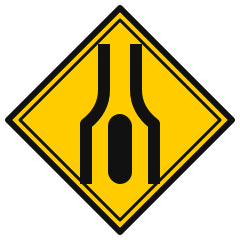
- A median ahead you may pass on either side
- A divided highway ends; keep right
- A one-way street begins ahead
- Two lanes merge into one ahead
When must you yield to a pedestrian at an intersection without a marked crosswalk?
- When they are near your half of the road
- Only if they wave at you
- Never; only marked crosswalks give pedestrians the right-of-way
- Only if they have a green signal
You fail the motorcycle knowledge test. When can you retake it?
- After 24 hours
- The same day
- After 14 days have passed
- After 7 days
How should motorcycle gloves fit with your jacket?
- They should be fingerless for better feel
- They should end below the wrist bone
- They should be worn under the sleeves only
- They should cover the wrists and overlap the sleeves
How is a reserved lane marked on the road surface?
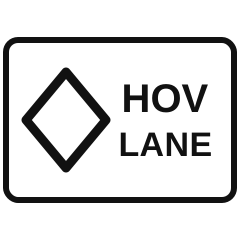
- With a solid yellow centre line
- With a painted red X in the lane
- With orange cones along the edge
- With a white diamond symbol
After stopping at a red light, when may you turn right?
- Only if a pedestrian waves you on
- Only when a green arrow is showing
- When the way is clear, unless a sign forbids it
- Never; you must wait for the green
What does this sign warn you about?

- A lane that ends ahead
- A detour to the left
- A winding road ahead
- A slippery surface ahead
Why should you avoid riding over freshly painted road markings?
- It is allowed only on rural highways
- It is illegal and the wet paint is slippery
- It voids your motorcycle's insurance
- It damages the road's new surface
What does a yellow left-turn arrow mean?
- Oncoming traffic must now stop and let you go first
- Turn left only after a full stop
- You may still turn left freely
- The arrow is about to end; stop if you can
You are stopped uphill behind a truck. Why leave extra space?
- The truck may roll back when it starts
- You need room to make a U-turn
- Trucks always reverse at red lights
- The truck's exhaust is very hot
May you ride in a bus lane marked with a diamond and bus symbol?
- Only to pass a slow bus
- Yes, motorcycles always may
- Yes, but only if you have a passenger with you
- No, motorcycles aren't permitted
How close to the nearest rail may you stop at a railway crossing?
- No closer than 5 metres
- No closer than 20 metres
- Right at the rail
- No closer than 1 metre
How must a learner's supervisor accompany them?
- As a passenger riding on the learner's own motorcycle
- From another vehicle, keeping the learner in sight
- By phone or video call from home
- Only at the start and end of each ride
What is threshold braking?
- Using only the rear brake, very hard
- Pumping both brakes on and off quickly
- Braking gently over a long distance
- Braking both wheels hard just short of locking
All BC Class 6 / 8 Motorcycle practice tests
- BC Class 6 / 8 Motorcycle Mock Exam 1 – 40 QuestionsTimed practice · 45 minutes · answers explained
- BC Class 6 / 8 Motorcycle Mock Exam 2 – 40 QuestionsTimed practice · 45 minutes · answers explained
- BC Class 6 / 8 Motorcycle Mock Exam 3 – 40 QuestionsTimed practice · 45 minutes · answers explained
- BC Class 6 / 8 Motorcycle Mock Exam 4 – 40 QuestionsTimed practice · 45 minutes · answers explained
- BC Class 6 / 8 Motorcycle Mock Exam 5 – 40 QuestionsTimed practice · 45 minutes · answers explained
- Regulatory, school and lane signsStop, yield and speed signs, do-not-enter and one-way signs, school, playground and crosswalk signs, lane use and turn control signs, parking signs and reserved lane signs.
- Warning, construction and railway signsYellow diamond warning signs, object markers, orange construction signs, information and destination signs, and the signs that warn of a railway crossing.
- Traffic lights, lane signals and road markingsSteady, flashing and arrow traffic lights, the transit priority signal, lane control signals, and yellow, white, reserved lane and other pavement markings.
- Choosing a motorcycle and riding gearPicking a motorcycle that fits you, the types of motorcycles, approved helmets, eye and face protection, riding clothing, high-visibility gear, gloves and boots.
- Controls, riding posture and pre-trip checkHandlebar and foot controls, the instrument panel, mirrors, ignition and fuel valve positions, stands, riding posture, the pre-trip check, tire care and periodic inspection.
About this practice test
How many questions are in BC Class 6 / 8 Motorcycle practice test 7?
40 original multiple-choice practice questions covering fitness, distraction and impairment, speed, gears, braking and steering, intersections and right-of-way, space margins, lane position and communication, observation and hazard perception, night, weather, road surfaces and cargo, controls, riding posture and pre-trip check, emergency braking, swerving and breakdowns, regulatory, school and lane signs, emergency vehicles, work zones, trains and horses, traffic lights, lane signals and road markings, pedestrians, cyclists, trucks and buses, warning, construction and railway signs, lanes, turns, passing and parking, learner licence, tests and penalties, choosing a motorcycle and riding gear. Each answer includes an explanation. This mixed practice set does not reproduce the official exam format or predict an official score.
Are the questions the same every time?
Yes. Practice test 7 always has the same 40 questions, so you can repeat it until you get them all right. The other 7 sets use different questions.
Are these real test questions?
No. The official question bank is not published. These are original questions written from the official handbook, which is what the real BC Class 6 / 8 Motorcycle test is based on.