After stopping, your view of the cross street is blocked. What should you do?
BC Class 6 / 8 Motorcycle overview
BC Class 6 / 8 Motorcycle Practice Test 4
40 questions on observation and hazard perception, riding with other motorcycles, pedestrians, cyclists, trucks and buses, night, weather, road surfaces and cargo, carrying a passenger and more.
- No sign-up
- Every answer explained
- Independent · not a government site
- Set 4 of 8
- 40 questions
- Instant feedback
0/40
All 40 questions in this test
Every question and its answer choices. The correct answers and explanations appear when you take the test above.
After stopping, your view of the cross street is blocked. What should you do?
- Honk and go
- Go if you hear no engines
- Edge forward until you can see clearly
- Wait for the car behind to move
Your group has nine riders. What does the guide suggest?
- Ride two abreast in each lane
- Split into two smaller groups
- Keep one group but ride faster
- Ride single file the whole way
On which roads must you let a signalling transit bus with a yield-to-bus sign pull out?
- All roads in B.C.
- Only roads with bus lanes
- Highways with a limit over 80 km/h only
- Roads with a limit of 60 km/h or less
You are about to ride onto gravel. What should you do with the brakes?
- Brake hard once you are on the gravel
- Release them just before reaching the gravel
- Lock the rear wheel to scrub off speed
- Use only the front brake on the gravel
Where should a passenger hold on?
- The rear fender or tail light
- The rider's waist or the grab rail
- The rider's shoulders or the back of the helmet
- The ends of the handlebars
You pass a sign warning of a soft shoulder ahead. What should you do?
- Use the shoulder if the lane is busy
- Move to the shoulder to let trucks pass
- Stay off the shoulder
- Ride on the shoulder only at low speed
Your more experienced friends take curves faster than you want. What should you do?
- Ride at your own safe speed and meet them later
- Ask them to ride side by side with you
- Take a shortcut so you can catch up later
- Keep up with them so you don't fall behind
When is the best time to brake?
- While shifting into a higher gear
- Just after you start a swerve
- While leaning in the middle of a curve
- When upright, moving straight and looking ahead
What is progressive braking?
- Braking hard at first, then releasing fully
- Using only the rear brake first
- Increasing brake pressure gradually
- Pumping the front brake quickly
The advance green arrow ends and the light shows a steady green ball. May you still turn left?
- Yes, yielding to pedestrians and oncoming traffic
- No, you must wait for the next green arrow
- Yes, and oncoming traffic must stop for you
- Only if you are turning from the right lane
What does a steady white rectangle on a transit priority signal mean?
- All traffic may turn right
- Motorcycles may go before cars
- Only buses may go
- Pedestrians may cross diagonally
Behind a truck or bus, how can you tell the driver can likely see you?
- You can read its licence plate
- You are within two seconds of it
- Its brake lights are on
- You can see both of its side mirrors
How often should you do a pre-trip check?
- Only after rain
- Only before long trips
- Every time before you ride
- Once a month
When does the 30 km/h limit in a B.C. playground zone apply?
- Only when children can be seen
- 8 a.m. to 5 p.m. on school days only
- Weekdays from 7 a.m. to 7 p.m.
- Every day from dawn to dusk
Why must you remember to cancel your turn signal?
- Signals stop working above 50 km/h
- Signals drain the battery in seconds
- The law limits signals to five flashes
- Most motorcycle signals don't cancel themselves
How far from the nearest rail of a railway crossing must you park?
- At least 15 m
- At least 6 m
- At least 5 m
- At least 30 m
You are involved in a crash. What must you do?
- Stay, help and exchange the required details
- Ride on and report it within a week
- Discuss with the driver who caused it
- Leave right away if no one appears hurt
Why should you never assume other road users see you?
- Headlights only help others at night
- Motorcycles never show up in car mirrors at all
- Drivers are told to ignore motorcycles
- They may misjudge your speed and distance
How far must you stay behind a fire truck?
- At least 150 metres
- At least 75 metres
- At least 50 metres
- At least 300 metres
What formation should a group normally use on an open highway?
- Side by side in each lane
- Single file in the centre
- Staggered formation
- One rider per lane across the road
What do studies say about a helmet and your hearing?
- It makes you less alert on long rides
- A helmet does not reduce hearing or alertness
- It blocks the sound of sirens
- It should be removed in heavy traffic
What is a 'stale' green light?
- One that is stuck and won't change
- One that is flashing for pedestrians
- One that has been green a long time
- One that has only just turned green
Double broken yellow lines mark a lane. What kind of lane is it?
- A reversible lane controlled by lane signals
- A passing lane for slow-moving vehicles
- A bus-only lane during the rush hours
- A two-way left-turn lane for both sides
A vehicle ahead has stopped at a crosswalk. May you pass it?
- Yes, on the left if no one is coming
- Yes, on the right at low speed
- Only if you sound your horn
- No, it is illegal and unsafe
How far over the limit counts as excessive speeding that can lead to impoundment?
- 20 km/h or more
- 40 km/h or more
- 10 km/h or more
- 60 km/h or more
When should you slow down to leave a freeway?
- While still in the right lane
- After you are in the exit lane
- Before you signal
- On the shoulder before the exit
What colour are construction zone signs?
- Yellow-green
- Orange
- Brown
- Blue
What should you do at a painted island?
- Use it as a left-turn waiting area
- Ride over it if the lane is blocked
- Keep to its right; don't ride on or over it
- Park on it for a short stop
Why avoid riding in the very centre of a lane at intersections?
- A grease strip often builds up there
- Manhole covers are only on the edges
- Drivers can't see the centre
- It is illegal in B.C.
Someone is tailgating you. What should you do with your space in front?
- Close it so the tailgater can't pass
- Keep it at exactly two seconds
- Brake hard to warn the driver behind
- Slowly increase it to four seconds
You plan to drink at a party. What is the best plan?
- Ride home slowly, using quiet back roads
- Wait one hour after your last drink, then ride
- Ride there and decide later how you feel
- Leave the bike at home and arrange a ride
The speed limit is 50 km/h. You approach a stopped police car with flashing lights. What is your maximum speed?
- 20 km/h
- 40 km/h
- 30 km/h
- 50 km/h
When may you pass on the right?
- On the shoulder, if it is paved and wide
- Whenever traffic ahead is moving slowly
- With two or more lanes your way, or a left-turner ahead
- Only on roads with a single lane each way
When may a motorcycle learner ride?
- Only between sunrise and sunset
- Any time, as long as a supervisor is with you
- Only on weekends
- Until midnight
What is the safe angle range for crossing railway tracks?
- Parallel to the rails
- Any angle at low speed
- 45 to 90 degrees
- 10 to 30 degrees
Why shouldn't you brake while swerving abruptly?
- You could skid and fall
- The ABS will switch off
- The brake light won't work
- It is illegal while signalling
You take your road test on a motorcycle of 200 cc or less. What restriction goes on your licence?
- Scooters only
- No passengers
- Maximum 60 km/h
- Daylight riding only
How fast should you ride in fog?
- At the posted speed limit
- Fast enough to get out of the fog quickly
- Slow enough to stop within the distance you can see
- At the speed of the car ahead
Which footwear does the guide recommend for riding?
- Sandals with secure ankle straps
- Boots covering the ankles with low heels
- Running shoes with thick, soft soles
- Dress shoes with smooth leather soles
What does this sign mean?
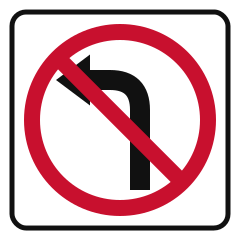
- Left turns are not allowed here
- The left lane must turn left
- Turn left only after a full stop
- Left turns are allowed only on a green arrow
All BC Class 6 / 8 Motorcycle practice tests
- BC Class 6 / 8 Motorcycle Mock Exam 1 – 40 QuestionsTimed practice · 45 minutes · answers explained
- BC Class 6 / 8 Motorcycle Mock Exam 2 – 40 QuestionsTimed practice · 45 minutes · answers explained
- BC Class 6 / 8 Motorcycle Mock Exam 3 – 40 QuestionsTimed practice · 45 minutes · answers explained
- BC Class 6 / 8 Motorcycle Mock Exam 4 – 40 QuestionsTimed practice · 45 minutes · answers explained
- BC Class 6 / 8 Motorcycle Mock Exam 5 – 40 QuestionsTimed practice · 45 minutes · answers explained
- Regulatory, school and lane signsStop, yield and speed signs, do-not-enter and one-way signs, school, playground and crosswalk signs, lane use and turn control signs, parking signs and reserved lane signs.
- Warning, construction and railway signsYellow diamond warning signs, object markers, orange construction signs, information and destination signs, and the signs that warn of a railway crossing.
- Traffic lights, lane signals and road markingsSteady, flashing and arrow traffic lights, the transit priority signal, lane control signals, and yellow, white, reserved lane and other pavement markings.
- Choosing a motorcycle and riding gearPicking a motorcycle that fits you, the types of motorcycles, approved helmets, eye and face protection, riding clothing, high-visibility gear, gloves and boots.
- Controls, riding posture and pre-trip checkHandlebar and foot controls, the instrument panel, mirrors, ignition and fuel valve positions, stands, riding posture, the pre-trip check, tire care and periodic inspection.
About this practice test
How many questions are in BC Class 6 / 8 Motorcycle practice test 4?
40 original multiple-choice practice questions covering observation and hazard perception, riding with other motorcycles, pedestrians, cyclists, trucks and buses, night, weather, road surfaces and cargo, carrying a passenger, warning, construction and railway signs, fitness, distraction and impairment, speed, gears, braking and steering, intersections and right-of-way, traffic lights, lane signals and road markings, controls, riding posture and pre-trip check, regulatory, school and lane signs, lanes, turns, passing and parking, emergency braking, swerving and breakdowns, emergency vehicles, work zones, trains and horses, choosing a motorcycle and riding gear, learner licence, tests and penalties, space margins, lane position and communication. Each answer includes an explanation. This mixed practice set does not reproduce the official exam format or predict an official score.
Are the questions the same every time?
Yes. Practice test 4 always has the same 40 questions, so you can repeat it until you get them all right. The other 7 sets use different questions.
Are these real test questions?
No. The official question bank is not published. These are original questions written from the official handbook, which is what the real BC Class 6 / 8 Motorcycle test is based on.