The traffic lights at an intersection are all dark. How should you treat the intersection?
BC Class 6 / 8 Motorcycle overview
BC Class 6 / 8 Motorcycle: Traffic lights, lane signals and road markings
Steady, flashing and arrow traffic lights, the transit priority signal, lane control signals, and yellow, white, reserved lane and other pavement markings.
- No sign-up
- Every answer explained
- Independent · not a government site
- 19 questions
- Topic drill
0/19
Study reference: Learn to Ride Smart (ICBC, March 2026 edition), Ch. 4 Signs, signals and road markings — Lane control signals, traffic lights, yellow lines, white lines, reserved lane markings, other markings, pp. 42–46
All 19 questions in this test
Every question and its answer choices. The correct answers and explanations appear when you take the test above.
The traffic lights at an intersection are all dark. How should you treat the intersection?
- As an uncontrolled intersection
- As a yield for traffic on the right only
- As a four-way stop
- As if your road has the right-of-way
What must you do at a flashing red light?
- Stop fully, then go when it is safe
- Wait for the light to turn green
- Yield only to vehicles on your right
- Slow down and go with caution
Why should you avoid riding over freshly painted road markings?
- It is allowed only on rural highways
- It is illegal and the wet paint is slippery
- It voids your motorcycle's insurance
- It damages the road's new surface
What does this sign mean?
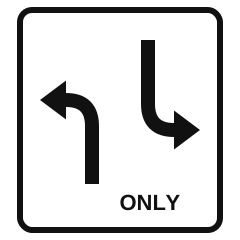
- Two-way traffic begins at the next block
- Traffic must merge into one lane
- Both lanes ahead must turn left
- A shared centre lane for left turns
You see a flashing green arrow pointing left together with a steady red light. What may you do?
- Go straight; left turns must wait for green
- Nothing until the red turns green
- Turn right only after stopping
- Turn left; through traffic must stop
What does a flashing yellow light mean?
- Slow down and go with caution
- Only turning traffic may go
- Stop and wait for a green light
- The light is about to turn red
What does a yellow line on your left tell you?
- Traffic beyond it is coming toward you
- The road is a one-way street
- Traffic beyond it is going the same way you are
- The lane is for turning only
What does a steady white rectangle on a transit priority signal mean?
- All traffic may turn right
- Motorcycles may go before cars
- Only buses may go
- Pedestrians may cross diagonally
What does a solid white line between lanes going the same way mean?
- Passing is allowed with care
- The lane ends ahead
- Do not change lanes
- Change lanes when safe
A lane control signal over your lane shows a flashing yellow X. What should you do?
- Continue in the lane but slow to 40 km/h
- Move out of the lane into one with a green arrow
- Use the lane only if you are turning left
- Stop under the signal and wait for green
There is a broken yellow line and a solid yellow line side by side. When may you pass?
- Only at night with your headlight on
- Whenever the solid line is on your side
- When safe and the broken line is on your side
- Never, from either direction of travel
What does a steady green straight-ahead arrow mean?
- Go straight after a full stop
- Go straight only; no turns
- Yield to oncoming traffic
- Turn left or right only
The centre line is a double solid yellow line. What does it mean?
- No passing
- Pass only on motorcycles
- The lane is reversible
- Pass with extra caution
An overhead lane control signal shows a red X. What does it mean?
- The lane ends in 1 km
- The lane is for buses only
- You may use the lane to pass
- Do not ride in that lane
Double broken yellow lines mark a lane. What kind of lane is it?
- A reversible lane controlled by lane signals
- A passing lane for slow-moving vehicles
- A bus-only lane during the rush hours
- A two-way left-turn lane for both sides
What does a yellow left-turn arrow mean?
- Oncoming traffic must now stop and let you go first
- Turn left only after a full stop
- You may still turn left freely
- The arrow is about to end; stop if you can
In B.C., what does a flashing green light usually mean?
- Pedestrians must wait to cross
- You have a protected left turn
- The light will stay green for one minute
- The light is pedestrian-controlled; go if clear
What should you do at a painted island?
- Use it as a left-turn waiting area
- Ride over it if the lane is blocked
- Keep to its right; don't ride on or over it
- Park on it for a short stop
What does a steady yellow light mean?
- Speed up to clear the intersection
- Go on if no pedestrians are crossing
- Stop only if you are turning left
- Stop unless you can't stop safely
Traffic lights, lane signals and road markings: key rules to remember
Our summary of what the official handbook says on this topic, in our own words. Read it before or after the practice questions above, then check the original chapter. Read the official chapter ↗
Lane control signals
- Lane control signals hang over lanes and show which lanes are open.
- A green arrow means you may ride in the lane; a red X means do not ride in it.
- A flashing yellow X means move out of the lane and into one with a green arrow.
- If the signals over every lane are flashing yellow, slow down and go with caution.
Traffic lights
- In general, red means stop, yellow means caution and green means go; flashing lights and arrows change the meaning.
- In some places green arrows flash and in others they do not.
- Steady red: stop; after a full stop you may turn right, or turn left onto a one-way street, unless a sign forbids it.
- Steady yellow: slow down and stop before the intersection unless you cannot stop safely in time.
- Steady green: go only if the intersection is clear.
- Flashing red: stop, then go only when it is safe.
- Flashing yellow: slow down and go with caution.
- Flashing green: a pedestrian-controlled light; go only if the intersection is clear.
- Green arrow: turn the way the arrow points.
- Green straight-ahead arrow: no turns; go straight through only.
- Flashing green arrow with a steady green light: you may turn the way of the arrow or go straight.
- Flashing green arrow with a steady red light: left turns allowed; through traffic must stop for the red.
- Yellow arrow: the advance left-turn signal is about to change; slow down and stop unless you cannot stop safely.
- Transit priority signal: a steady white rectangle; only buses may go on it.
- If traffic lights fail (dark or all flashing), treat the intersection as a four-way stop (p. 49).
Road markings
- Road markings warn or direct you; they are painted on the road, curbs or other surfaces.
- It is illegal to ride over freshly painted, wet pavement markings.
Yellow lines
- Yellow lines separate traffic going in opposite directions; with a yellow line on your left, traffic on the other side is coming toward you.
- Broken yellow line: passing is allowed when it is safe.
- Broken line beside a solid line: you may pass only when it is safe and the broken line is on your side.
- Double solid yellow line: no passing.
- Single solid yellow line: passing is allowed but with extra caution (p. 60 calls passing over it risky).
- Double broken yellow lines: a reversible lane; lane control signals show whether you may use it.
- Two-way left-turn lane: shared by traffic from both directions for left turns; the markings can also be drawn with the solid lines inside the broken ones.
White lines
- White lines separate lanes going the same way; they also mark crosswalks, stopping positions and the right shoulder of highways.
- Solid white line: do not change lanes.
- Broken white line: you may change lanes when it is safe.
- Stop line: stop before the line.
- Crosswalk lines: stop for pedestrians in the crosswalk.
- Some pedestrian-activated crosswalks have lights in the pavement; stop for pedestrians in the crosswalk.
Reserved lane and other markings
- HOV lanes are marked with thick solid or broken lines and white diamonds.
- Reserved lane markings: extra signs or markings say which vehicles may use the lane.
- Bicycle lane: for cyclists only; marked with a bicycle outline and sometimes a diamond; cyclists ride the same direction as the traffic beside them.
- Arrow markings in a lane: e.g., vehicles in this lane must turn left, or must go straight or turn left.
- Painted island: keep to the right of it and do not ride on or over it.
Study the Traffic lights, lane signals and road markings rules as flashcards →
Other topics
- Regulatory, school and lane signsStop, yield and speed signs, do-not-enter and one-way signs, school, playground and crosswalk signs, lane use and turn control signs, parking signs and reserved lane signs.
- Warning, construction and railway signsYellow diamond warning signs, object markers, orange construction signs, information and destination signs, and the signs that warn of a railway crossing.
- Choosing a motorcycle and riding gearPicking a motorcycle that fits you, the types of motorcycles, approved helmets, eye and face protection, riding clothing, high-visibility gear, gloves and boots.
- Controls, riding posture and pre-trip checkHandlebar and foot controls, the instrument panel, mirrors, ignition and fuel valve positions, stands, riding posture, the pre-trip check, tire care and periodic inspection.
- Intersections and right-of-wayWhen to signal, uncontrolled and controlled intersections, where to stop, stale and fresh green lights, left turns, two-way and four-way stops, yield signs, traffic circles and roundabouts.
- Lanes, turns, passing and parkingChoosing a lane, lane tracking for right and left turns, turning lanes, U-turns, HOV, bus and bicycle lanes, passing and merging, freeway entrances and exits, and parking rules.
- Observation and hazard perceptionThe see-think-do strategy, scanning 12 seconds ahead, mirrors, blind spots and shoulder checks, observing at intersections, the four kinds of hazards, and assessing risk.
- Speed, gears, braking and steeringChoosing a safe speed, default speed limits, using the gears and both brakes, inertia, traction and gravity, low-speed steering, countersteering and handling curves.
- Space margins, lane position and communicationFollowing distance and stopping distance, tailgaters, side space, the three lane positions, lane splitting, choosing a safe gap, and communicating with signals, brake light, horn and eye contact.
- Pedestrians, cyclists, trucks and busesYielding to pedestrians, school and playground zones, people with disabilities, cyclists and bicycle hand signals, large vehicles and their blind spots and turbulence, school buses and transit buses.
- Emergency vehicles, work zones, trains and horsesPulling over for emergency vehicles, slowing past stopped vehicles with flashing lights, construction zone rules, railway crossings and trains, and passing horses safely.
- Riding with other motorcyclesGroup size, staggered formation, where to put less experienced riders, passing as a group, intersections, group signals and passing another motorcyclist.
- Fitness, distraction and impairmentVision and hearing, illness and medication, fatigue, staying focused, B.C.'s electronic device law, dangerous emotions, alcohol and drugs, risk taking, peer pressure and aggression on the road.
- Carrying a passengerWhen you may carry a passenger, how a passenger changes handling, adjusting the motorcycle, keeping a passenger safe, and how to be a safe passenger.
- Night, weather, road surfaces and cargoFog, rain, glare and night riding, headlight rules, gravel, uneven pavement, railway tracks, slippery surfaces, ice, hydroplaning, crowned and banked roads, crosswinds and carrying cargo.
- Emergency braking, swerving and breakdownsThreshold braking, ABS, avoiding skids, swerving and accelerating to avoid a crash, flat tires, engine and headlight failure, wobbles, animals, riding over obstacles and what to do at a crash scene.
- Learner licence, tests and penaltiesClass 6L and 8L learner restrictions, supervisors, the motorcycle skills test, novice restrictions, GLP penalties, licence restrictions from the road test motorcycle, fines, points and impoundment.