Every question and its answer choices. The correct answers and explanations appear when you take the test above.
Where would you see an object marker like this one?

- At the end of a school or playground zone
- On an obstruction you must pass with care
- On the back of a slow-moving farm vehicle
- Above a lane that is reserved for buses
May motorcycles use HOV lanes in B.C.?
- Never, whatever signs are posted
- On some roads, where 'Motorcycles OK' is posted
- Always, on every road with an HOV lane
- Only when you are carrying a passenger
Why shouldn't you brake while swerving abruptly?
- You could skid and fall
- The ABS will switch off
- The brake light won't work
- It is illegal while signalling
How can you tell a helmet is approved?
- It has a built-in sun visor
- Its label shows DOT, Snell or ECE
- It is sold by a motorcycle dealer
- It covers both ears completely
You are blinded by low sun glare. What should you do?
- Speed up to get out of the glare
- Close your eyes for a moment until the glare passes
- Slow down and look down and to the sides
- Look straight at the light to adjust
You face several hazards at once. What should you deal with first?
- The closest one to the curb
- The one you saw first
- The most dangerous one
- The one on your left
What should you do at a painted island?
- Use it as a left-turn waiting area
- Ride over it if the lane is blocked
- Keep to its right; don't ride on or over it
- Park on it for a short stop
The centre line is a double solid yellow line. What does it mean?
- No passing
- Pass only on motorcycles
- The lane is reversible
- Pass with extra caution
You are in a lane marked by an overhead arrow sign. What must you do?
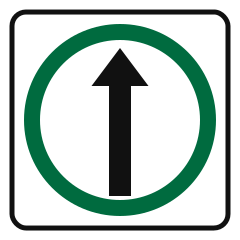
- Treat the arrows as a suggestion only
- Go in the direction the arrows show
- Change lanes in the intersection if needed
- Follow the arrows only during rush hour
A large truck approaches from the other direction. What should you do?
- Move right, then return 3 seconds after it passes
- Brake hard until the truck has gone by you
- Move to the left position so you can see past the truck
- Speed up so you pass the truck more quickly
You are stopped uphill behind a truck. Why leave extra space?
- The truck may roll back when it starts
- You need room to make a U-turn
- Trucks always reverse at red lights
- The truck's exhaust is very hot
A tire starts to whine or shudder while you brake. What does it mean?
- The ABS has switched off
- The brakes are working exactly as designed
- The tire is overinflated
- A wheel is about to lock; ease up
On a motorcycle with linked brakes, what happens when you use either brake control?
- The engine is cut off right away
- The anti-lock braking system switches itself off
- Only the front brake is applied
- Both front and rear brakes are applied
What is progressive braking?
- Braking hard at first, then releasing fully
- Using only the rear brake first
- Increasing brake pressure gradually
- Pumping the front brake quickly
You are leaving a parking lot onto a street. Where should you first stop?
- At the edge of the traffic lane
- Only if a car is coming
- In the bicycle lane
- Before the sidewalk or pedestrian area
Someone is tailgating you. What should you do with your space in front?
- Close it so the tailgater can't pass
- Keep it at exactly two seconds
- Brake hard to warn the driver behind
- Slowly increase it to four seconds
When should you do a mirror and shoulder check?
- Only when a car is close behind you in traffic
- Only at night, when mirrors are harder to use
- Before pulling out, changing lanes or position, or turning
- Only before changing lanes on a freeway or highway
What does this sign warn of?

- A steep hill ahead
- A slippery road ahead
- A winding road ahead
- A gravel shoulder ahead
Someone is passing you. What should you do?
- Flash your brake light repeatedly
- Keep your speed or slow down to let them in
- Speed up to close the gap ahead
- Move toward the centre line
An ambulance with lights and siren approaches. What must traffic in both directions do?
- Pull over and stop
- Stop only if in the same lane
- Speed up to clear the road
- Keep moving at the same speed
On a slippery road, how much stopping distance should you allow?
- Twice the normal distance
- Four times the normal distance
- The normal distance
- Half the normal distance
What does this sign warn you about?

- The pavement ends in a short distance
- Two-way traffic is coming up ahead
- A divided road is beginning ahead
- A narrow structure, often a bridge
A school zone sign has a tab reading 30 km/h with no hours shown. When does the limit apply?

- Only during the morning and afternoon bells
- Only when a crossing guard is present
- 8 a.m. to 5 p.m. on school days
- Every day from dawn to dusk
Most motorcycle mirrors are convex. What does that mean for you?
- Vehicles look closer and larger than they really are
- You see only one lane behind you
- Vehicles look farther away than they are
- There are no blind spots
At a four-way stop, you and an oncoming driver arrive together. You turn left; they go straight. Who goes first?
- Whoever is on the right
- You, because you signalled first
- The oncoming driver going straight
- You, because motorcycles are smaller
When does a 30 km/h school zone end?
- At the next intersection you reach
- At the back of the sign on the other side
- After exactly 100 metres of road
- When you no longer see any children
Who may not use hand-held electronic devices while riding in B.C.?
- Only riders in the GLP program
- All riders, including GLP riders
- Only riders on numbered highways
- Only riders under 19 years old
Which is an example of a 'surprise' hazard?
- A driver weaving back and forth
- A sign warning of a curve
- A wide paved shoulder
- A painted crosswalk
When does the 30 km/h limit in a B.C. playground zone apply?
- Only when children can be seen
- 8 a.m. to 5 p.m. on school days only
- Weekdays from 7 a.m. to 7 p.m.
- Every day from dawn to dusk
What shape and colour are most warning signs?
- A green rectangle
- A yellow diamond
- A white rectangle
- A red octagon
In a strong crosswind from your left, what should you do?
- Sit upright and speed up
- Ride on the right edge of the lane
- Lean away from the wind, to the right, and speed up
- Lean the motorcycle into the wind, to the left
How should a staggered group pass a slower vehicle?
- All riders together, side by side
- The last rider first, then the others
- One rider at a time, starting with the leader
- Two riders at a time in the same lane
What does a yellow left-turn arrow mean?
- Oncoming traffic must now stop and let you go first
- Turn left only after a full stop
- You may still turn left freely
- The arrow is about to end; stop if you can
Where should a passenger hold on?
- The rear fender or tail light
- The rider's waist or the grab rail
- The rider's shoulders or the back of the helmet
- The ends of the handlebars
Which helmet type gives the best crash protection?
- A full-face helmet
- A half helmet
- A shorty helmet with goggles
- An open-face helmet
Double broken yellow lines mark a lane. What kind of lane is it?
- A reversible lane controlled by lane signals
- A passing lane for slow-moving vehicles
- A bus-only lane during the rush hours
- A two-way left-turn lane for both sides
Two vehicles reach an uncontrolled intersection at the same time. Who must yield?
- The larger vehicle always goes through first
- The vehicle on the left yields to the right
- The vehicle on the right yields to the left
- The motorcycle always goes through first
What does this sign warn of?

- Deer may be on the road
- A wildlife park entrance
- A farm crossing for cattle
- A hunting area beside the road
Which two restrictions are removed when a learner passes the motorcycle skills test?
- The supervisor and 60 km/h restrictions
- All learner restrictions
- The passenger and daylight restrictions
- The L sign and zero-alcohol restrictions
You are in the left lane of a one-way street when a fire truck comes up behind with its siren on. Where do you pull over?
- To the left
- Nowhere; keep going
- Into the intersection ahead
- To the right, crossing all lanes