BC Class 6 / 8 Motorcycle overview

BC Class 6 / 8 Motorcycle Practice Test 5

40 questions on traffic lights, lane signals and road markings, emergency braking, swerving and breakdowns, learner licence, tests and penalties, fitness, distraction and impairment, carrying a passenger and more.

  • Set 5 of 8
  • 40 questions
  • Instant feedback
0/40
Practice test 5 · Question 1Score 0/0
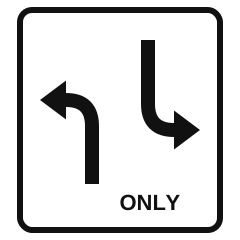
A white rectangle with two curved arrows pointing opposite ways and the word ONLY

What does this sign mean?

All 40 questions in this test

Every question and its answer choices. The correct answers and explanations appear when you take the test above.

  1. What does this sign mean?

    A white rectangle with two curved arrows pointing opposite ways and the word ONLY
    1. Two-way traffic begins at the next block
    2. Traffic must merge into one lane
    3. Both lanes ahead must turn left
    4. A shared centre lane for left turns
  2. On a motorcycle with ABS, how should you brake in an emergency?

    1. Use only the front brake, squeezing as hard as you can
    2. Release and reapply the brakes every second
    3. Pump the brakes rapidly to help the ABS
    4. Firm, continuous, hard pressure on both brakes
  3. What does it cost to reinstate your licence after a prohibition?

    1. $50
    2. $500
    3. $100
    4. $250
  4. How does a glass of beer compare to a glass of wine or an average cocktail?

    1. They contain about the same alcohol
    2. Beer has much more alcohol in it
    3. Beer has much less alcohol in it
    4. Beer doesn't affect riding at all, in any amount
  5. What lowers your blood alcohol level?

    1. Only time
    2. A cold shower
    3. Eating a big meal
    4. Black coffee
  6. How does a passenger usually change the way a motorcycle handles?

    1. Faster acceleration and shorter braking
    2. No change if the passenger is light
    3. Slower acceleration and longer braking
    4. Lighter steering at low speed
  7. You are in the intersection waiting to turn left and the light turns yellow. What may you do?

    1. Stay in place until the next green light comes on
    2. Go straight through instead of turning left
    3. Complete the turn, watching for red-light runners
    4. Back up behind the stop line and wait there
  8. What does a lighted arrow board in a work zone mean?

    Black rectangle with yellow lights forming an arrow pointing left
    1. Move over in the direction of the arrow
    2. Workers are on the left shoulder only
    3. Speed up to clear the work area
    4. The lane beside you ends in exactly 1 km
  9. When may you cross a bicycle lane?

    1. Never, even to reach a driveway
    2. Where the line is broken, or for a driveway
    3. Only when your light is showing green
    4. Wherever the bicycle lane looks empty
  10. When should you never pass?

    1. When the vehicle ahead is slow
    2. On a straight road with a broken line
    3. In daylight on a dry road
    4. When approaching the top of a hill
  11. You approach a horse and rider on the road. What should you do?

    1. Slow down, pass wide and avoid revving or honking
    2. Honk so the rider knows you're there
    3. Rev the engine to signal your approach
    4. Pass quickly to reduce the time beside it
  12. How often should you complete the full observation cycle of ahead, sides and mirrors?

    1. Only at intersections
    2. Every 20 seconds
    3. Once per city block
    4. Every five to eight seconds
  13. Following other riders into a curve, what should you remember?

    1. Speed up so you aren't left behind by the others
    2. Stay right on their rear wheel
    3. Copy the leader's line exactly
    4. Choose your own safe speed and path
  14. What should you check on the tires before carrying a passenger?

    1. Only the tread depth on the front tire
    2. Nothing, since tires don't need any changes for weight
    3. Pressure for the extra load, per the manual
    4. The colour of the valve caps
  15. Before the crest of a hill, which lane position should you move to?

    1. The shoulder
    2. The centre or right position
    3. On the centre line
    4. The left position
  16. Why can't an off-road motorcycle be ridden on the street?

    1. It lacks full lights, a horn and emission controls
    2. Its tires are too wide for pavement
    3. It has no clutch, gears or rear brake
    4. Its engine is always 50 cc or smaller
  17. How old must the supervisor of a Class 8L rider be?

    1. At least 25
    2. At least 21
    3. At least 19
    4. At least 30
  18. Why should a riding jacket fit snugly?

    1. So it is easier to sit upright
    2. So it doesn't balloon or flap in the wind
    3. So it keeps the helmet strap in place
    4. So the reflective strips line up
  19. What does this sign warn of?

    Yellow diamond showing a traffic light
    1. A school crosswalk ahead
    2. A stop sign at the next corner
    3. Traffic lights ahead
    4. A railway crossing ahead
  20. A blind pedestrian raises their white cane at a curb. What does it mean?

    1. They want you to sound your horn
    2. They are trying to hail a taxi
    3. They are telling you to go first
    4. They are unsure; stop and let them cross
  21. How do you work the gearshift lever?

    1. With your right foot, without the clutch
    2. With your left hand, on the handlebar
    3. With your left foot, together with the clutch
    4. With your right foot, after the brake
  22. What does this sign mean?

    White square, U-shaped arrow, red circle and slash
    1. U-turns are not allowed
    2. The road ahead curves sharply back
    3. A turnaround area is coming up
    4. Traffic must turn around at the barrier
  23. Stopped traffic on your right is squeezing your group as you ride straight through an intersection. What may the group do?

    1. Use the paved shoulder on the right
    2. Ride two abreast to clear it faster
    3. Form single file on the left side of the lane
    4. Spread out across both lanes of traffic
  24. A school zone sign has a tab reading 30 km/h with no hours shown. When does the limit apply?

    Five-sided sign with two black child figures
    1. Only during the morning and afternoon bells
    2. Only when a crossing guard is present
    3. 8 a.m. to 5 p.m. on school days
    4. Every day from dawn to dusk
  25. Why should you never ride off while the motorcycle is still on its stand?

    1. It locks the rear brake on the bike
    2. It drains the battery very quickly
    3. The stand can dig in when you turn
    4. It voids the motorcycle's warranty
  26. On a rural highway with no speed sign posted, what limit applies?

    1. 80 km/h
    2. 90 km/h
    3. 100 km/h
    4. 70 km/h
  27. At speeds up to about 10 km/h, how do you steer?

    1. Push on the opposite handgrip
    2. Shift your weight to the back
    3. Turn the bars the way you want to go
    4. Lean the motorcycle well over
  28. How close to a crosswalk or intersection may you park?

    1. No closer than 10 m
    2. No closer than 6 m
    3. Right up to the line
    4. No closer than 3 m
  29. In a strong crosswind from your left, what should you do?

    1. Sit upright and speed up
    2. Ride on the right edge of the lane
    3. Lean away from the wind, to the right, and speed up
    4. Lean the motorcycle into the wind, to the left
  30. Why might a cyclist move toward the middle of the lane?

    1. Because bike lanes are illegal
    2. Cyclists must always ride in the centre
    3. To turn left or avoid glass or potholes
    4. To block motorcycles from passing
  31. What must you do at a flashing red light?

    1. Stop fully, then go when it is safe
    2. Wait for the light to turn green
    3. Yield only to vehicles on your right
    4. Slow down and go with caution
  32. There is a crosswalk but no stop line. Where do you stop?

    1. Beside the stop sign post
    2. Just before the nearest crosswalk
    3. Just before entering the intersection
    4. In the middle of the crosswalk
  33. Your low beam burns out at night. What should you do?

    1. Follow close behind another vehicle's lights
    2. Keep riding with no headlight on at all
    3. Turn on hazard lights and ride faster
    4. Switch to high beam and get off the road
  34. What does 'overriding your headlight' mean?

    1. Flashing the headlight before you pass
    2. Riding with one of the two headlight bulbs burnt out
    3. Using the high beam on city streets
    4. Riding too fast to stop within the lit area
  35. Which lane position is usually the default, dominant position?

    1. The right position
    2. The left position
    3. On the lane line
    4. The centre position
  36. A Class 8N rider is prohibited from driving. What happens to their novice time?

    1. Nothing changes to the time
    2. It is cut by six months only
    3. It pauses, then picks up again
    4. It resets to zero after reinstatement
  37. Which is an example of a 'surprise' hazard?

    1. A driver weaving back and forth
    2. A sign warning of a curve
    3. A wide paved shoulder
    4. A painted crosswalk
  38. Who may not use hand-held electronic devices while riding in B.C.?

    1. Only riders in the GLP program
    2. All riders, including GLP riders
    3. Only riders on numbered highways
    4. Only riders under 19 years old
  39. At a four-way stop, two vehicles stop at about the same time. Who goes first?

    1. The vehicle on the right
    2. The vehicle turning left
    3. The vehicle on the left
    4. The vehicle going faster
  40. A long train has just cleared the crossing. Why wait before going?

    1. The bell must stop ringing three times
    2. The gate has to be inspected first
    3. A second train may be coming on another track
    4. Trains always back up after passing

All BC Class 6 / 8 Motorcycle practice tests

About this practice test

How many questions are in BC Class 6 / 8 Motorcycle practice test 5?

40 original multiple-choice practice questions covering traffic lights, lane signals and road markings, emergency braking, swerving and breakdowns, learner licence, tests and penalties, fitness, distraction and impairment, carrying a passenger, intersections and right-of-way, warning, construction and railway signs, lanes, turns, passing and parking, observation and hazard perception, emergency vehicles, work zones, trains and horses, riding with other motorcycles, space margins, lane position and communication, choosing a motorcycle and riding gear, pedestrians, cyclists, trucks and buses, controls, riding posture and pre-trip check, regulatory, school and lane signs, speed, gears, braking and steering, night, weather, road surfaces and cargo. Each answer includes an explanation. This mixed practice set does not reproduce the official exam format or predict an official score.

Are the questions the same every time?

Yes. Practice test 5 always has the same 40 questions, so you can repeat it until you get them all right. The other 7 sets use different questions.

Are these real test questions?

No. The official question bank is not published. These are original questions written from the official handbook, which is what the real BC Class 6 / 8 Motorcycle test is based on.

