Who must wear an approved motorcycle helmet in B.C.?
BC Class 6 / 8 Motorcycle overview
BC Class 6 / 8 Motorcycle Mock Exam 5
Same format as the real test. Answers stay hidden until you submit.
- No sign-up
- Every answer explained
- Independent · not a government site
- 40 questions
- 45 min
- Pass mark 32/40
0/40
All 40 questions in this test
Every question and its answer choices. The correct answers and explanations appear when you take the test above.
Who must wear an approved motorcycle helmet in B.C.?
- Riders only, not their passengers
- Every rider and every passenger
- Riders on highways only
- Riders under 19 only
What formation should a group normally use on an open highway?
- Side by side in each lane
- Single file in the centre
- Staggered formation
- One rider per lane across the road
Why is the centre lane of a three-lane road a little riskier than the right lane?
- It has a slippery grease strip down the middle of it
- Traffic can move into it from both sides
- It has more potholes
- It is closer to oncoming traffic
About how far does a typical train need to stop?
- About 2 kilometres
- About 500 metres
- About 50 metres
- About 200 metres on level track
How should you treat an unmarked T-intersection?
- As if the through road must yield to you
- As a four-way stop
- Like any other uncontrolled intersection
- As a yield for traffic on your left only
Where are you most likely to see this sign?

- At the start of a school zone
- At the entrance to a parking lot
- On a freeway exit ramp
- Before a narrow one-lane bridge
The traffic lights at an intersection are all dark. How should you treat the intersection?
- As an uncontrolled intersection
- As a yield for traffic on the right only
- As a four-way stop
- As if your road has the right-of-way
A blind pedestrian raises their white cane at a curb. What does it mean?
- They want you to sound your horn
- They are trying to hail a taxi
- They are telling you to go first
- They are unsure; stop and let them cross
What must you do at this sign?

- Use the shoulder to get around slower traffic
- Speed up to merge ahead of other traffic
- Let crossing traffic and pedestrians go first
- Stop every time, even when the road is clear
Which helmet type gives the best crash protection?
- A full-face helmet
- A half helmet
- A shorty helmet with goggles
- An open-face helmet
A sign warns of construction ahead, but the road looks clear. What should you do?
- Keep your speed until you see workers
- Move onto the shoulder right away
- Slow down and be ready for hazards
- Speed up to get through it quickly
On which roads must you let a signalling transit bus with a yield-to-bus sign pull out?
- All roads in B.C.
- Only roads with bus lanes
- Highways with a limit over 80 km/h only
- Roads with a limit of 60 km/h or less
When is it too early to signal a right turn?
- Anytime before you reach the stop line
- Whenever you are in a turning lane
- Only after dark, when signals are bright
- When driveways come before your turn
In city riding, how far ahead does 12 seconds of scanning usually mean?
- About 50 metres
- About half a block
- About five blocks
- About one to two blocks
What blood alcohol level is allowed for a Class 8L or 8N rider?
- Zero
- Under .05
- Under .08
- Under .02
When may you go again after stopping for a school bus?
- When the bus driver waves you past
- When the bus moves or its lights go off
- When the children reach the sidewalk on either side
- After waiting about 30 seconds
How should you pass another motorcyclist?
- Share their lane and ride past beside them
- As you would pass a car, changing lanes legally
- Pass them on the shoulder on the right side
- Flash your lights at them until they move over for you
On a B.C. destination sign, what unit are the distances in?
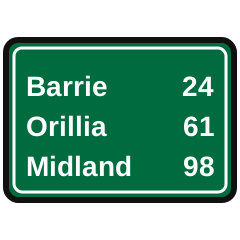
- Kilometres
- Minutes of travel
- Metres
- Miles
Which way do you travel in a traffic circle?
- Straight across the centre island
- Either way, if no one else is coming
- Counterclockwise, with right turns in and out
- Clockwise, entering with a left turn
What is the 'load triangle'?
- The triangle reflector fixed to cargo
- The rack behind the passenger's seat
- The area between the two axles and your head
- The space under the fuel tank and seat
At a four-way stop, you and an oncoming driver arrive together. You turn left; they go straight. Who goes first?
- Whoever is on the right
- You, because you signalled first
- The oncoming driver going straight
- You, because motorcycles are smaller
Why shouldn't you wave a pedestrian across in the middle of a block?
- Only buses may stop for pedestrians
- Pedestrians must always cross at lights
- It slows down cyclists behind you
- Other drivers may not expect it
A friend can't reach the passenger footpegs. What should you do?
- Let them hold their feet up
- Carry them on short trips only
- Don't carry them
- Let them rest feet on the exhaust
When is the best time to brake?
- While shifting into a higher gear
- Just after you start a swerve
- While leaning in the middle of a curve
- When upright, moving straight and looking ahead
What should the throttle do when you let go of it?
- Stay where you left it
- Snap back to idle
- Lock at the last speed
- Rotate fully open
What does a maximum speed sign tell you?

- The speed you must keep in every weather condition
- The top legal speed in good, dry conditions
- The lowest speed allowed on that road
- A suggested speed for heavy vehicles only
May you carry a passenger with a Class 6L or 8L learner's licence?
- No
- Yes, if they are over 19
- Yes, after the skills test
- Yes, in daylight only
Someone is tailgating you. What should you do with your space in front?
- Close it so the tailgater can't pass
- Keep it at exactly two seconds
- Brake hard to warn the driver behind
- Slowly increase it to four seconds
What speed should a group ride at?
- A speed comfortable for the least experienced rider
- The posted speed limit at all times
- The speed of the group's fastest rider
- The speed the leader likes best
After passing, where does the second rider return to?
- The right lane position
- The centre of the lane
- Beside the leader
- The left lane position, beside the leader
Lanes are closed ahead in a construction zone. When should you merge?
- After passing the arrow board
- At the last moment
- As soon as possible
- Only when a worker waves you
Leaving a one-way street, you turn left onto a two-way street. Which lane should you end up in?
- The curb lane on the far right
- The bicycle lane beside the curb
- The lane nearest the centre line
- Whichever lane has the least traffic
How do you work the gearshift lever?
- With your right foot, without the clutch
- With your left hand, on the handlebar
- With your left foot, together with the clutch
- With your right foot, after the brake
How should your wrists be when gripping the handgrips?
- Bent sharply upward
- Raised well above the grips
- Flat or slightly dropped
- Resting on the tank
Which type of motorcycle does the guide describe as suiting learners, with an upright posture?
- Sport
- Standard
- Off-road
- Touring
Which road surface gives the least traction?
- Ice
- Gravel
- Wet pavement
- Snow
Whose safety are you responsible for when carrying a passenger?
- Only your own
- Neither; the passenger rides at own risk
- Your passenger's as well as your own
- Only the passenger's
Someone is passing you. What should you do?
- Flash your brake light repeatedly
- Keep your speed or slow down to let them in
- Speed up to close the gap ahead
- Move toward the centre line
Approaching an intersection, in what order should you scan the road you are crossing?
- Right, then left only
- Left, centre, right, then left again
- Left only, since traffic comes from there
- Centre only, then mirrors
Why should you avoid riding over freshly painted road markings?
- It is allowed only on rural highways
- It is illegal and the wet paint is slippery
- It voids your motorcycle's insurance
- It damages the road's new surface
Keep practising
- BC Class 6 / 8 Motorcycle Mock Exam 1 – 40 QuestionsTimed practice · 45 minutes · answers explained
- BC Class 6 / 8 Motorcycle Mock Exam 2 – 40 QuestionsTimed practice · 45 minutes · answers explained
- BC Class 6 / 8 Motorcycle Mock Exam 3 – 40 QuestionsTimed practice · 45 minutes · answers explained
- BC Class 6 / 8 Motorcycle Mock Exam 4 – 40 QuestionsTimed practice · 45 minutes · answers explained
- BC Class 6 / 8 Motorcycle Practice Test 140 questions with explanations
- BC Class 6 / 8 Motorcycle Practice Test 240 questions with explanations
- BC Class 6 / 8 Motorcycle Practice Test 340 questions with explanations
- BC Class 6 / 8 Motorcycle Practice Test 440 questions with explanations