Approaching an intersection, in what order should you scan the road you are crossing?
BC Class 6 / 8 Motorcycle overview
BC Class 6 / 8 Motorcycle Practice Test 2
40 questions on observation and hazard perception, regulatory, school and lane signs, carrying a passenger, choosing a motorcycle and riding gear, traffic lights, lane signals and road markings and more.
- No sign-up
- Every answer explained
- Independent · not a government site
- Set 2 of 8
- 40 questions
- Instant feedback
0/40
All 40 questions in this test
Every question and its answer choices. The correct answers and explanations appear when you take the test above.
Approaching an intersection, in what order should you scan the road you are crossing?
- Right, then left only
- Left, centre, right, then left again
- Left only, since traffic comes from there
- Centre only, then mirrors
You are in a lane marked by an overhead arrow sign. What must you do?
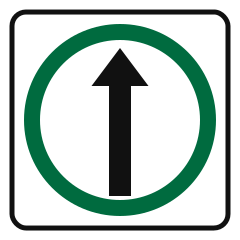
- Treat the arrows as a suggestion only
- Go in the direction the arrows show
- Change lanes in the intersection if needed
- Follow the arrows only during rush hour
What must every passenger wear?
- A seat belt
- A high-visibility vest only, with no other gear
- An approved motorcycle helmet
- Sunglasses
Which helmet type gives the best crash protection?
- A full-face helmet
- A half helmet
- A shorty helmet with goggles
- An open-face helmet
The traffic lights at an intersection are all dark. How should you treat the intersection?
- As an uncontrolled intersection
- As a yield for traffic on the right only
- As a four-way stop
- As if your road has the right-of-way
Why is mixing even a small amount of alcohol with drugs dangerous?
- It can greatly increase impairment
- The drugs cancel the alcohol
- It only affects passengers
- It only matters for prescription drugs
There is no stop line, no crosswalk and no sidewalk. Where do you stop?
- Wherever you can see best
- Just before you enter the intersection
- One full car length back from the corner
- At the nearest driveway
After passing a truck, when should you move back into its lane?
- When you can see its headlights in your mirror
- After one second
- When the driver flashes the lights
- As soon as your rear wheel clears the truck's front bumper
Where are you most likely to see this sign?

- At the start of a school zone
- At the entrance to a parking lot
- On a freeway exit ramp
- Before a narrow one-lane bridge
Within how many days must you update the address on your licence after moving?
- 90 days
- 10 days
- 30 days
- 60 days
After passing, where does the second rider return to?
- The right lane position
- The centre of the lane
- Beside the leader
- The left lane position, beside the leader
When is it too early to signal a right turn?
- Anytime before you reach the stop line
- Whenever you are in a turning lane
- Only after dark, when signals are bright
- When driveways come before your turn
What should the throttle do when you let go of it?
- Stay where you left it
- Snap back to idle
- Lock at the last speed
- Rotate fully open
How much riding experience do experts suggest before carrying a passenger?
- About 500 km
- One full season
- About 10,000 km
- About 2,500 km
How much clear space should you keep on each side of your motorcycle?
- At least three metres
- At least 30 centimetres
- At least one metre
- Half a lane
Your steering suddenly feels very light in heavy rain. What is happening and what should you do?
- A flat front tire; brake hard at once
- Normal rain grip; keep the same speed
- Hydroplaning; roll off, don't brake or turn
- Engine failure; squeeze the clutch
What does this sign warn of?

- A yield sign ahead
- A stop sign ahead
- A closed lane ahead
- A red light camera ahead
A friend can't reach the passenger footpegs. What should you do?
- Let them hold their feet up
- Carry them on short trips only
- Don't carry them
- Let them rest feet on the exhaust
How does motorcycle ABS differ from car ABS, according to the guide?
- It won't let you brake and steer together
- It always shortens your stopping distance
- It lets you brake hard in deep, loose gravel
- It works only on the rear wheel of the bike
Which road surface gives the least traction?
- Ice
- Gravel
- Wet pavement
- Snow
During a pre-trip check you find the horn doesn't work. What should you do?
- Ride if the brake light works
- Ride only in daylight
- Don't ride until it is fixed
- Ride but use hand signals instead
Two vehicles reach an uncontrolled intersection at the same time. Who must yield?
- The larger vehicle always goes through first
- The vehicle on the left yields to the right
- The vehicle on the right yields to the left
- The motorcycle always goes through first
The speed limit is 90 km/h. You approach a stopped tow truck with flashing lights. What is your maximum speed?
- 60 km/h
- 80 km/h
- 70 km/h
- 40 km/h
In a staggered formation, the leader is in the left lane position. Where is the second rider?
- In the next lane over
- Slightly behind, in the right lane position
- Directly beside the leader
- Directly behind in the left position
When may you turn left across a solid double yellow line in the middle of a block?
- Only at night when traffic is very light
- When safe, not impeding traffic, and not signed
- Only to make a U-turn in the middle of a long block
- Never, whatever the traffic conditions are
In city riding, how far ahead does 12 seconds of scanning usually mean?
- About 50 metres
- About half a block
- About five blocks
- About one to two blocks
How long must you hold a Class 8L before the Class 8 road test?
- At least 30 days
- At least 12 months
- At least 24 months
- At least 6 months
Which headlight beam should you use in fog or heavy rain?
- High beam with flashers
- No headlight
- Low beam
- High beam
You see a sign telling slower traffic to keep right. Your speed is below the flow. What should you do?
- Ride on the right shoulder
- Turn on your four-way flashers and stay left
- Stay left so others can't cut in
- Move into the right lane
When choosing a first motorcycle, which is a good sign it fits you?
- Your feet reach the ground when you straddle it
- Its seat is high enough to see over cars
- It is the most powerful model that you can afford to buy
- It matches the bike your friends ride
At medium or high speed in a curve, how should rider and motorcycle lean?
- Together, at the same angle
- Rider leaning opposite the bike
- Rider upright, bike leaned
- Rider leaned, bike upright
When should you accelerate to avoid a collision?
- Only when you are riding in first gear
- Whenever a car approaches from either side of you
- Always first, before trying to brake
- Only when you can't brake or steer around
Why shouldn't you honk at a cyclist without a good reason?
- A loud honk could startle them into a fall
- It is reserved for warning trucks
- It makes cyclists ride even faster
- Honking at cyclists is always illegal
Leaving a one-way street, you turn left onto a two-way street. Which lane should you end up in?
- The curb lane on the far right
- The bicycle lane beside the curb
- The lane nearest the centre line
- Whichever lane has the least traffic
About how much of your riding information comes through your eyes?
- About 30 per cent
- About 50 per cent
- About 95 per cent
- About 80 per cent
What does this sign warn you about?

- The right lane ends ahead
- A lane is added on the right
- A divided highway begins
- The road becomes one-way
There is a broken yellow line and a solid yellow line side by side. When may you pass?
- Only at night with your headlight on
- Whenever the solid line is on your side
- When safe and the broken line is on your side
- Never, from either direction of travel
You must ride over a plank in the road. How should you approach it?
- Seated, with the throttle held wide open
- Upright and head-on, rising slightly
- Leaning, at a shallow angle to it
- Braking hard just as you hit it
A curve sign has a tab showing 50 km/h. What should you do?

- Brake hard once you are leaning into the curve
- Treat it as the minimum speed for the curve
- Slow to about the speed shown, or less in poor conditions
- Keep your speed if the posted limit is higher
You are in the left lane of a one-way street when a fire truck comes up behind with its siren on. Where do you pull over?
- To the left
- Nowhere; keep going
- Into the intersection ahead
- To the right, crossing all lanes
All BC Class 6 / 8 Motorcycle practice tests
- BC Class 6 / 8 Motorcycle Mock Exam 1 – 40 QuestionsTimed practice · 45 minutes · answers explained
- BC Class 6 / 8 Motorcycle Mock Exam 2 – 40 QuestionsTimed practice · 45 minutes · answers explained
- BC Class 6 / 8 Motorcycle Mock Exam 3 – 40 QuestionsTimed practice · 45 minutes · answers explained
- BC Class 6 / 8 Motorcycle Mock Exam 4 – 40 QuestionsTimed practice · 45 minutes · answers explained
- BC Class 6 / 8 Motorcycle Mock Exam 5 – 40 QuestionsTimed practice · 45 minutes · answers explained
- Regulatory, school and lane signsStop, yield and speed signs, do-not-enter and one-way signs, school, playground and crosswalk signs, lane use and turn control signs, parking signs and reserved lane signs.
- Warning, construction and railway signsYellow diamond warning signs, object markers, orange construction signs, information and destination signs, and the signs that warn of a railway crossing.
- Traffic lights, lane signals and road markingsSteady, flashing and arrow traffic lights, the transit priority signal, lane control signals, and yellow, white, reserved lane and other pavement markings.
- Choosing a motorcycle and riding gearPicking a motorcycle that fits you, the types of motorcycles, approved helmets, eye and face protection, riding clothing, high-visibility gear, gloves and boots.
- Controls, riding posture and pre-trip checkHandlebar and foot controls, the instrument panel, mirrors, ignition and fuel valve positions, stands, riding posture, the pre-trip check, tire care and periodic inspection.
About this practice test
How many questions are in BC Class 6 / 8 Motorcycle practice test 2?
40 original multiple-choice practice questions covering observation and hazard perception, regulatory, school and lane signs, carrying a passenger, choosing a motorcycle and riding gear, traffic lights, lane signals and road markings, fitness, distraction and impairment, intersections and right-of-way, pedestrians, cyclists, trucks and buses, learner licence, tests and penalties, riding with other motorcycles, space margins, lane position and communication, controls, riding posture and pre-trip check, night, weather, road surfaces and cargo, warning, construction and railway signs, emergency braking, swerving and breakdowns, speed, gears, braking and steering, emergency vehicles, work zones, trains and horses, lanes, turns, passing and parking. Each answer includes an explanation. This mixed practice set does not reproduce the official exam format or predict an official score.
Are the questions the same every time?
Yes. Practice test 2 always has the same 40 questions, so you can repeat it until you get them all right. The other 7 sets use different questions.
Are these real test questions?
No. The official question bank is not published. These are original questions written from the official handbook, which is what the real BC Class 6 / 8 Motorcycle test is based on.