How many passengers may a learner carry, not counting immediate family?
Yukon Class 7 overview
Yukon Class 7 Practice Test 8
30 questions on graduated licensing: learner and novice stages, intersections and right-of-way, you and your vehicle, see-think-do: observation, speed and space, sharing the road and more.
- No sign-up
- Every answer explained
- Independent · not a government site
- Set 8 of 12
- 30 questions
- Instant feedback
0/30
All 30 questions in this test
Every question and its answer choices. The correct answers and explanations appear when you take the test above.
How many passengers may a learner carry, not counting immediate family?
- As many as there are seatbelts
- One, plus the co-driver
- Two, including the co-driver
- Three, including the co-driver
You must stop at an intersection that has a crosswalk and a stop line. Where do you stop?
- At the edge of the cross street
- Just before the crosswalk
- Inside the crosswalk
- Just before the stop line
In which situation should you never use cruise control?
- When travelling a long distance
- When traffic is light and steady
- On a dry, straight highway
- On wet, snowy or icy roads
While you wait in the intersection to turn left, how should your front wheels be?
- Pointed straight ahead
- Turned left only on a hill
- Turned right, toward the curb
- Turned left, ready to go
Why is it dangerous to coast downhill in neutral?
- You need to be in gear to control the vehicle
- It is legal only on gravel roads
- It overheats the brakes immediately
- It uses more fuel than driving in gear
A motorcyclist is riding in the left part of the lane. What should you assume?
- That their signal light is broken
- That they want you to pass them on the right side
- Not a turn; riders use that position to be seen
- That they are about to turn left
What does a flashing red traffic light mean?
- Slow down and proceed with caution, as at a yield sign
- Only emergency vehicles may enter
- The light is about to turn green
- Stop, then go when safe, as at a stop sign
Your gas pedal sticks. What should you do?
- Brake, shift to neutral and steer to safety
- Turn off the ignition at speed
- Pump the gas pedal several times
- Reach down and pull the pedal up by hand while driving
What lighting must a bicycle ridden at night in Yukon have?
- A flashing yellow light on the handlebars
- A green front light and a white rear light, both flashing
- A white headlight, red tail light and red rear reflector
- Only reflectors on the pedals and wheels
In good conditions, what following distance should you keep behind the vehicle ahead?
- At least 2 car lengths
- At least 1 second
- At least 3 seconds
- At least 10 metres
Your co-driver had a beer before a practice drive. What happens to the hours you logged on that drive?
- They count if under one hour
- They count at half value
- They do not count
- They count if you drove well
Why can a hands-free phone call still be distracting?
- Hands-free phones are too loud to hear traffic
- The phone blocks your mirrors
- The conversation itself is the distraction
- It drains the vehicle battery
A major disaster is under way and you see a sign telling you to stay off a certain road. Why?
- It is closed for routine maintenance
- It may be used only by emergency vehicles
- It is a toll road during disasters
- It is reserved for buses and carpools
What does this sign warn you about?

- A winding road ahead
- A slippery road ahead
- A lane that ends ahead
- A detour to the right
For how long is a Yukon driver's licence valid?
- Up to ten years
- Up to two years
- Up to five years
- For life
What does this sign mean?

- A detour ahead
- Road closed to all traffic
- Truck route only
- Construction has ended
You are pulling out of a parking lot onto a street with a sidewalk. Where should you first stop?
- At the edge of the travel lane
- On the sidewalk
- Before the sidewalk
- After entering the street
Researchers estimate that driving within three hours of using cannabis has what effect?
- It doubles your risk of a crash
- It has no measurable effect
- It halves your reaction time
- It only affects night vision
Why should you avoid changing lanes in an intersection?
- It wears out your tires faster
- It makes your signal stop working
- It can confuse other drivers and cause a crash
- It is the only place passing is allowed
What is the heaviest trailer a Class 5 licence lets you tow without a heavy trailer endorsement?
- 4,000 kg
- 4,550 kg
- 11,000 kg
- 2,000 kg
When does the handbook say you may use your high beams?
- Whenever another driver flashes theirs
- Whenever it is raining or snowing
- On unlit roads at night, with no vehicle ahead or coming
- In any town at night, to see pedestrians and cyclists better
Why does your vehicle need a longer distance to stop when going downhill?
- Gravity pulls it forward and speeds it up
- Tires grip better uphill only
- Inertia is lower on a slope
- Brakes grip properly only on level road surfaces
On a freeway with more than two lanes in each direction, where should you usually drive?
- In whichever lane is fastest
- On the right shoulder whenever you are driving slowly
- In the far left lane
- In the centre lane or a right-hand lane
Your friend is driving far too fast and other ideas have failed. What does the handbook suggest as a last step?
- Pull the parking brake
- Turn off the ignition
- Grab the steering wheel
- Ask to be let out of the car
You are in a lane marked by this lane use sign. What must you do at the intersection?
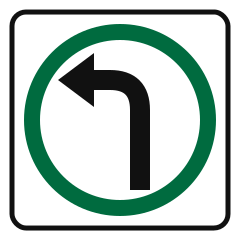
- Turn left or right
- Go straight or turn left
- Turn left
- Go straight only
You want to turn left into a driveway in the middle of a block, across a single solid yellow line. Is this allowed?
- Only between 9 a.m. and 4 p.m.
- Yes, if safe, traffic isn't held up and no sign forbids it
- No, solid lines may never be crossed
- Only if you are turning into a business, not a private home
There is a flashing green arrow pointing left together with a steady red light. What does this mean?
- Everyone must stop and wait
- You may go straight but not turn
- Left turns must yield to through traffic
- You may turn left; through traffic must stop
The rear of your car skids to the right on black ice. What should you do?
- Brake hard and hold the steering wheel perfectly still
- Ease off the gas and steer where you want to go
- Shift into neutral and brake
- Steer left as hard as possible
What is the point of no return when approaching a stale green light?
- The stop line where you must always stop
- The middle of the intersection on a left turn
- The crosswalk where pedestrians have priority
- The point after which you can no longer stop safely
An oncoming driver's headlights are dazzling you. Where should you look?
- At the centre line
- Toward the right edge of the road
- Straight into the lights
- Into your rear-view mirror instead
All Yukon Class 7 practice tests
- Yukon Class 7 Mock Exam 1 – 30 QuestionsUntimed practice · answers explained
- Yukon Class 7 Mock Exam 2 – 30 QuestionsUntimed practice · answers explained
- Yukon Class 7 Mock Exam 3 – 30 QuestionsUntimed practice · answers explained
- Yukon Class 7 Mock Exam 4 – 30 QuestionsUntimed practice · answers explained
- Yukon Class 7 Mock Exam 5 – 30 QuestionsUntimed practice · answers explained
- Regulatory, lane use and parking signsSign shapes and colours, stop and yield, speed, do not enter, one way, keep right, no passing, winter tire signs, lane use and turn control signs, parking and reserved lane signs.
- Crosswalk, school and playground zone signsCrosswalk signs, fluorescent yellow-green school signs, the 30 km/h playground zone that applies around the clock, and school zone hours on school days.
- Warning, construction and railway signsYellow diamond warning signs, object markers, orange construction signs, information signs, railway crossing signs and the slow-moving vehicle sign.
- Traffic lights and lane control signalsSteady, flashing and arrow lights, stale green lights, turning on red, advance left-turn arrows, transit signals and lane control signals.
- Road markingsYellow and white lines, passing rules by line type, reversible and two-way left-turn lanes, stop lines, crosswalks, reserved lane diamonds and bicycle lanes.
About this practice test
How many questions are in Yukon Class 7 practice test 8?
30 original multiple-choice practice questions covering graduated licensing: learner and novice stages, intersections and right-of-way, you and your vehicle, see-think-do: observation, speed and space, sharing the road, traffic lights and lane control signals, weather, night driving and emergencies, impairment and high-risk behaviour, regulatory, lane use and parking signs, warning, construction and railway signs, your licence, demerits and penalties, lanes, turns and passing. Each answer includes an explanation. This mixed practice set does not reproduce the official exam format or predict an official score.
Are the questions the same every time?
Yes. Practice test 8 always has the same 30 questions, so you can repeat it until you get them all right. The other 11 sets use different questions.
Are these real test questions?
No. The official question bank is not published. These are original questions written from the official handbook, which is what the real Yukon Class 7 test is based on.