What does a yellow left-turn arrow mean?
Yukon Class 7 overview
Yukon Class 7 Mock Exam 1
Same format as the real test. Answers stay hidden until you submit. The official time limit is not published; the timer is a practice setting.
- No sign-up
- Every answer explained
- Independent · not a government site
- 30 questions
- untimed
- Pass mark 24/30
0/30
All 30 questions in this test
Every question and its answer choices. The correct answers and explanations appear when you take the test above.
What does a yellow left-turn arrow mean?
- The left-turn signal is about to end; stop if you can
- Turn left now; the arrow just came on
- The left-turn lane is closed
- Yield to pedestrians first, then complete your left turn
What is the point of no return when approaching a stale green light?
- The stop line where you must always stop
- The middle of the intersection on a left turn
- The crosswalk where pedestrians have priority
- The point after which you can no longer stop safely
You are in a crash. When must you report it to the police?
- Only if damage is over $5,000
- Only if someone is killed
- If damage is over $1,000 or someone is injured
- Only if a vehicle has to be towed away from the scene
You park facing uphill on a street with a curb. Which way should you turn your front wheels?
- To the left, away from the curb
- It does not matter with a curb
- To the right, toward the curb
- Straight ahead
Near the crest of a hill, when is a U-turn illegal?
- When other traffic cannot see you within 150 metres
- Only when the road is wet or icy
- Only when a no U-turn sign is posted
- When other traffic cannot see you within 50 metres
At a four-way stop, who goes first?
- The largest vehicle at the stop
- The first vehicle to arrive and stop
- The vehicle going straight through
- The vehicle on the left side
How close to a fire hydrant may you park?
- No closer than 5 metres
- No closer than 10 metres
- No closer than 1.5 metres
- No closer than 3 metres
You are stopped at a steady red light and want to turn right. What may you do?
- Turn right after a full stop when the way is clear
- Turn right without stopping if no one is coming
- Wait for the green light before any turn
- Turn right only if a sign says it is allowed
Two vehicles arrive at the same time at an intersection with no signs or signals. Who must yield?
- The vehicle on the right yields to the one on the left
- The smaller vehicle yields to the larger one
- The vehicle on the left yields to the one on the right
- The vehicle going straight yields to the turning one
You are driving on a space-saver spare tire. What is the highest speed you should drive?
- 100 km/h
- 50 km/h
- 110 km/h
- 80 km/h
Your oil pressure warning light is not on. What does that tell you about the oil in the engine?
- The oil is the right grade
- The oil was changed recently and is still clean
- The oil level is full
- Nothing about how much oil is in the engine
What is the minimum tread depth your tires must have?
- 3.2 mm (1/8 inch)
- 1.6 mm (1/16 inch)
- 0.8 mm (1/32 inch)
- 5 mm (3/16 inch)
Which statement about anti-lock brakes is correct?
- On gravel, stopping distances may be longer
- They always stop you sooner
- They let you drive faster safely
- They stop the wheels from locking on dry roads only
You drive a vehicle you are not licensed for and have a crash. What can happen with your insurance?
- It pays half of all costs
- It still pays in full
- It pays only the other driver
- Your claim may be denied
What is the largest vehicle a Class 7 learner may drive?
- Up to 11,000 kg gross weight and seating for 7
- Up to 4,000 kg gross weight and seating for 7
- Any car or truck with two axles
- Up to 4,550 kg and seating for 9
What happens to the force of impact if you double your speed?
- It becomes three times greater
- It stays the same
- It doubles
- It becomes four times greater
What does this sign mean?
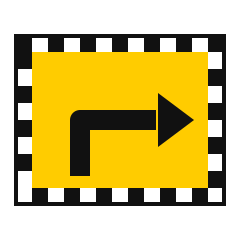
- Exit ramp ahead; use the right lane
- Road continues straight; arrow is advice
- Detour begins; follow orange signs
- Hazard ahead; turn in the direction shown
What do white lines on the road separate?
- Traffic moving in opposite directions
- Lanes of traffic moving in the same direction
- Construction zones from open lanes
- Two-way left-turn lanes from through lanes
You are pulling out of a parking lot onto a street with a sidewalk. Where should you first stop?
- At the edge of the travel lane
- On the sidewalk
- Before the sidewalk
- After entering the street
What does this yellow diamond sign warn you about?
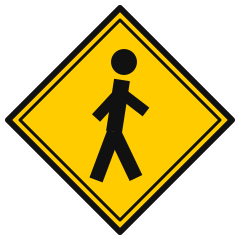
- A pedestrian crosswalk ahead
- A hiking trail beside the road
- A school bus stop ahead
- A no-pedestrians zone
During which hours may a Class 7 learner drive?
- Between 6 a.m. and 10 p.m.
- Between sunrise and sunset
- Between 5 a.m. and midnight
- At any hour with a co-driver
A passing lane on the highway is about to end. What does the handbook say?
- Trucks must stop to let cars merge
- Faster vehicles must exit at the end
- The left lane always has the right-of-way
- Drivers in both lanes must merge before it ends
What does a playground nearby warning sign ask you to do?
- Stop before the next corner
- Keep to the left lane
- Be prepared to slow down
- Use your high beams
How close may you park to the entrance of a driveway, back lane or garage?
- No closer than 0.5 metres
- No closer than 3 metres
- No closer than 1.5 metres
- No closer than 5 metres
Do you need to signal left when entering a single-lane traffic circle?
- Yes, until you pass the first exit
- Yes, the whole time you are in it
- No; you never signal in a traffic circle
- No; signal only when you are going to exit
What does it mean to overdrive your headlights?
- Using high beams in town
- Using fog lights on a clear night with no fog or snow
- Driving too fast to stop within the area they light
- Leaving them on after parking
A baby rides in a rear-facing child seat. Until when must the rear-facing stage be used at a minimum?
- Until at least 10 kg and walking unassisted
- Until at least 22 kg and 2 years old
- Until at least 5 kg and sitting up
- Until the baby is six months old
There is a marked crosswalk but no stop line. Where should you stop?
- Two car lengths back from it
- Just before the crosswalk
- At the curb line of the cross street
- Just past the crosswalk
What is a protected left turn?
- A turn made with a crossing guard present
- A turn made from the right lane at any time
- A turn made on a yellow light after first coming to a stop
- A turn on a green arrow while through traffic faces red
A regulatory sign on a Yukon highway is displayed telling drivers about winter tires or chains. What does that mean?
- Chains are banned on this stretch
- Winter tires are suggested but optional
- Winter tires or chains must be used
- Only trucks need chains on this road
Keep practising
- Yukon Class 7 Mock Exam 2 – 30 QuestionsUntimed practice · answers explained
- Yukon Class 7 Mock Exam 3 – 30 QuestionsUntimed practice · answers explained
- Yukon Class 7 Mock Exam 4 – 30 QuestionsUntimed practice · answers explained
- Yukon Class 7 Mock Exam 5 – 30 QuestionsUntimed practice · answers explained
- Yukon Class 7 Practice Test 130 questions with explanations
- Yukon Class 7 Practice Test 230 questions with explanations
- Yukon Class 7 Practice Test 330 questions with explanations
- Yukon Class 7 Practice Test 430 questions with explanations