Yukon Learner's Practice Test – Printable PDF
100 Yukon Class 7 practice questions on signs, rules and safe driving, with an answer key on separate pages that cites the handbook. Print or save as PDF. Free.
- No sign-up
- Every answer explained
- Independent · not a government site
- 100 questions
- Answer key included
- Free, no sign-up
If you would rather study on paper, or you will be somewhere with patchy cell coverage, this page lays out 100 Yukon learner's questions as a printable test. Press the print button and choose Save as PDF to keep a copy on your phone. The questions are spread evenly across all 15 topics in our bank, from regulatory, warning and construction signs to right-of-way, parking, see-think-do, sharing the road, impairment, and winter and emergency driving. The answer key starts on a new page after question 100, so you can finish the whole paper before you check anything.
Mark yourself against the real standard. The Yukon Driver's Basic Handbook sets the pass mark at 80 per cent, so 80 of these 100 is the line and 90 is a safer target. Every question is original, written from the 2023 edition of the handbook, and each answer names the page it comes from so you can reread what you missed. A few questions come from the licensing and penalties chapters, which the handbook says are not tested but which apply to you from your first day as a learner. Watch for the numbers that keep coming up: 30 km/h in playground zones at any hour, 3 seconds of following distance and 4 in poor conditions, parking at least 5 metres from a hydrant or crosswalk, and staying at least 150 metres behind a fire truck.
Yukon Learner's Practice Test – Printable PDF
1.At what age must Class 5, 6 and 7 licence holders first provide a medical report?
- 80
- 70
- 60
- 65
2.What does a no-stopping sign tell you?
- No stopping for the next 100 metres only
- No stopping except to drop off passengers
- No stopping between it and the next no-stopping sign
- No stopping on the opposite side of the street
3.You are stopped at a red light on a one-way street and want to turn left onto another one-way street. What does the handbook allow?
- A left turn after a full stop, if clear and not prohibited
- A left turn without stopping if traffic is light
- No turn of any kind until the light is green
- A left turn only with an advance green arrow
4.How does the vehicle limit for novice drivers differ from the learner limit?
- There is no limit for novices
- Novices may drive up to 11,000 kg
- Novices may tow trailers up to 4,550 kg with a co-driver
- Novices may drive vehicles seating up to 9, not 7
5.The road is slippery and uneven. What following distance should you keep?
- At least 4 seconds
- At least 1 car length
- At least 3 seconds
- At least 2 seconds
6.Can you share a lane with a motorcycle if it is riding at one side of the lane?
- Yes, in slow city traffic
- Only if the rider waves you on
- Yes, if you stay in the other half
- No; a motorcycle needs the whole lane
7.What does this sign mean?

- A detour ahead
- Road closed to all traffic
- Truck route only
- Construction has ended
8.Which way must cyclists travel in a marked bicycle lane?
- In either direction if the lane is wide
- Against traffic so they can see cars
- Only toward the nearest intersection
- In the same direction as the traffic beside them
9.How much longer can it take to stop on ice compared with normal braking distance?
- About twice as long
- Up to 10 times longer
- About three times as long
- About the same distance
10.What should you do when you see this school zone sign?

- Reduce speed when children are present
- Sound your horn to warn children
- Keep your speed but stay right
- Stop and wait for a crossing guard
11.How do you take possession of an intersection when turning left on a green light?
- Move fully past the crosswalk, stay on your side, stop before the middle
- Stop in the crosswalk with your wheels turned left
- Drive to the far side and angle your car to the left
- Wait behind the stop line until the oncoming lane is empty
12.A fully licensed Yukon driver wants to use a phone while driving. What is allowed?
- Texting at red lights
- Any device if the road is empty
- A hand-held phone at low speeds
- A hands-free device only
13.Why should you avoid stopping in a freeway acceleration lane or merging area?
- You risk being rear-ended
- It blocks the ramp meter
- It counts as parking on a freeway
- It is reserved for trucks
14.Which of these is an illegal place to park?
- On a residential side street
- Beside a curb painted white
- On a bridge
- Next to a closed business
15.Transport Canada recommends keeping children in the back seat until what age?
- 16
- 8
- 13
- 10
16.Police impound a vehicle driven by an unlicensed driver. How long can the impoundment last?
- 24 hours
- Until the driver pays a fine
- 7 days
- 30 days or longer
17.What does this sign mean?
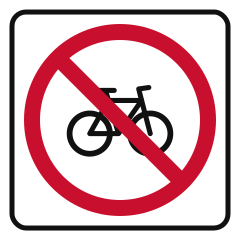
- Cyclists may be on the road ahead
- Bicycles must use the shoulder
- No bicycle riding beyond this point
- Bicycle lane begins here
18.A yellow lane control signal is shown over the lane you are in. What should you do?
- Move into a lane with a green arrow
- Stop before the signal
- Turn on your four-way flashers
- Stay in the lane and slow down
19.How many hours of driving practice must a learner log with a valid co-driver?
- 20 hours
- 50 hours
- 100 hours
- 30 hours
20.In good conditions, what following distance should you keep behind the vehicle ahead?
- At least 2 car lengths
- At least 1 second
- At least 3 seconds
- At least 10 metres
21.A train has just passed a multi-track crossing. Why should you wait before going?
- A second train may be hidden behind the first
- The tracks must cool down
- The gate must reset for 2 minutes before you cross
- Trains always travel in pairs
22.What does this sign tell you to expect?

- A runaway lane on the right
- A truck stop ahead
- Trucks must use the right lane
- A steep hill ahead, so slow down
23.When may you cross a bicycle lane in your car?
- Anywhere, as long as no cyclist is in sight ahead
- Where its line is broken, or to use a driveway
- Never; you must use another route
- Only at signalized intersections
24.What does it mean to overdrive your headlights?
- Using high beams in town
- Using fog lights on a clear night with no fog or snow
- Driving too fast to stop within the area they light
- Leaving them on after parking
25.A school zone sign shows 30 km/h but no hours. When does the limit apply?
- Only when a crossing guard is present
- 24 hours a day, every day
- 8 a.m. to 4:30 p.m. on school days
- 7 a.m. to 6 p.m. on weekdays
26.How should you treat an unmarked T-intersection?
- The same as any other uncontrolled intersection
- As if the through road had a stop sign for its traffic
- As a four-way stop
- As if you always have the right-of-way
27.On a long two-day road trip, when does the handbook say tiredness is most likely to affect you?
- On the second day
- On the first morning
- In the first hour
- Only after midnight
28.You are changing lanes. Who has the right-of-way?
- Whoever is travelling faster
- Vehicles already in the lane you are moving into
- You do, once your signal is on
- Vehicles in the lane you are leaving, coming up behind
29.You park a standard-transmission car facing downhill. What gear should you leave it in?
- First
- Second
- Neutral
- Reverse
30.A child uses a booster seat. When can they stop using it?
- At 120 cm tall or at least 30 kg
- At age 6, whatever their size
- At 135 cm tall or at least 36 kg
- At 145 cm tall or at least 45 kg
31.A fully licensed driver gets a second demerit point suspension within one year of the first. How long is it?
- Twelve months
- Three months
- Six months
- One month
32.The Yukon handbook says you can read any sign in three ways. What are they?
- Its shape, its border and its post
- Its shape, its colour and its message
- Its colour, its distance and its lighting
- Its height, its size and its location
33.What is the point of no return when approaching a stale green light?
- The stop line where you must always stop
- The middle of the intersection on a left turn
- The crosswalk where pedestrians have priority
- The point after which you can no longer stop safely
34.What must you have done to be eligible for the Class 5 road test?
- Be 15, hold a Class 7 for 3 months and log 30 hours
- Be 16, hold a Class 7 for 6 months and log 50 hours
- Be 17, hold a Class 7 for 12 months and log 100 hours
- Be 16 and pass a second written test
35.Why should you avoid turning your signal on too early?
- It cancels your brake lights
- It wears out the signal bulb
- It is only legal within 10 m of the turn you'll make
- Others may expect you to turn at an earlier road
36.You must stop at a railway crossing for a train. Where should you stop?
- Between 5 and 15 metres from the nearest rail
- Between 1 and 3 metres back from the nearest rail
- Right at the nearest rail
- At least 30 metres from the rail
37.You are stopped at a railway crossing with gates. The train has passed and the gate is rising. When may you go?
- When the last car of the train passes
- When the car beside you starts moving
- Once the gate is fully raised and it is safe
- As soon as the gate starts to lift
38.Where must you stop when a white stop line is painted at an intersection?
- Before the line
- On top of the line
- Past the line at the crosswalk
- At the edge of the cross street
39.On wet roads, how much braking distance should you allow?
- The same as on dry roads
- At least twice the normal distance
- Half the normal distance
- About 10 per cent more than on dry roads
40.You approach a school crosswalk where a crossing guard is directing people. What should you do?
- Proceed slowly if the walkers are already on the far side
- Pass slowly on the guard's left side
- Stop only if the guard holds up a sign
- Yield to pedestrians and follow the guard's directions
41.Which of these is correct when driving in a multi-lane roundabout?
- Signal left before you exit
- Change lanes to reach your exit
- Do not change lanes while in it
- Ride beside large trucks to pass them
42.How does a glass of beer compare with a glass of wine or an average cocktail?
- It is legal to drink before driving
- It has about half the alcohol
- It contains the same amount of alcohol
- It has much less effect on driving
43.You turn left onto a road that has a centre turning lane. How should you complete the turn?
- Turn into the centre lane and stay there
- Stop in the centre lane, then merge
- Drive in the centre lane until a gap opens
- Arc into the travelled lane, not the centre lane
44.How close to a crosswalk or intersection may you park?
- No closer than 2 metres
- No closer than 5 metres
- No closer than 15 metres
- No closer than 9 metres
45.A baby rides in a rear-facing child seat. Until when must the rear-facing stage be used at a minimum?
- Until at least 10 kg and walking unassisted
- Until at least 22 kg and 2 years old
- Until at least 5 kg and sitting up
- Until the baby is six months old
46.What is the heaviest trailer a Class 5 licence lets you tow without a heavy trailer endorsement?
- 4,000 kg
- 4,550 kg
- 11,000 kg
- 2,000 kg
47.A white regulatory sign shows an arrow inside a green circle. What does the green circle tell you?
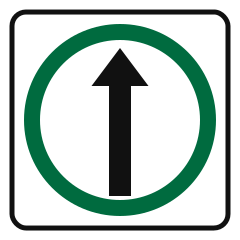
- The action shown is a hazard
- The action shown is permitted
- The action shown is for buses only
- The action shown is forbidden
48.In Yukon, what does a flashing green traffic light mean?
- The light is about to turn yellow
- Pedestrian-controlled; go only if your lane is clear
- Traffic must stop as if for a red
- You have a protected left turn while oncoming traffic stops
49.Where must a learner display the L sign?
- On the driver-side door panel
- Visible to drivers coming from behind
- On the front windshield, lower corner
- Inside the glovebox with the licence
50.How long does it take the average driver to see a hazard, decide and then begin braking?
- About 3/4 second to see-think, then 3/4 second to do
- About five seconds in total
- About three seconds to see, then another two to brake
- Less than a tenth of a second
51.You have just passed a large truck. When is it safe to move back into its lane?
- As soon as your rear bumper clears the front of its cab
- When the truck driver flashes high beams
- When you are one car length ahead of it
- When you see its headlights in your rear-view mirror
52.What does this sign warn you about?

- A traffic control person ahead
- A crossing guard at a school
- A parade route ahead
- A pedestrian crosswalk
53.Your lane is marked on both sides by double broken yellow lines. What does this mean?
- It is a bus lane during rush hour
- It is a two-way left-turn lane
- The lane is reversible; signals show if you may use it
- It is a passing lane open to traffic from either direction
54.You are in a crash. When must you report it to the police?
- Only if damage is over $5,000
- Only if someone is killed
- If damage is over $1,000 or someone is injured
- Only if a vehicle has to be towed away from the scene
55.What colour are school zone and school crosswalk signs in Yukon?
- Orange with black symbols
- Blue with white symbols
- Red with white lettering
- Fluorescent yellow-green
56.At a four-way stop, who goes first?
- The largest vehicle at the stop
- The first vehicle to arrive and stop
- The vehicle going straight through
- The vehicle on the left side
57.How much more likely is a driver who combines alcohol and drugs to crash than a sober driver?
- Four times
- Twenty times
- Nine times
- Two times
58.Near the crest of a hill, when is a U-turn illegal?
- When other traffic cannot see you within 150 metres
- Only when the road is wet or icy
- Only when a no U-turn sign is posted
- When other traffic cannot see you within 50 metres
59.You park facing downhill next to a curb. Which way should your front wheels point?
- Left if the street is busy
- To the left, away from the curb
- Straight ahead
- To the right, toward the curb
60.In which situation should you never use cruise control?
- When travelling a long distance
- When traffic is light and steady
- On a dry, straight highway
- On wet, snowy or icy roads
61.How can unpaid fines for moving violations affect you?
- They have no effect on your licence
- They can block your licence renewal
- They only affect vehicle registration
- They are cancelled after a year
62.Where are turn control signs mounted?
- Directly above the intersection
- On the median after the intersection
- Painted on the pavement in each lane
- On the right shoulder 100 m before
63.The green left-turn arrow has gone off, but the regular green light is still on. Can you still turn left?
- Only if no one is in the crosswalk
- Yes, yielding to pedestrians and oncoming traffic
- Yes, and oncoming traffic must yield to you
- No, you must wait for the next arrow
64.Who can be your co-driver as a Yukon learner?
- Any adult who holds a learner's licence
- Someone who has held a novice licence for a full year
- Someone with a full licence for at least two years
- Anyone over 18, licensed or not
65.On a highway, about how far ahead does 12 seconds of scanning take your eyes?
- About one city block
- About 2 kilometres
- About half a kilometre
- About 50 metres
66.A motorcyclist is riding in the left part of the lane. What should you assume?
- That their signal light is broken
- That they want you to pass them on the right side
- Not a turn; riders use that position to be seen
- That they are about to turn left
67.You are on a one-way road and see this sign. What does it warn you about?

- A passing lane ahead
- A traffic circle ahead
- A one-way road ahead
- Two-way traffic ahead
68.Why should you avoid driving over pavement markings that were just painted?
- The paint can damage your tires
- Driving over wet, freshly painted lines is illegal
- It voids your vehicle insurance
- Only trucks are allowed to cross new paint
69.You see one elk cross the highway ahead. What should you expect?
- It will stay still if you honk
- There may be more animals nearby
- Animals never return to the road
- The road is now clear
70.It is 9 p.m. on a Sunday and you are driving through a posted 30 km/h playground zone. What speed limit applies?
- The normal limit for the road
- 50 km/h
- 30 km/h
- 40 km/h
71.At a two-way stop, which traffic has the right-of-way?
- Whoever is turning right
- Traffic on the stop sign street
- The vehicle that has waited longest
- Traffic on the through street
72.Researchers estimate that driving within three hours of using cannabis has what effect?
- It doubles your risk of a crash
- It has no measurable effect
- It halves your reaction time
- It only affects night vision
73.On a freeway with more than two lanes in each direction, where should you usually drive?
- In whichever lane is fastest
- On the right shoulder whenever you are driving slowly
- In the far left lane
- In the centre lane or a right-hand lane
74.There is a stop sign at the corner. How close to it may you park?
- No closer than 5 metres
- No closer than 10 metres
- No closer than 20 metres
- No closer than 1 metre
75.Your car has no automatic daytime running lights. What must you do when driving on Yukon roads during the day?
- Use high beams on the highway
- Drive with your low beam headlights on
- Use your parking lights only
- Drive with no lights in good weather
76.You drive a vehicle you are not licensed for and have a crash. What can happen with your insurance?
- It pays half of all costs
- It still pays in full
- It pays only the other driver
- Your claim may be denied
77.You are driving below the speed of regular traffic and see a sign telling slower vehicles what to do. What should you do?
- Turn on your hazard lights
- Move into the right lane
- Pull onto the shoulder and stop
- Move into the left lane
78.You are waiting in the intersection to turn left and the light turns yellow. What does the handbook say?
- You may legally complete your turn, watching for traffic
- You must wait right where you are until it turns green again
- You must go straight through instead
- You must back up behind the stop line
79.How many passengers may a learner carry, not counting immediate family?
- As many as there are seatbelts
- One, plus the co-driver
- Two, including the co-driver
- Three, including the co-driver
80.You carry a load that sticks out past the back of your vehicle. What must you attach to its end?
- An orange triangle
- A white reflector
- A flashing yellow light
- A red flag
81.What rights does a horse carriage operator have on a public road in Yukon?
- The same rights and duties as drivers
- Rights only between dawn and dusk each day
- No rights; they must use the ditch
- Priority over every other vehicle
82.A signal lights ahead sign has its own lights flashing. What should you do?

- Speed up before the light changes
- Treat the signal ahead as a yield
- Turn on your hazard lights
- Prepare to stop at the signal ahead
83.How are high occupancy vehicle (HOV) lanes marked on the road?
- Green paint and bicycle symbols
- Double yellow lines and red arrows on the pavement
- Thick solid or broken lines and white diamonds
- Orange cones and dotted lines
84.What does the handbook say about driving with snow or frost on your windows?
- It is fine if the windshield is clear
- It is allowed at low speeds
- It is illegal only on highways
- It is illegal unless your windows are clear
85.According to Yukon examiners, what is a common reason drivers fail the road test?
- Using the horn at intersections
- Signalling too early before turns
- Driving slightly below the speed limit on main roads
- Speeding through school and playground zones
86.At a four-way stop, two cars facing each other arrive at about the same time. One is turning left, the other going straight. Who goes first?
- The one on the right of the other
- The one turning left
- The one going straight
- The one that signals first
87.According to the handbook, on average what share of drivers killed in Yukon are impaired?
- About 50 per cent
- About 25 per cent
- About 75 per cent
- About 10 per cent
88.Where is a U-turn illegal in Yukon?
- At any intersection with a stop sign
- At an intersection with a traffic light
- On any street with parked cars
- On any rural road
89.When parallel parking, how close to the curb should your vehicle be?
- Touching the curb
- Within 1.5 metres
- Within 50 centimetres
- Within 1 metre
90.To cut fuel use, when does the handbook suggest turning off your motor while you are stopped?
- When stopped for more than 60 seconds
- When stopped for more than 5 minutes
- Never; restarting uses more fuel
- Only when stopped at a red light
91.For how long is a Yukon driver's licence valid?
- Up to ten years
- Up to two years
- Up to five years
- For life
92.What does this white regulatory sign tell you?
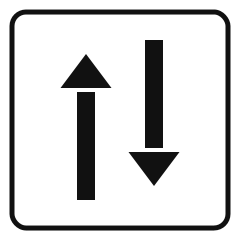
- Reversible lane; follow the overhead signals
- Two-way traffic; keep right unless passing
- One-way road; either lane may be used
- Divided highway begins; stay in your lane
93.What does a yellow left-turn arrow mean?
- The left-turn signal is about to end; stop if you can
- Turn left now; the arrow just came on
- The left-turn lane is closed
- Yield to pedestrians first, then complete your left turn
94.How long must you hold a novice licence before applying for a full Class 5?
- At least 6 months in a row
- At least 18 months in a row, no violations
- At least 24 months in total
- At least 12 months in total, with a clean record
95.A driver is tailgating you. What does the handbook suggest?
- Speed up to pull away
- Brake sharply to warn them
- Slow down slightly to add space in front
- Move closer to the car ahead to block them
96.A lane is closed ahead in a construction zone. When should you merge?
- As soon as you can
- After passing the first cone
- At the last possible moment
- Only when a worker tells you
97.What shape and colour are most warning signs?
- Orange and triangular
- Yellow and diamond-shaped
- Green and square
- White and rectangular
98.The centre line beside you is a solid yellow line, and on the far side of it is a broken yellow line. May you pass?
- Yes, but only to pass a slow truck or farm vehicle
- No, unless you stay under the limit
- Yes, if the road ahead is clear
- No; only when the broken line is on your side
99.Your vehicle catches fire. What should you do?
- Open the hood to find the fire
- Get everyone out and move well away; don't open the hood
- Keep driving to a service station
- Stay inside with all the windows closed until help arrives
100.What does a playground nearby warning sign ask you to do?
- Stop before the next corner
- Keep to the left lane
- Be prepared to slow down
- Use your high beams
Answer key with explanations
1. B — 70
Non-commercial drivers do not need medical reports until age 70. Reports are required again at 75 and 80, then every two years.
Your licence, demerits and penalties · Based on: Yukon Driver's Basic Handbook (2023 edition), Ch. 10 Licensing requirements, p. 144
2. C — No stopping between it and the next no-stopping sign
A no-stopping sign applies from the sign to the next no-stopping sign. A version with times applies only during the posted hours.
Regulatory, lane use and parking signs · Based on: Yukon Driver's Basic Handbook (2023 edition), Ch. 3 Signs, signals and road markings, p. 28
3. A — A left turn after a full stop, if clear and not prohibited
After stopping and making sure the intersection is clear, you may turn left onto a one-way street on a red, unless a sign prohibits it.
Traffic lights and lane control signals · Based on: Yukon Driver's Basic Handbook (2023 edition), Ch. 3 Signs, signals and road markings, p. 41
4. D — Novices may drive vehicles seating up to 9, not 7
Both stages are limited to 4,000 kg gross vehicle weight, but novices may drive vehicles seating up to 9 people, including the driver, while learners are limited to 7.
Graduated licensing: learner and novice stages · Based on: Yukon Driver's Basic Handbook (2023 edition), Ch. 9 Graduated Driver Licensing program, p. 138
5. A — At least 4 seconds
Increase your following distance to four seconds in bad weather or on uneven or slippery roads.
See-think-do: observation, speed and space · Based on: Yukon Driver's Basic Handbook (2023 edition), Ch. 5 See-think-do, p. 71
6. D — No; a motorcycle needs the whole lane
Never try to share a lane with a motorcycle. It needs the whole lane to travel safely.
Sharing the road · Based on: Yukon Driver's Basic Handbook (2023 edition), Ch. 6 Sharing the road, p. 85
7. A — A detour ahead
A detour sign warns that traffic will be routed off the usual road. Follow the detour signs.
Warning, construction and railway signs · Based on: Yukon Driver's Basic Handbook (2023 edition), Ch. 3 Signs, signals and road markings, p. 33
8. D — In the same direction as the traffic beside them
Bicycle lanes are for cyclists only, and cyclists must travel the same way as the traffic next to them.
Road markings · Based on: Yukon Driver's Basic Handbook (2023 edition), Ch. 3 Signs, signals and road markings, p. 38
9. B — Up to 10 times longer
The handbook warns it can take 10 times the normal braking distance to stop on ice.
Weather, night driving and emergencies · Based on: Yukon Driver's Basic Handbook (2023 edition), Ch. 8 Preventing and handling emergencies, p. 116
10. A — Reduce speed when children are present
This sign marks a school zone. Slow down when children are present and obey any posted limit.
Crosswalk, school and playground zone signs · Based on: Yukon Driver's Basic Handbook (2023 edition), Ch. 3 Signs, signals and road markings, p. 29
11. A — Move fully past the crosswalk, stay on your side, stop before the middle
To take possession, move into the intersection fully over the crosswalk, stay on your side of the road, and stop before the midway point.
Intersections and right-of-way · Based on: Yukon Driver's Basic Handbook (2023 edition), Ch. 4 Rules of the road, p. 42
12. D — A hands-free device only
Yukon bans hand-held electronic devices while driving but lets fully licensed drivers use hands-free devices, such as hands-free GPS.
Impairment and high-risk behaviour · Based on: Yukon Driver's Basic Handbook (2023 edition), Ch. 7 Impairment and high risk behaviour, p. 101
13. A — You risk being rear-ended
Stopping in the acceleration lane or merging area puts you at risk of being hit from behind by vehicles speeding up to merge.
Lanes, turns and passing · Based on: Yukon Driver's Basic Handbook (2023 edition), Ch. 4 Rules of the road, p. 53
14. C — On a bridge
It is illegal to park on a bridge or in a highway tunnel, as well as on sidewalks, in bicycle lanes and where you block a traffic sign.
Parking rules · Based on: Yukon Driver's Basic Handbook (2023 edition), Ch. 4 Rules of the road, p. 56
15. C — 13
The handbook notes Transport Canada's advice to keep children in the back seat until 13 years of age.
You and your vehicle · Based on: Yukon Driver's Basic Handbook (2023 edition), Ch. 2 You and your vehicle, p. 14
16. D — 30 days or longer
If a vehicle is driven illegally, for example by an unlicensed, impaired or uninsured driver, police can impound it immediately for 30 days or longer. The owner pays the costs.
Your licence, demerits and penalties · Based on: Yukon Driver's Basic Handbook (2023 edition), Ch. 10 Licensing requirements, p. 149
17. C — No bicycle riding beyond this point
A bicycle inside a red circle with a slash means cycling is not allowed past this point.
Regulatory, lane use and parking signs · Based on: Yukon Driver's Basic Handbook (2023 edition), Ch. 3 Signs, signals and road markings, p. 28
18. A — Move into a lane with a green arrow
A yellow lane control signal means move out of this lane and into a lane that shows a green arrow.
Traffic lights and lane control signals · Based on: Yukon Driver's Basic Handbook (2023 edition), Ch. 3 Signs, signals and road markings, p. 34
19. B — 50 hours
Learners must log and record 50 hours of driving practice with a valid co-driver, ideally in a variety of traffic and weather conditions.
Graduated licensing: learner and novice stages · Based on: Yukon Driver's Basic Handbook (2023 edition), Ch. 9 Graduated Driver Licensing program, p. 132
20. C — At least 3 seconds
Always keep at least a three-second following distance in good conditions.
See-think-do: observation, speed and space · Based on: Yukon Driver's Basic Handbook (2023 edition), Ch. 5 See-think-do, p. 71
21. A — A second train may be hidden behind the first
There is often more than one track. A leading cause of car-train crashes is drivers not waiting for a second train hidden behind the first.
Sharing the road · Based on: Yukon Driver's Basic Handbook (2023 edition), Ch. 6 Sharing the road, p. 93
22. D — A steep hill ahead, so slow down
This sign warns of a steep hill. Slow down, and remember your vehicle needs more distance to stop going downhill.
Warning, construction and railway signs · Based on: Yukon Driver's Basic Handbook (2023 edition), Ch. 3 Signs, signals and road markings, p. 31
23. B — Where its line is broken, or to use a driveway
You may cross a bicycle lane only where the white line is broken or to turn into or out of a driveway. Signal early and yield to cyclists.
Road markings · Based on: Yukon Driver's Basic Handbook (2023 edition), Ch. 3 Signs, signals and road markings, p. 51
24. C — Driving too fast to stop within the area they light
Overdriving means going so fast you can't stop within the distance your headlights cover. It is especially dangerous on curves.
Weather, night driving and emergencies · Based on: Yukon Driver's Basic Handbook (2023 edition), Ch. 8 Preventing and handling emergencies, p. 118
25. C — 8 a.m. to 4:30 p.m. on school days
When a 30 km/h school zone sign has no other times posted, the limit applies from 8 a.m. to 4:30 p.m. on school days.
Crosswalk, school and playground zone signs · Based on: Yukon Driver's Basic Handbook (2023 edition), Ch. 3 Signs, signals and road markings, p. 80
26. A — The same as any other uncontrolled intersection
The handbook says to treat an unmarked T-intersection the same as any other uncontrolled intersection.
Intersections and right-of-way · Based on: Yukon Driver's Basic Handbook (2023 edition), Ch. 4 Rules of the road, p. 39
27. A — On the second day
Fatigue is cumulative. Don't drive too far at once, and be especially careful on the second day of a long trip.
Impairment and high-risk behaviour · Based on: Yukon Driver's Basic Handbook (2023 edition), Ch. 7 Impairment and high risk behaviour, p. 100
28. B — Vehicles already in the lane you are moving into
When you enter a lane, the vehicles already in that lane have the right-of-way. Make sure the gap is big enough and signal.
Lanes, turns and passing · Based on: Yukon Driver's Basic Handbook (2023 edition), Ch. 4 Rules of the road, p. 51
29. D — Reverse
Set the parking brake and, with a standard transmission, leave it in reverse facing downhill or in first gear facing uphill or on a level surface.
Parking rules · Based on: Yukon Driver's Basic Handbook (2023 edition), Ch. 4 Rules of the road, p. 56
30. D — At 145 cm tall or at least 45 kg
Booster seats start once a child is over 22 kg and must be used until the child is 145 cm (4 ft 9 in) tall or weighs at least 45 kg (100 lb).
You and your vehicle · Based on: Yukon Driver's Basic Handbook (2023 edition), Ch. 2 You and your vehicle, p. 13
31. B — Three months
A second demerit point suspension within one year of the first results in a three-month suspension. A third within two years means six months.
Your licence, demerits and penalties · Based on: Yukon Driver's Basic Handbook (2023 edition), Ch. 10 Licensing requirements, p. 146
32. B — Its shape, its colour and its message
Signs are read by shape, colour and the message printed on them. Knowing all three helps you work out signs you have never seen before.
Regulatory, lane use and parking signs · Based on: Yukon Driver's Basic Handbook (2023 edition), Ch. 3 Signs, signals and road markings, p. 27
33. D — The point after which you can no longer stop safely
Based on speed, road conditions and traffic behind, pick a point where you can no longer stop safely. Past it, keep going even if the light turns yellow.
Traffic lights and lane control signals · Based on: Yukon Driver's Basic Handbook (2023 edition), Ch. 3 Signs, signals and road markings, p. 41
34. B — Be 16, hold a Class 7 for 6 months and log 50 hours
To take the Class 5 road test you must be at least 16, have held your Class 7 for six months in a row right before the test, and have logged at least 50 hours.
Graduated licensing: learner and novice stages · Based on: Yukon Driver's Basic Handbook (2023 edition), Ch. 9 Graduated Driver Licensing program, p. 134
35. D — Others may expect you to turn at an earlier road
Signal when the next intersection or driveway is where you will turn. Signalling too soon makes people expect you to turn at the next available road.
See-think-do: observation, speed and space · Based on: Yukon Driver's Basic Handbook (2023 edition), Ch. 5 See-think-do, p. 74
36. A — Between 5 and 15 metres from the nearest rail
Stop no closer than five metres and no farther than 15 metres from the nearest rail.
Sharing the road · Based on: Yukon Driver's Basic Handbook (2023 edition), Ch. 6 Sharing the road, p. 93
37. C — Once the gate is fully raised and it is safe
At a gated crossing you must stay stopped until the gate is fully raised, then cross only when it is safe.
Warning, construction and railway signs · Based on: Yukon Driver's Basic Handbook (2023 edition), Ch. 3 Signs, signals and road markings, p. 34
38. A — Before the line
A white stop line marks where to stop. Stop before it, not on or past it.
Road markings · Based on: Yukon Driver's Basic Handbook (2023 edition), Ch. 3 Signs, signals and road markings, p. 37
39. B — At least twice the normal distance
On wet roads, slow down, leave more following distance and allow at least twice the normal braking distance.
Weather, night driving and emergencies · Based on: Yukon Driver's Basic Handbook (2023 edition), Ch. 8 Preventing and handling emergencies, p. 113
40. D — Yield to pedestrians and follow the guard's directions
At a school crosswalk you yield to pedestrians, and if there is a crossing guard you follow their directions. The handbook says to obey school patrols at all times.
Crosswalk, school and playground zone signs · Based on: Yukon Driver's Basic Handbook (2023 edition), Ch. 3 Signs, signals and road markings, p. 29
41. C — Do not change lanes while in it
Do not change lanes inside a roundabout, and do not ride alongside trucks or buses. Signal right before you exit.
Intersections and right-of-way · Based on: Yukon Driver's Basic Handbook (2023 edition), Ch. 4 Rules of the road, p. 45
42. C — It contains the same amount of alcohol
It is a myth that beer affects driving less. A glass of beer contains the same amount of alcohol as a glass of wine or an average cocktail.
Impairment and high-risk behaviour · Based on: Yukon Driver's Basic Handbook (2023 edition), Ch. 7 Impairment and high risk behaviour, p. 98
43. D — Arc into the travelled lane, not the centre lane
Drive in a smooth arc into the travelled lane of the cross street. Do not use the centre turning lane as a merge lane.
Lanes, turns and passing · Based on: Yukon Driver's Basic Handbook (2023 edition), Ch. 4 Rules of the road, p. 48
44. B — No closer than 5 metres
You may not park within 5 metres of a crosswalk or an intersection.
Parking rules · Based on: Yukon Driver's Basic Handbook (2023 edition), Ch. 4 Rules of the road, p. 56
45. A — Until at least 10 kg and walking unassisted
Stage 1 rear-facing seats are used from birth until the child weighs at least 10 kilograms (22 lb) and can walk unassisted.
You and your vehicle · Based on: Yukon Driver's Basic Handbook (2023 edition), Ch. 2 You and your vehicle, p. 13
46. B — 4,550 kg
A Class 2, 3, 4 or 5 licence permits towing trailers up to 4,550 kilograms. Heavier trailers need a Class 1 or a heavy trailer endorsement.
Your licence, demerits and penalties · Based on: Yukon Driver's Basic Handbook (2023 edition), Ch. 10 Licensing requirements, p. 142
47. B — The action shown is permitted
A green circle shows a permitted action. A red circle with a slash shows one that is not permitted.
Regulatory, lane use and parking signs · Based on: Yukon Driver's Basic Handbook (2023 edition), Ch. 3 Signs, signals and road markings, p. 27
48. B — Pedestrian-controlled; go only if your lane is clear
A flashing green light is activated by pedestrians. You may go only if the intersection is clear in your lane of travel, and watch for whoever pressed the button.
Traffic lights and lane control signals · Based on: Yukon Driver's Basic Handbook (2023 edition), Ch. 3 Signs, signals and road markings, p. 35
49. B — Visible to drivers coming from behind
The L sign must be visible to drivers of vehicles approaching from behind. Free replacement signs are available at any Motor Vehicles office.
Graduated licensing: learner and novice stages · Based on: Yukon Driver's Basic Handbook (2023 edition), Ch. 9 Graduated Driver Licensing program, p. 133
50. A — About 3/4 second to see-think, then 3/4 second to do
It takes about three-quarters of a second to see-think and another three-quarters of a second to do. Only then does your vehicle begin to slow down.
See-think-do: observation, speed and space · Based on: Yukon Driver's Basic Handbook (2023 edition), Ch. 5 See-think-do, p. 71
51. D — When you see its headlights in your rear-view mirror
Leave extra room before pulling in, since large vehicles take longer to slow down. Make sure you can see the truck's headlights in your rear-view mirror, then keep your speed.
Sharing the road · Based on: Yukon Driver's Basic Handbook (2023 edition), Ch. 6 Sharing the road, p. 87
52. A — A traffic control person ahead
This orange sign warns that a traffic control person is directing traffic ahead. Be ready to obey their directions.
Warning, construction and railway signs · Based on: Yukon Driver's Basic Handbook (2023 edition), Ch. 3 Signs, signals and road markings, p. 33
53. C — The lane is reversible; signals show if you may use it
Double broken yellow lines mark a reversible lane. Lane control signals tell you whether you may use it.
Road markings · Based on: Yukon Driver's Basic Handbook (2023 edition), Ch. 3 Signs, signals and road markings, p. 36
54. C — If damage is over $1,000 or someone is injured
You must remain at the scene, give reasonable help and report the crash to police if the damage is over $1,000 or there is an injury.
Weather, night driving and emergencies · Based on: Yukon Driver's Basic Handbook (2023 edition), Ch. 8 Preventing and handling emergencies, p. 128
55. D — Fluorescent yellow-green
School zone signs, and the school crosswalk ahead sign, are fluorescent yellow-green so they stand out to drivers.
Crosswalk, school and playground zone signs · Based on: Yukon Driver's Basic Handbook (2023 edition), Ch. 3 Signs, signals and road markings, p. 27
56. B — The first vehicle to arrive and stop
At a four-way stop, the first vehicle to arrive and stop completely goes first.
Intersections and right-of-way · Based on: Yukon Driver's Basic Handbook (2023 edition), Ch. 4 Rules of the road, p. 44
57. C — Nine times
The handbook cites a study finding that a driver who combines alcohol and drugs is nine times more likely to crash than a sober driver.
Impairment and high-risk behaviour · Based on: Yukon Driver's Basic Handbook (2023 edition), Ch. 7 Impairment and high risk behaviour, p. 99
58. A — When other traffic cannot see you within 150 metres
A U-turn is illegal on or near the crest of a hill where other traffic within 150 metres cannot see you.
Lanes, turns and passing · Based on: Yukon Driver's Basic Handbook (2023 edition), Ch. 4 Rules of the road, p. 55
59. D — To the right, toward the curb
Turn your wheels to the right when parking downhill, with or without a curb, and when parking uphill without a curb.
Parking rules · Based on: Yukon Driver's Basic Handbook (2023 edition), Ch. 4 Rules of the road, p. 56
60. D — On wet, snowy or icy roads
Cruise control is only for ideal highway conditions. Never use it on slippery surfaces, in urban traffic, when tired, on hills or winding roads, when towing or when passing.
You and your vehicle · Based on: Yukon Driver's Basic Handbook (2023 edition), Ch. 2 You and your vehicle, p. 18
61. B — They can block your licence renewal
Pay fines promptly. Outstanding fines for moving violations affect your ability to renew your licence or may lead to a suspension.
Your licence, demerits and penalties · Based on: Yukon Driver's Basic Handbook (2023 edition), Ch. 10 Licensing requirements, p. 146
62. A — Directly above the intersection
Turn control signs hang directly above the intersection, and you must follow the direction of the arrow.
Regulatory, lane use and parking signs · Based on: Yukon Driver's Basic Handbook (2023 edition), Ch. 3 Signs, signals and road markings, p. 30
63. B — Yes, yielding to pedestrians and oncoming traffic
Once the arrow ends and only the green light is showing, you may still turn left, but you no longer have protection and must yield to pedestrians and oncoming traffic.
Traffic lights and lane control signals · Based on: Yukon Driver's Basic Handbook (2023 edition), Ch. 3 Signs, signals and road markings, p. 43
64. C — Someone with a full licence for at least two years
Your co-driver must have held a valid full-privilege licence for at least two years immediately before teaching you, and must have zero alcohol and drugs in their system.
Graduated licensing: learner and novice stages · Based on: Yukon Driver's Basic Handbook (2023 edition), Ch. 9 Graduated Driver Licensing program, p. 132
65. C — About half a kilometre
Scanning at least 12 seconds ahead means one to two blocks in city driving and about half a kilometre on the highway.
See-think-do: observation, speed and space · Based on: Yukon Driver's Basic Handbook (2023 edition), Ch. 5 See-think-do, p. 58
66. C — Not a turn; riders use that position to be seen
Don't assume a rider in the left part of the lane is turning left. Motorcyclists often ride there to make themselves more visible.
Sharing the road · Based on: Yukon Driver's Basic Handbook (2023 edition), Ch. 6 Sharing the road, p. 85
67. D — Two-way traffic ahead
Two arrows pointing in opposite directions warn that you will soon share the road with oncoming traffic.
Warning, construction and railway signs · Based on: Yukon Driver's Basic Handbook (2023 edition), Ch. 3 Signs, signals and road markings, p. 31
68. B — Driving over wet, freshly painted lines is illegal
The handbook states it is illegal to drive over freshly painted, wet pavement markings.
Road markings · Based on: Yukon Driver's Basic Handbook (2023 edition), Ch. 3 Signs, signals and road markings, p. 36
69. B — There may be more animals nearby
Wild animals often move in herds. If you see one, there may be more.
Weather, night driving and emergencies · Based on: Yukon Driver's Basic Handbook (2023 edition), Ch. 8 Preventing and handling emergencies, p. 119
70. C — 30 km/h
Playground zone limits do not switch off at night or on weekends. The 30 km/h limit applies 24 hours a day, every day.
Crosswalk, school and playground zone signs · Based on: Yukon Driver's Basic Handbook (2023 edition), Ch. 3 Signs, signals and road markings, p. 29
71. D — Traffic on the through street
At a two-way stop, the street without stop signs is a through street, and its traffic has the right-of-way. Wait for a safe gap.
Intersections and right-of-way · Based on: Yukon Driver's Basic Handbook (2023 edition), Ch. 4 Rules of the road, p. 43
72. A — It doubles your risk of a crash
Cannabis impairs thinking and motor skills. Driving within three hours of consuming it is estimated to double your crash risk.
Impairment and high-risk behaviour · Based on: Yukon Driver's Basic Handbook (2023 edition), Ch. 7 Impairment and high risk behaviour, p. 99
73. D — In the centre lane or a right-hand lane
Use the centre or a right-hand lane, leaving the left lane for higher-speed traffic and passing vehicles.
Lanes, turns and passing · Based on: Yukon Driver's Basic Handbook (2023 edition), Ch. 4 Rules of the road, p. 47
74. A — No closer than 5 metres
You may not park within 5 metres of a stop sign or a traffic light.
Parking rules · Based on: Yukon Driver's Basic Handbook (2023 edition), Ch. 4 Rules of the road, p. 56
75. B — Drive with your low beam headlights on
On Yukon roadways you must drive with low beam headlights on during the day if your vehicle lacks automatic daytime running lights.
You and your vehicle · Based on: Yukon Driver's Basic Handbook (2023 edition), Ch. 2 You and your vehicle, p. 18
76. D — Your claim may be denied
Driving without a valid licence, the proper class or contrary to licence conditions voids your insurance. Your claim may be denied and you could pay all costs.
Your licence, demerits and penalties · Based on: Yukon Driver's Basic Handbook (2023 edition), Ch. 10 Licensing requirements, p. 146
77. B — Move into the right lane
The sign tells drivers going slower than regular traffic to use the right lane, leaving the left lane free for passing.
Regulatory, lane use and parking signs · Based on: Yukon Driver's Basic Handbook (2023 edition), Ch. 3 Signs, signals and road markings, p. 28
78. A — You may legally complete your turn, watching for traffic
If you are already in the intersection to turn left when the light turns yellow, you are legally allowed to complete the turn. Watch for oncoming drivers who keep going.
Traffic lights and lane control signals · Based on: Yukon Driver's Basic Handbook (2023 edition), Ch. 3 Signs, signals and road markings, p. 42
79. C — Two, including the co-driver
Learners are limited to two passengers including the co-driver, unless each extra passenger is a parent, grandparent, spouse, brother, sister or child of the learner.
Graduated licensing: learner and novice stages · Based on: Yukon Driver's Basic Handbook (2023 edition), Ch. 9 Graduated Driver Licensing program, p. 133
80. D — A red flag
When a load extends behind your vehicle, attach a red flag to the end of it as a warning to other drivers.
See-think-do: observation, speed and space · Based on: Yukon Driver's Basic Handbook (2023 edition), Ch. 5 See-think-do, p. 76
81. A — The same rights and duties as drivers
Horses may be ridden on most public roads, and horse carriage operators have the same rights and responsibilities as motor vehicle operators.
Sharing the road · Based on: Yukon Driver's Basic Handbook (2023 edition), Ch. 6 Sharing the road, p. 94
82. D — Prepare to stop at the signal ahead
This sign warns of traffic lights ahead. When its own lights are flashing, the handbook says to prepare to stop.
Warning, construction and railway signs · Based on: Yukon Driver's Basic Handbook (2023 edition), Ch. 3 Signs, signals and road markings, p. 31
83. C — Thick solid or broken lines and white diamonds
HOV lanes are set off with thick solid or broken lines and white diamond symbols. Signs say which vehicles may use them.
Road markings · Based on: Yukon Driver's Basic Handbook (2023 edition), Ch. 3 Signs, signals and road markings, p. 38
84. D — It is illegal unless your windows are clear
It is against the law to drive unless your windows are clear of snow, ice, fog or anything else that blocks them.
Weather, night driving and emergencies · Based on: Yukon Driver's Basic Handbook (2023 edition), Ch. 8 Preventing and handling emergencies, p. 112
85. D — Speeding through school and playground zones
Examiners list speeding through school and playground zones as a common reason for failing. Watch for these zones and their limits.
Crosswalk, school and playground zone signs · Based on: Yukon Driver's Basic Handbook (2023 edition), Ch. 3 Signs, signals and road markings, p. 135
86. C — The one going straight
When two vehicles face each other at a four-way stop, the one making a left turn should yield to the one going straight.
Intersections and right-of-way · Based on: Yukon Driver's Basic Handbook (2023 edition), Ch. 4 Rules of the road, p. 44
87. A — About 50 per cent
On average, 50 per cent of the drivers killed in Yukon are impaired.
Impairment and high-risk behaviour · Based on: Yukon Driver's Basic Handbook (2023 edition), Ch. 7 Impairment and high risk behaviour, p. 97
88. B — At an intersection with a traffic light
U-turns are illegal at an intersection with a traffic light, on a curve, near a hill crest, where signs or bylaws prohibit them and in other listed places.
Lanes, turns and passing · Based on: Yukon Driver's Basic Handbook (2023 edition), Ch. 4 Rules of the road, p. 55
89. C — Within 50 centimetres
Park parallel to the curb and within 50 centimetres of it.
Parking rules · Based on: Yukon Driver's Basic Handbook (2023 edition), Ch. 4 Rules of the road, p. 56
90. A — When stopped for more than 60 seconds
Avoid idling: turn the motor off if you will be stopped for more than 60 seconds, such as at the side of the road, when you are not actively driving.
You and your vehicle · Based on: Yukon Driver's Basic Handbook (2023 edition), Ch. 2 You and your vehicle, p. 25
91. C — Up to five years
A driver's licence in Yukon is valid for a period of up to five years. It is your job to renew it before it expires.
Your licence, demerits and penalties · Based on: Yukon Driver's Basic Handbook (2023 edition), Ch. 10 Licensing requirements, p. 144
92. B — Two-way traffic; keep right unless passing
This sign reminds you that traffic flows both ways on this road. Keep right except when you are passing.
Regulatory, lane use and parking signs · Based on: Yukon Driver's Basic Handbook (2023 edition), Ch. 3 Signs, signals and road markings, p. 28
93. A — The left-turn signal is about to end; stop if you can
A yellow arrow means the advance left-turn signal is about to end. Slow down and stop before the intersection unless you cannot safely stop.
Traffic lights and lane control signals · Based on: Yukon Driver's Basic Handbook (2023 edition), Ch. 3 Signs, signals and road markings, p. 35
94. B — At least 18 months in a row, no violations
You must hold your Class 5 novice licence for at least 18 months in a row (540 days) without violating the program restrictions.
Graduated licensing: learner and novice stages · Based on: Yukon Driver's Basic Handbook (2023 edition), Ch. 9 Graduated Driver Licensing program, p. 138
95. C — Slow down slightly to add space in front
You cannot control the space behind you, but slowing slightly gives you more room ahead so you can stop gradually. You can also change lanes or pull over to let them pass.
See-think-do: observation, speed and space · Based on: Yukon Driver's Basic Handbook (2023 edition), Ch. 5 See-think-do, p. 72
96. A — As soon as you can
Merge to avoid a lane closure as soon as you can. This helps keep traffic flowing.
Sharing the road · Based on: Yukon Driver's Basic Handbook (2023 edition), Ch. 6 Sharing the road, p. 91
97. B — Yellow and diamond-shaped
Most warning signs are yellow diamonds. They warn you of possible hazards ahead so you can adjust your driving.
Warning, construction and railway signs · Based on: Yukon Driver's Basic Handbook (2023 edition), Ch. 3 Signs, signals and road markings, p. 31
98. D — No; only when the broken line is on your side
With a broken and a solid yellow line together, you may pass only when it is safe and the broken line is on your side.
Road markings · Based on: Yukon Driver's Basic Handbook (2023 edition), Ch. 3 Signs, signals and road markings, p. 36
99. B — Get everyone out and move well away; don't open the hood
Stop and get everyone out immediately. Don't open the hood, which could spread the fire, and move well away.
Weather, night driving and emergencies · Based on: Yukon Driver's Basic Handbook (2023 edition), Ch. 8 Preventing and handling emergencies, p. 123
100. C — Be prepared to slow down
The playground nearby sign warns that a playground is close, so be ready to slow down for children.
Crosswalk, school and playground zone signs · Based on: Yukon Driver's Basic Handbook (2023 edition), Ch. 3 Signs, signals and road markings, p. 29
Original practice questions by Canada Exam Prep, written from the official handbook. Not official test questions. Free to print for personal study.
FAQ
Yukon learner's practice test (printable PDF): common questions
Is there an official Yukon learner's test PDF?
No. Yukon does not publish its test questions. The official study guide is the Yukon Driver's Basic Handbook, a free PDF on yukon.ca, also published in French as the Guide de la route du Yukon. Practice question PDFs, including this one, are written by third parties.
How do I save this test as a PDF?
Press the print button on this page and choose Save as PDF as the printer, on a phone or a computer. The site menu, buttons and ads are left out of the printout, and the answer key prints on its own pages after the questions.
What score should I aim for on this printable test?
The handbook pass mark is 80 per cent, which is 80 of these 100 questions. Aim for 90 or more before you go, and reread the handbook page for each question you miss. The real test is taken in person at a Motor Vehicles office, and yukon.ca lists the fee as $20 per attempt.
Keep practising
- Yukon road signs chartAll 43 road signs in our Yukon Class 7 bank on one page, from stop and yield to deer, falling rock and school zone signs, with what each one asks of you.
- Yukon Class 7 study guide
- Yukon Class 7 Mock Exam 1 – 30 QuestionsUntimed practice · answers explained
- Yukon Class 7 Mock Exam 2 – 30 QuestionsUntimed practice · answers explained
- Yukon Class 7 Practice Test 130 questions with explanations
- Yukon Class 7 Practice Test 230 questions with explanations
- Yukon Class 7 Practice Test 330 questions with explanations
Practice by topic
- Regulatory, lane use and parking signsSign shapes and colours, stop and yield, speed, do not enter, one way, keep right, no passing, winter tire signs, lane use and turn control signs, parking and reserved lane signs.
- Crosswalk, school and playground zone signsCrosswalk signs, fluorescent yellow-green school signs, the 30 km/h playground zone that applies around the clock, and school zone hours on school days.
- Warning, construction and railway signsYellow diamond warning signs, object markers, orange construction signs, information signs, railway crossing signs and the slow-moving vehicle sign.
- Traffic lights and lane control signalsSteady, flashing and arrow lights, stale green lights, turning on red, advance left-turn arrows, transit signals and lane control signals.
- Road markingsYellow and white lines, passing rules by line type, reversible and two-way left-turn lanes, stop lines, crosswalks, reserved lane diamonds and bicycle lanes.
- You and your vehicleSeat, head restraint and airbag distance, seatbelts and child car seat stages, lights required on Yukon roads, tires, cruise control and winter preparation.
- Intersections and right-of-wayWhere to stop, uncontrolled intersections, two-way and four-way stops, yield signs, left turns on green, traffic circles and roundabouts, and entering a roadway.
- Lanes, turns and passingChoosing a lane, lane tracking for turns, turning and reserved lanes, bicycle lanes, lane changes, passing, merging, freeway ramps, U-turns and turning around.
- Parking rulesWhere parking is illegal and the distances that apply, distance from the curb, wheel position on hills and leaving the vehicle in gear.
- See-think-do: observation, speed and spaceScanning, mirrors and blind spots, the default 50 km/h limit, curves, following distance, stopping distance, gap selection and communicating with other road users.
- Sharing the roadPedestrians, cyclists, motorcycles, large vehicles, school and transit buses, emergency vehicles and workers, construction zones, trains and animals.
- Impairment and high-risk behaviourFitness to drive, emotions, alcohol and cannabis, medications, fatigue, electronic devices, peer pressure and aggressive driving.
- Weather, night driving and emergenciesLow visibility, rain and hydroplaning, ice and snow, being stranded, headlight rules, animals, emergency braking, skids, breakdowns and duties after a crash.
- Graduated licensing: learner and novice stagesGetting a Class 7 learner's licence, co-driver rules, learner and novice restrictions, the road test and graduating to a full Class 5. The handbook says this chapter is background, not test material.
- Your licence, demerits and penaltiesLicence classes, carrying and renewing your licence, new residents, demerit point suspensions, impaired driving consequences and vehicle impoundment. Background material, not tested per the handbook.