It is 9 p.m. on a Sunday and you are driving through a posted 30 km/h playground zone. What speed limit applies?
Yukon Class 7 overview
Yukon Class 7: Crosswalk, school and playground zone signs
Crosswalk signs, fluorescent yellow-green school signs, the 30 km/h playground zone that applies around the clock, and school zone hours on school days.
- No sign-up
- Every answer explained
- Independent · not a government site
- 12 questions
- Topic drill
0/12
Study reference: Yukon Driver's Basic Handbook (2023 edition), Ch. 3 Signs, signals and road markings — Crosswalk, school and playground signs, p. 29
All 12 questions in this test
Every question and its answer choices. The correct answers and explanations appear when you take the test above.
It is 9 p.m. on a Sunday and you are driving through a posted 30 km/h playground zone. What speed limit applies?
- The normal limit for the road
- 50 km/h
- 30 km/h
- 40 km/h
What does a playground nearby warning sign ask you to do?
- Stop before the next corner
- Keep to the left lane
- Be prepared to slow down
- Use your high beams
What does this yellow diamond sign warn you about?
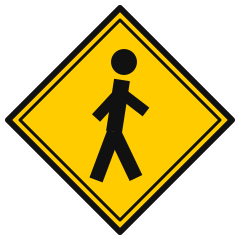
- A pedestrian crosswalk ahead
- A hiking trail beside the road
- A school bus stop ahead
- A no-pedestrians zone
What colour are school zone and school crosswalk signs in Yukon?

- Orange with black symbols
- Blue with white symbols
- Red with white lettering
- Fluorescent yellow-green
A school zone sign shows 30 km/h but no hours. When does the limit apply?
- Only when a crossing guard is present
- 24 hours a day, every day
- 8 a.m. to 4:30 p.m. on school days
- 7 a.m. to 6 p.m. on weekdays
What should you do when you see this school zone sign?
- Reduce speed when children are present
- Sound your horn to warn children
- Keep your speed but stay right
- Stop and wait for a crossing guard
You approach a school crosswalk where a crossing guard is directing people. What should you do?
- Proceed slowly if the walkers are already on the far side
- Pass slowly on the guard's left side
- Stop only if the guard holds up a sign
- Yield to pedestrians and follow the guard's directions
You pass a playground zone sign showing a 30 km/h limit. When does that limit apply?
- 24 hours a day, every day
- 8 a.m. to 4:30 p.m. on school days
- Only when children are visible
- Dawn to dusk from May to September
One type of Yukon school zone sign sets a 50 km/h limit. When is it in effect?
- 24 hours a day, seven days a week, whether or not children are present
- 7 a.m. to 9 a.m. and 3 p.m. to 5 p.m. daily
- 8 a.m.–4:30 p.m. school days, with children on road or shoulder
- Only during school bus loading on weekdays
How do you know a school zone has ended?
- You see an end of school zone sign or a speed limit sign
- You pass the last school building
- You have driven one full block beyond the school's property
- The crosswalk lines stop
According to Yukon examiners, what is a common reason drivers fail the road test?
- Using the horn at intersections
- Signalling too early before turns
- Driving slightly below the speed limit on main roads
- Speeding through school and playground zones
You see a sign for a pedestrian-activated crosswalk and its lights are flashing. What should you do?
- Speed up to clear it first
- Prepare to stop
- Change lanes to go around
- Sound your horn as you pass
Crosswalk, school and playground zone signs: key rules to remember
Our summary of what the official handbook says on this topic, in our own words. Read it before or after the practice questions above, then check the original chapter. Read the official chapter ↗
Ch. 3, p. 29 (Crosswalk, school and playground signs); Ch. 1, p. 5; Ch. 6, p. 80; Ch. 9, p. 135
- Pedestrian-activated crosswalk sign: prepare to stop if the lights are flashing.
- Pedestrian crosswalk sign: yield to people crossing.
- School crosswalk: yield to pedestrians; if there is a crossing guard, follow their directions. Obey school patrols/crossing supervisors at all times (p. 80).
- School zone sign: reduce speed when children are present.
- Playground nearby: be prepared to slow down.
- Playground zone: 30 km/h, in effect 24 hours a day, every day (also p. 5).
- School zone, 50 km/h version: 8 a.m. to 4:30 p.m. on school days when children are on the roadway or shoulder.
- School zone, 30 km/h: 8 a.m. to 4:30 p.m. on school days, or the hours on the tab under the sign, on school days (p. 80).
- School zone ends at an end of school zone sign or a speed limit sign (p. 80).
- School zone and school crosswalk ahead signs are fluorescent yellow-green (pp. 27, 32).
- Examiners: speeding through school and playground zones is a common reason for failing the road test (p. 135).
Study the Crosswalk, school and playground zone signs rules as flashcards →
Other topics
- Regulatory, lane use and parking signsSign shapes and colours, stop and yield, speed, do not enter, one way, keep right, no passing, winter tire signs, lane use and turn control signs, parking and reserved lane signs.
- Warning, construction and railway signsYellow diamond warning signs, object markers, orange construction signs, information signs, railway crossing signs and the slow-moving vehicle sign.
- Traffic lights and lane control signalsSteady, flashing and arrow lights, stale green lights, turning on red, advance left-turn arrows, transit signals and lane control signals.
- Road markingsYellow and white lines, passing rules by line type, reversible and two-way left-turn lanes, stop lines, crosswalks, reserved lane diamonds and bicycle lanes.
- You and your vehicleSeat, head restraint and airbag distance, seatbelts and child car seat stages, lights required on Yukon roads, tires, cruise control and winter preparation.
- Intersections and right-of-wayWhere to stop, uncontrolled intersections, two-way and four-way stops, yield signs, left turns on green, traffic circles and roundabouts, and entering a roadway.
- Lanes, turns and passingChoosing a lane, lane tracking for turns, turning and reserved lanes, bicycle lanes, lane changes, passing, merging, freeway ramps, U-turns and turning around.
- Parking rulesWhere parking is illegal and the distances that apply, distance from the curb, wheel position on hills and leaving the vehicle in gear.
- See-think-do: observation, speed and spaceScanning, mirrors and blind spots, the default 50 km/h limit, curves, following distance, stopping distance, gap selection and communicating with other road users.
- Sharing the roadPedestrians, cyclists, motorcycles, large vehicles, school and transit buses, emergency vehicles and workers, construction zones, trains and animals.
- Impairment and high-risk behaviourFitness to drive, emotions, alcohol and cannabis, medications, fatigue, electronic devices, peer pressure and aggressive driving.
- Weather, night driving and emergenciesLow visibility, rain and hydroplaning, ice and snow, being stranded, headlight rules, animals, emergency braking, skids, breakdowns and duties after a crash.
- Graduated licensing: learner and novice stagesGetting a Class 7 learner's licence, co-driver rules, learner and novice restrictions, the road test and graduating to a full Class 5. The handbook says this chapter is background, not test material.
- Your licence, demerits and penaltiesLicence classes, carrying and renewing your licence, new residents, demerit point suspensions, impaired driving consequences and vehicle impoundment. Background material, not tested per the handbook.