A construction sign warns of a soft shoulder ahead. What should you do?
Yukon Class 7 overview
Yukon Class 7 Practice Test 1
30 questions on warning, construction and railway signs, see-think-do: observation, speed and space, graduated licensing: learner and novice stages, crosswalk, school and playground zone signs, lanes, turns and passing and more.
- No sign-up
- Every answer explained
- Independent · not a government site
- Set 1 of 12
- 30 questions
- Instant feedback
0/30
All 30 questions in this test
Every question and its answer choices. The correct answers and explanations appear when you take the test above.
A construction sign warns of a soft shoulder ahead. What should you do?
- Park on the shoulder to wait
- Stay off the shoulder
- Drive on the shoulder slowly
- Use the shoulder only to pass
In ideal conditions, how long does a vehicle stopped at an intersection need to turn left and reach 50 km/h?
- About seven seconds
- About two seconds
- About ten seconds
- About five seconds
What does this sign mean?
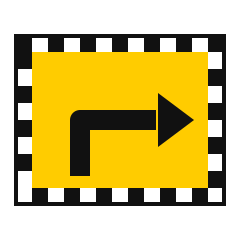
- Exit ramp ahead; use the right lane
- Road continues straight; arrow is advice
- Detour begins; follow orange signs
- Hazard ahead; turn in the direction shown
What is the pass mark on the Yukon knowledge test?
- 80 per cent
- 70 per cent
- 90 per cent
- 75 per cent
You see a sign for a pedestrian-activated crosswalk and its lights are flashing. What should you do?
- Speed up to clear it first
- Prepare to stop
- Change lanes to go around
- Sound your horn as you pass
What separates a freeway acceleration lane from the rest of the roadway?
- A row of white diamonds
- A solid white line
- A double solid yellow line
- A broken yellow line
According to Yukon examiners, what is a common reason drivers fail the road test?
- Using the horn at intersections
- Signalling too early before turns
- Driving slightly below the speed limit on main roads
- Speeding through school and playground zones
What does a steady white rectangular light at an intersection mean?
- All traffic may turn right
- Emergency vehicles are approaching
- Only buses may go on this signal
- Pedestrians may cross diagonally
What does this sign tell you?

- The advised speed for trucks only
- The minimum speed allowed on this road
- The speed you must keep at all times
- The fastest you may drive in good conditions
Your car has a blind spot detector and a backup camera. Do you still need shoulder checks?
- Yes; they do not replace turning your head
- No, the detector and camera replace them fully
- Only when backing up
- Only at night
How close to a crosswalk or intersection may you park?
- No closer than 2 metres
- No closer than 5 metres
- No closer than 15 metres
- No closer than 9 metres
What does this white regulatory sign tell you?
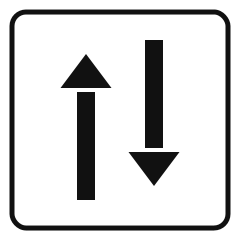
- Reversible lane; follow the overhead signals
- Two-way traffic; keep right unless passing
- One-way road; either lane may be used
- Divided highway begins; stay in your lane
How do you take possession of an intersection when turning left on a green light?
- Move fully past the crosswalk, stay on your side, stop before the middle
- Stop in the crosswalk with your wheels turned left
- Drive to the far side and angle your car to the left
- Wait behind the stop line until the oncoming lane is empty
According to Transport Canada, about how long does it take for a BAC of .08 to return to zero?
- About twelve hours
- About six hours
- About one hour
- About three hours
What is highway hypnosis?
- Falling asleep at a red light
- Losing awareness on a long, unchanging road
- Staring at oncoming headlights on a dark night
- Feeling dizzy from carbon monoxide
You are driving at the speed limit on a multi-lane highway. Is it fine to stay in the left lane the whole way?
- Yes, as long as you keep to the limit
- No, the left lane is for trucks only
- No; it can push others to pass on the right
- Yes, the left lane is the safest one
Police impound a vehicle driven by an unlicensed driver. How long can the impoundment last?
- 24 hours
- Until the driver pays a fine
- 7 days
- 30 days or longer
What do white lines on the road separate?
- Traffic moving in opposite directions
- Lanes of traffic moving in the same direction
- Construction zones from open lanes
- Two-way left-turn lanes from through lanes
You are stopped behind a large truck facing uphill. Why leave extra space in front?
- Trucks are not allowed to back up
- It may roll back when the driver releases the brake
- Its exhaust is hot near your hood
- You will need room to pass it on the hill if it stalls
You see one elk cross the highway ahead. What should you expect?
- It will stay still if you honk
- There may be more animals nearby
- Animals never return to the road
- The road is now clear
You and another vehicle arrive at a traffic circle with no signs at the same time. Whom do you yield to?
- The vehicle on your left
- Nobody; enter together
- The vehicle that is larger
- The vehicle on your right
Your car has airbags. Do you still need to wear a seatbelt?
- No; airbags give the same protection
- Only in the back seat
- Only on highways over 80 km/h
- Yes; airbags do not replace seatbelts
Where must you never place a rear-facing child seat?
- In front of an active airbag
- On a seat with a lap and shoulder belt
- Behind the driver's seat
- In the centre of the back seat
You are waiting in the intersection to turn left and the light turns yellow. What does the handbook say?
- You may legally complete your turn, watching for traffic
- You must wait right where you are until it turns green again
- You must go straight through instead
- You must back up behind the stop line
Who is responsible for avoiding a collision with a pedestrian?
- Always the driver
- The driver only at crosswalks
- The pedestrian, if jaywalking
- Whoever had the right-of-way
The curb beside an open space is painted yellow. May you park there?
- Only after 6 p.m.
- Yes, if you stay in the vehicle with flashers on
- No; parking is illegal at yellow or red curbs
- Yes, for up to 15 minutes
Your vehicle catches fire. What should you do?
- Open the hood to find the fire
- Get everyone out and move well away; don't open the hood
- Keep driving to a service station
- Stay inside with all the windows closed until help arrives
When will you be asked to re-test for your licence?
- If it has been expired for more than 30 days in a row
- If you move to another Yukon town
- If it has been expired over two years in a row
- Every time you renew after age 50
When can you book a Class 5 road test in Yukon?
- Only after a driving school signs off
- Any time after your learner's licence is issued
- After your log book has been dropped off for inspection
- Only on the day you turn 16
What does a double solid yellow centre line mean?
- Passing allowed when safe
- The lane is reversible
- No passing allowed
- Passing allowed for cyclists only
All Yukon Class 7 practice tests
- Yukon Class 7 Mock Exam 1 – 30 QuestionsUntimed practice · answers explained
- Yukon Class 7 Mock Exam 2 – 30 QuestionsUntimed practice · answers explained
- Yukon Class 7 Mock Exam 3 – 30 QuestionsUntimed practice · answers explained
- Yukon Class 7 Mock Exam 4 – 30 QuestionsUntimed practice · answers explained
- Yukon Class 7 Mock Exam 5 – 30 QuestionsUntimed practice · answers explained
- Regulatory, lane use and parking signsSign shapes and colours, stop and yield, speed, do not enter, one way, keep right, no passing, winter tire signs, lane use and turn control signs, parking and reserved lane signs.
- Crosswalk, school and playground zone signsCrosswalk signs, fluorescent yellow-green school signs, the 30 km/h playground zone that applies around the clock, and school zone hours on school days.
- Warning, construction and railway signsYellow diamond warning signs, object markers, orange construction signs, information signs, railway crossing signs and the slow-moving vehicle sign.
- Traffic lights and lane control signalsSteady, flashing and arrow lights, stale green lights, turning on red, advance left-turn arrows, transit signals and lane control signals.
- Road markingsYellow and white lines, passing rules by line type, reversible and two-way left-turn lanes, stop lines, crosswalks, reserved lane diamonds and bicycle lanes.
About this practice test
How many questions are in Yukon Class 7 practice test 1?
30 original multiple-choice practice questions covering warning, construction and railway signs, see-think-do: observation, speed and space, graduated licensing: learner and novice stages, crosswalk, school and playground zone signs, lanes, turns and passing, traffic lights and lane control signals, regulatory, lane use and parking signs, parking rules, intersections and right-of-way, impairment and high-risk behaviour, your licence, demerits and penalties, road markings, sharing the road, weather, night driving and emergencies, you and your vehicle. Each answer includes an explanation. This mixed practice set does not reproduce the official exam format or predict an official score.
Are the questions the same every time?
Yes. Practice test 1 always has the same 30 questions, so you can repeat it until you get them all right. The other 11 sets use different questions.
Are these real test questions?
No. The official question bank is not published. These are original questions written from the official handbook, which is what the real Yukon Class 7 test is based on.