How often should you complete your full observation cycle of ahead, sides and mirrors?
Yukon Class 7 overview
Yukon Class 7 Practice Test 7
30 questions on see-think-do: observation, speed and space, your licence, demerits and penalties, traffic lights and lane control signals, sharing the road, you and your vehicle and more.
- No sign-up
- Every answer explained
- Independent · not a government site
- Set 7 of 12
- 30 questions
- Instant feedback
0/30
All 30 questions in this test
Every question and its answer choices. The correct answers and explanations appear when you take the test above.
How often should you complete your full observation cycle of ahead, sides and mirrors?
- Every 30 seconds
- Only before turning
- Every five to eight seconds
- Every 15 to 20 seconds
After serving a demerit point suspension, a fully licensed driver's licence is reinstated with how many points?
- Ten
- Three
- Seven
- Zero
You are approaching an intersection and the light turns steady yellow. What should you do?
- Stop immediately, even if you are already inside the intersection
- Stop before the intersection unless you can't stop safely
- Speed up to get through before it turns red
- Continue at the same speed; yellow means go
When might you not need to stop for an emergency vehicle using lights and siren?
- When it is behind you in the left lane of a highway
- On any highway posted at 90 km/h
- On a divided highway when it is across the median
- When you are already turning right
To cut fuel use, when does the handbook suggest turning off your motor while you are stopped?
- When stopped for more than 60 seconds
- When stopped for more than 5 minutes
- Never; restarting uses more fuel
- Only when stopped at a red light
What is the only thing that lowers your blood alcohol content?
- Strong coffee
- Time
- A cold shower
- A large meal
You are in a crash. When must you report it to the police?
- Only if damage is over $5,000
- Only if someone is killed
- If damage is over $1,000 or someone is injured
- Only if a vehicle has to be towed away from the scene
You are stopped at a cross street and see this sign. What does it tell you?

- The lane ahead ends in the arrow's direction
- The cross street is closed except to buses
- You must turn in the arrow's direction now
- Traffic on the cross street moves one way only
At a four-way stop, two cars facing each other arrive at about the same time. One is turning left, the other going straight. Who goes first?
- The one on the right of the other
- The one turning left
- The one going straight
- The one that signals first
What does zero tolerance mean for learner and novice drivers?
- Absolutely no alcohol or drugs in your body
- No alcohol after midnight
- One drink is allowed if it is taken with food
- A BAC under .05 is allowed
How does the vehicle limit for novice drivers differ from the learner limit?
- There is no limit for novices
- Novices may drive up to 11,000 kg
- Novices may tow trailers up to 4,550 kg with a co-driver
- Novices may drive vehicles seating up to 9, not 7
You are turning left from a one-way road onto a two-way road. Which lanes do you use?
- From the right lane into the far right lane, beside the curb
- From the left lane into the lane right of the centre line
- From any lane into any open lane
- From the centre lane into the curb lane
The handbook recommends the Dutch Reach when you get out of your car. What is it?
- Opening your door with the hand farther from it
- Steering with one hand on top of the wheel
- Reaching over to signal a turn by hand
- Checking the back seat before leaving
You want to park on the opposite side of a street with a yellow centre line. What does the handbook say?
- You may not cross the yellow line to park or leave a spot
- You may cross it if no traffic is coming
- You may cross it if you signal left first and check mirrors
- You may cross it only during daylight
You are stopped at a railway crossing with gates. The train has passed and the gate is rising. When may you go?
- When the last car of the train passes
- When the car beside you starts moving
- Once the gate is fully raised and it is safe
- As soon as the gate starts to lift
What marks a reserved lane on the road surface?
- A yellow X painted in the lane
- A white diamond painted in the lane
- A green arrow painted in the lane
- A solid red line along the curb
A person with a white cane raises it at the curb. What does this signal to you?
- They will wait for you to pass
- They are hailing a taxi
- Stop and give them the right-of-way
- They want you to honk to guide them
You must turn around mid-block on a road with a solid line in the middle. What turn does the handbook describe?
- A turn using the opposite shoulder
- A two-point turn, backing into a driveway
- A three-point turn across the line
- A U-turn from the right lane
How many demerit points may be recorded for a driving conviction under the Criminal Code of Canada?
- 3
- 15
- 10
- 5
What is the largest vehicle a Class 7 learner may drive?
- Up to 11,000 kg gross weight and seating for 7
- Up to 4,000 kg gross weight and seating for 7
- Any car or truck with two axles
- Up to 4,550 kg and seating for 9
What kind of information do information and destination signs give?
- Hazards and road conditions
- Speed limits, turn rules and other regulations
- Construction and detour times
- Destinations, route numbers and facilities
You are following another car at night with your high beams on. How close can you get before you must switch to low beams?
- 300 metres
- 50 metres
- 30 metres
- 150 metres
You move to a new address in Whitehorse. What does the law require?
- Notify the RCMP detachment within 30 days
- Tell a Motor Vehicles office for licence and registration
- Tell your insurance company only, by phone
- Nothing until your licence comes up for renewal
How may you use a two-way left-turn lane marked in the centre of the road?
- To merge after turning onto the road
- To wait while parking on the left
- Only to turn left; it is not a merge lane
- To pass slower traffic on the left
You want to turn left at a two-lane roundabout. Which lane should you enter?
- The truck apron
- The left lane
- Either lane
- The right lane
You are stopped at a red light on a one-way street and want to turn left onto another one-way street. What does the handbook allow?
- A left turn after a full stop, if clear and not prohibited
- A left turn without stopping if traffic is light
- No turn of any kind until the light is green
- A left turn only with an advance green arrow
About how far does a typical train need to stop?
- About 50 metres
- About 200 metres
- About 500 metres
- About two kilometres
A baby rides in a rear-facing child seat. Until when must the rear-facing stage be used at a minimum?
- Until at least 10 kg and walking unassisted
- Until at least 22 kg and 2 years old
- Until at least 5 kg and sitting up
- Until the baby is six months old
What does this sign warn you about?
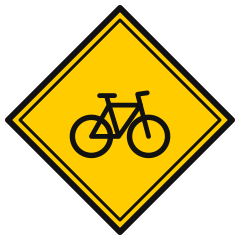
- Cyclists may be on the roadway
- Bicycles are not allowed
- A bicycle shop is nearby
- Bicycle racks for parking
A fully licensed Yukon driver wants to use a phone while driving. What is allowed?
- Texting at red lights
- Any device if the road is empty
- A hand-held phone at low speeds
- A hands-free device only
All Yukon Class 7 practice tests
- Yukon Class 7 Mock Exam 1 – 30 QuestionsUntimed practice · answers explained
- Yukon Class 7 Mock Exam 2 – 30 QuestionsUntimed practice · answers explained
- Yukon Class 7 Mock Exam 3 – 30 QuestionsUntimed practice · answers explained
- Yukon Class 7 Mock Exam 4 – 30 QuestionsUntimed practice · answers explained
- Yukon Class 7 Mock Exam 5 – 30 QuestionsUntimed practice · answers explained
- Regulatory, lane use and parking signsSign shapes and colours, stop and yield, speed, do not enter, one way, keep right, no passing, winter tire signs, lane use and turn control signs, parking and reserved lane signs.
- Crosswalk, school and playground zone signsCrosswalk signs, fluorescent yellow-green school signs, the 30 km/h playground zone that applies around the clock, and school zone hours on school days.
- Warning, construction and railway signsYellow diamond warning signs, object markers, orange construction signs, information signs, railway crossing signs and the slow-moving vehicle sign.
- Traffic lights and lane control signalsSteady, flashing and arrow lights, stale green lights, turning on red, advance left-turn arrows, transit signals and lane control signals.
- Road markingsYellow and white lines, passing rules by line type, reversible and two-way left-turn lanes, stop lines, crosswalks, reserved lane diamonds and bicycle lanes.
About this practice test
How many questions are in Yukon Class 7 practice test 7?
30 original multiple-choice practice questions covering see-think-do: observation, speed and space, your licence, demerits and penalties, traffic lights and lane control signals, sharing the road, you and your vehicle, impairment and high-risk behaviour, weather, night driving and emergencies, regulatory, lane use and parking signs, intersections and right-of-way, graduated licensing: learner and novice stages, lanes, turns and passing, road markings, warning, construction and railway signs. Each answer includes an explanation. This mixed practice set does not reproduce the official exam format or predict an official score.
Are the questions the same every time?
Yes. Practice test 7 always has the same 30 questions, so you can repeat it until you get them all right. The other 11 sets use different questions.
Are these real test questions?
No. The official question bank is not published. These are original questions written from the official handbook, which is what the real Yukon Class 7 test is based on.