You move to Yukon with a valid licence from another province. How long may you drive on it?
Yukon Class 7 overview
Yukon Class 7 Mock Exam 4
Same format as the real test. Answers stay hidden until you submit. The official time limit is not published; the timer is a practice setting.
- No sign-up
- Every answer explained
- Independent · not a government site
- 30 questions
- untimed
- Pass mark 24/30
0/30
All 30 questions in this test
Every question and its answer choices. The correct answers and explanations appear when you take the test above.
You move to Yukon with a valid licence from another province. How long may you drive on it?
- Your first 120 days of residence
- Your first 30 days
- Until it expires
- Your first 90 days after you arrive
Why should you not rely on daytime running lights at night?
- They are too bright for oncoming drivers
- They do not turn on the tail lights
- They drain the battery quickly
- They switch off above 50 km/h
What does this sign mean when you see it over a centre lane?
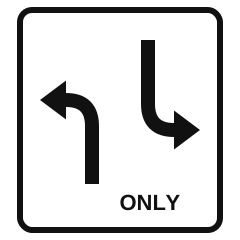
- Drivers from both directions must turn left
- Drivers may make a U-turn in this lane
- Traffic must merge left before the bridge
- Two lanes ahead are for passing only
Which headlights should you use in rain, snow and fog?
- Low beams
- Parking lights
- High beams
- No lights in daytime
Your vehicle stalls on a railway track. What should you do first?
- Get everyone out and move at least 30 metres away
- Try to restart the engine several times before leaving
- Stay inside with seatbelts on
- Push the car off the track
How many demerit points lead to a one-month suspension for a GDL driver?
- Ten
- Five
- Fifteen
- Seven
You must stop at a railway crossing for a train. Where should you stop?
- Between 5 and 15 metres from the nearest rail
- Between 1 and 3 metres back from the nearest rail
- Right at the nearest rail
- At least 30 metres from the rail
You are stranded in snow and decide to run the engine for heat. What should you do?
- Keep it running all night with the windows shut tight to save heat
- Leave the vehicle to find help right away
- Run it only with the exhaust pipe buried
- Run it sparingly and open the window farthest from the exhaust
You park facing downhill next to a curb. Which way should your front wheels point?
- Left if the street is busy
- To the left, away from the curb
- Straight ahead
- To the right, toward the curb
What does the handbook say about driving with snow or frost on your windows?
- It is fine if the windshield is clear
- It is allowed at low speeds
- It is illegal only on highways
- It is illegal unless your windows are clear
You are judging a gap to go straight across a road at a stop sign. How much time does the handbook say you need for each lane?
- About two seconds per lane, plus two seconds for safety
- About five seconds per lane, with no extra time for safety
- About seven seconds, whatever the width
- About one second per lane, plus one second
Why should you avoid driving over pavement markings that were just painted?
- The paint can damage your tires
- Driving over wet, freshly painted lines is illegal
- It voids your vehicle insurance
- Only trucks are allowed to cross new paint
You are stopped behind a large truck facing uphill. Why leave extra space in front?
- Trucks are not allowed to back up
- It may roll back when the driver releases the brake
- Its exhaust is hot near your hood
- You will need room to pass it on the hill if it stalls
Which of these is an illegal place to park?
- On a residential side street
- Beside a curb painted white
- On a bridge
- Next to a closed business
Why is a pickup truck or SUV with a heavy roof load more likely to roll over on a curve?
- Its tires have more traction
- It is lower to the ground
- Its centre of gravity is higher
- It has more inertia when stopped
On a regulatory sign, what does a red circle with a slash across a symbol mean?
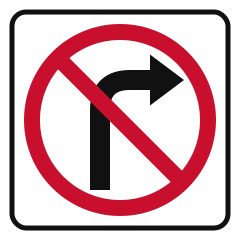
- The action shown is allowed with care
- The action shown is advised at night
- The action shown is not permitted
- The action shown is required ahead
Which statement about anti-lock brakes is correct?
- On gravel, stopping distances may be longer
- They always stop you sooner
- They let you drive faster safely
- They stop the wheels from locking on dry roads only
An emergency vehicle with flashing lights and siren is behind you. What should you do?
- Speed up to stay ahead of it
- Pull over to the right and stop
- Stop at once in your lane
- Pull over to the left and keep going
What does this sign mean?

- A detour ahead
- Road closed to all traffic
- Truck route only
- Construction has ended
To get your licence back after an impaired driving conviction, what may you be required to do?
- Take a remedial program and use an ignition interlock
- Retake the knowledge test only
- Wait one week, then reapply at any motor vehicles office
- Only pay a reinstatement fee
What must you have done to be eligible for the Class 5 road test?
- Be 15, hold a Class 7 for 3 months and log 30 hours
- Be 16, hold a Class 7 for 6 months and log 50 hours
- Be 17, hold a Class 7 for 12 months and log 100 hours
- Be 16 and pass a second written test
When is a road most slippery during rain?
- Right after the rain stops
- At the beginning of the rainfall
- Only once it turns to snow
- After several hours of heavy rain
A rider ahead is struggling to control a horse near the road. What should you do?
- Flash your high beams
- Pass quickly to get by before it bolts
- Pull over to the shoulder and stop
- Honk to warn the rider
What is the largest vehicle a Class 7 learner may drive?
- Up to 11,000 kg gross weight and seating for 7
- Up to 4,000 kg gross weight and seating for 7
- Any car or truck with two axles
- Up to 4,550 kg and seating for 9
What does this sign warn you about?
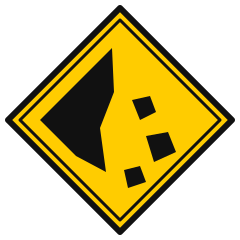
- Rocky soft shoulders ahead
- Falling rocks, and rocks on the road ahead
- Loose gravel from construction
- A landslide that has closed the whole road ahead
You see a vehicle stopped at a crosswalk in the lane beside you. What should you assume?
- The driver is waiting to park
- The driver has broken down
- The light ahead has turned red
- A pedestrian is trying to cross
How close may you park to the entrance of a driveway, back lane or garage?
- No closer than 0.5 metres
- No closer than 3 metres
- No closer than 1.5 metres
- No closer than 5 metres
A baby rides in a rear-facing child seat. Until when must the rear-facing stage be used at a minimum?
- Until at least 10 kg and walking unassisted
- Until at least 22 kg and 2 years old
- Until at least 5 kg and sitting up
- Until the baby is six months old
Why should you avoid turning your signal on too early?
- It cancels your brake lights
- It wears out the signal bulb
- It is only legal within 10 m of the turn you'll make
- Others may expect you to turn at an earlier road
On a long two-day road trip, when does the handbook say tiredness is most likely to affect you?
- On the second day
- On the first morning
- In the first hour
- Only after midnight
Keep practising
- Yukon Class 7 Mock Exam 1 – 30 QuestionsUntimed practice · answers explained
- Yukon Class 7 Mock Exam 2 – 30 QuestionsUntimed practice · answers explained
- Yukon Class 7 Mock Exam 3 – 30 QuestionsUntimed practice · answers explained
- Yukon Class 7 Mock Exam 5 – 30 QuestionsUntimed practice · answers explained
- Yukon Class 7 Practice Test 130 questions with explanations
- Yukon Class 7 Practice Test 230 questions with explanations
- Yukon Class 7 Practice Test 330 questions with explanations
- Yukon Class 7 Practice Test 430 questions with explanations