You approach a school crosswalk where a crossing guard is directing people. What should you do?
Yukon Class 7 overview
Yukon Class 7 Practice Test 3
30 questions on crosswalk, school and playground zone signs, weather, night driving and emergencies, impairment and high-risk behaviour, regulatory, lane use and parking signs, parking rules and more.
- No sign-up
- Every answer explained
- Independent · not a government site
- Set 3 of 12
- 30 questions
- Instant feedback
0/30
All 30 questions in this test
Every question and its answer choices. The correct answers and explanations appear when you take the test above.
You approach a school crosswalk where a crossing guard is directing people. What should you do?
- Proceed slowly if the walkers are already on the far side
- Pass slowly on the guard's left side
- Stop only if the guard holds up a sign
- Yield to pedestrians and follow the guard's directions
When are animals most likely to be on the road and hardest to see?
- At noon
- In bright afternoon sun
- At dusk and dawn
- Only in the middle of the night
On a long two-day road trip, when does the handbook say tiredness is most likely to affect you?
- On the second day
- On the first morning
- In the first hour
- Only after midnight
On a regulatory sign, what does a red circle with a slash across a symbol mean?
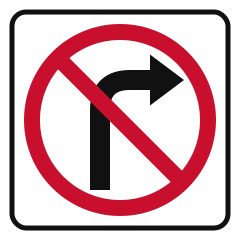
- The action shown is allowed with care
- The action shown is advised at night
- The action shown is not permitted
- The action shown is required ahead
When parallel parking, how close to the curb should your vehicle be?
- Touching the curb
- Within 1.5 metres
- Within 50 centimetres
- Within 1 metre
Why should you not rely on daytime running lights at night?
- They are too bright for oncoming drivers
- They do not turn on the tail lights
- They drain the battery quickly
- They switch off above 50 km/h
You are leaving a freeway. When should you slow down?
- Before you signal for the exit
- In the right lane before the exit
- After you have moved into the exit lane
- On the shoulder before the ramp
When must a novice driver have a co-driver?
- Between 10 p.m. and 6 a.m.
- Whenever driving on a highway
- Between midnight and 5 a.m.
- At all times for the first year
Why can a driver be penalized for ignoring a regulatory sign in Yukon?
- Regulatory signs are only advice for new drivers
- Fines apply only within Whitehorse city limits
- Disregarding one is an offence under the Motor Vehicles Act
- Only police officers can enforce regulatory signs
You are changing lanes. Who has the right-of-way?
- Whoever is travelling faster
- Vehicles already in the lane you are moving into
- You do, once your signal is on
- Vehicles in the lane you are leaving, coming up behind
What must you do every time you drive?
- Carry a letter from your insurer
- Carry your vehicle's bill of sale
- Carry your driver's licence
- Carry your birth certificate
Which of these is an illegal place to park?
- On a residential side street
- Beside a curb painted white
- On a bridge
- Next to a closed business
You are on a Yukon road with no speed limit sign. What is the speed limit?
- 70 km/h
- 30 km/h
- 50 km/h
- 80 km/h
You are stopped at a steady red light and want to turn right. What may you do?
- Turn right after a full stop when the way is clear
- Turn right without stopping if no one is coming
- Wait for the green light before any turn
- Turn right only if a sign says it is allowed
A transit bus is signalling to pull out from a stop and shows a yield-to-bus sign. What should you do?
- Speed up to pass it first
- Honk to warn the bus driver
- Allow it to pull out when it is safe
- Change lanes only if a sign says so
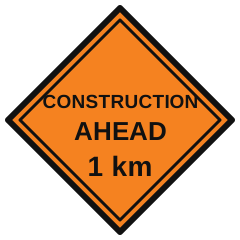
What does this orange sign tell you?
- Detour around a closure
- Construction ahead
- Truck route ahead
- Road open to local traffic
In Yukon, what does a flashing green traffic light mean?
- The light is about to turn yellow
- Pedestrian-controlled; go only if your lane is clear
- Traffic must stop as if for a red
- You have a protected left turn while oncoming traffic stops
Which way do you travel in a traffic circle?
- Either way, whichever is shorter
- Counter-clockwise, to the right
- Whichever way the car ahead goes
- Clockwise, to the left
How are high occupancy vehicle (HOV) lanes marked on the road?
- Green paint and bicycle symbols
- Double yellow lines and red arrows on the pavement
- Thick solid or broken lines and white diamonds
- Orange cones and dotted lines
An emergency vehicle with lights and siren is coming as you approach a roundabout. What should you do?
- Stop inside the roundabout
- Stop before entering and let it pass
- Enter quickly to clear the way
- Speed up and take the first exit
One type of Yukon school zone sign sets a 50 km/h limit. When is it in effect?
- 24 hours a day, seven days a week, whether or not children are present
- 7 a.m. to 9 a.m. and 3 p.m. to 5 p.m. daily
- 8 a.m.–4:30 p.m. school days, with children on road or shoulder
- Only during school bus loading on weekdays
The centre line beside you is a solid yellow line, and on the far side of it is a broken yellow line. May you pass?
- Yes, but only to pass a slow truck or farm vehicle
- No, unless you stay under the limit
- Yes, if the road ahead is clear
- No; only when the broken line is on your side
When is a road most slippery during rain?
- Right after the rain stops
- At the beginning of the rainfall
- Only once it turns to snow
- After several hours of heavy rain
You are very angry after an argument and feel you can't concentrate on driving. What should you do?
- Pull over, park and wait until you are calm
- Turn up the music to distract yourself
- Keep driving but use only the right lane
- Drive faster to get home sooner
Who can be your co-driver as a Yukon learner?
- Any adult who holds a learner's licence
- Someone who has held a novice licence for a full year
- Someone with a full licence for at least two years
- Anyone over 18, licensed or not
Before which of these actions should you shoulder check for cyclists?
- Turning on your headlights
- Starting the engine
- Opening your door to get out
- Adjusting the radio
Your oil pressure warning light is not on. What does that tell you about the oil in the engine?
- The oil is the right grade
- The oil was changed recently and is still clean
- The oil level is full
- Nothing about how much oil is in the engine
You see this sign with a speed tab below it. What should you do?

- Slow to the suggested speed for the sharp curve ahead
- Speed up to the tab speed after the curve
- Keep the posted limit; the tab is for trucks only
- Stop and check for oncoming traffic first
At what age must Class 5, 6 and 7 licence holders first provide a medical report?
- 80
- 70
- 60
- 65
You start to lose traction in a curve. What should you do?
- Accelerate to regain grip
- Shift into neutral and coast
- Brake hard and steer sharply
- Ease off the gas and do not brake
All Yukon Class 7 practice tests
- Yukon Class 7 Mock Exam 1 – 30 QuestionsUntimed practice · answers explained
- Yukon Class 7 Mock Exam 2 – 30 QuestionsUntimed practice · answers explained
- Yukon Class 7 Mock Exam 3 – 30 QuestionsUntimed practice · answers explained
- Yukon Class 7 Mock Exam 4 – 30 QuestionsUntimed practice · answers explained
- Yukon Class 7 Mock Exam 5 – 30 QuestionsUntimed practice · answers explained
- Regulatory, lane use and parking signsSign shapes and colours, stop and yield, speed, do not enter, one way, keep right, no passing, winter tire signs, lane use and turn control signs, parking and reserved lane signs.
- Crosswalk, school and playground zone signsCrosswalk signs, fluorescent yellow-green school signs, the 30 km/h playground zone that applies around the clock, and school zone hours on school days.
- Warning, construction and railway signsYellow diamond warning signs, object markers, orange construction signs, information signs, railway crossing signs and the slow-moving vehicle sign.
- Traffic lights and lane control signalsSteady, flashing and arrow lights, stale green lights, turning on red, advance left-turn arrows, transit signals and lane control signals.
- Road markingsYellow and white lines, passing rules by line type, reversible and two-way left-turn lanes, stop lines, crosswalks, reserved lane diamonds and bicycle lanes.
About this practice test
How many questions are in Yukon Class 7 practice test 3?
30 original multiple-choice practice questions covering crosswalk, school and playground zone signs, weather, night driving and emergencies, impairment and high-risk behaviour, regulatory, lane use and parking signs, parking rules, you and your vehicle, lanes, turns and passing, graduated licensing: learner and novice stages, your licence, demerits and penalties, see-think-do: observation, speed and space, traffic lights and lane control signals, sharing the road, warning, construction and railway signs, intersections and right-of-way, road markings. Each answer includes an explanation. This mixed practice set does not reproduce the official exam format or predict an official score.
Are the questions the same every time?
Yes. Practice test 3 always has the same 30 questions, so you can repeat it until you get them all right. The other 11 sets use different questions.
Are these real test questions?
No. The official question bank is not published. These are original questions written from the official handbook, which is what the real Yukon Class 7 test is based on.