Yukon Road Signs and What They Mean
All 43 road signs in our Yukon Class 7 bank on one page, from stop and yield to deer, falling rock and school zone signs, with what each one asks of you.
- No sign-up
- Every answer explained
- Independent · not a government site
- 43 signs
- Free, no sign-up
Road signs are one of the three things the Yukon learner's test checks, next to rules of the road and safe driving practices, and an 80 per cent pass mark leaves little room for guessing at a shape you only half remember. This chart gathers all 43 sign drawings from our Yukon question bank on one page, grouped the way our topics are: regulatory signs, school and playground zone signs, and warning and construction signs. Each entry gives the sign's meaning, taken from the correct answer to its practice question, and the reasoning behind it.
Chapter 3 of the Yukon Driver's Basic Handbook teaches you to read a sign three ways: by its shape, its colour and its printed message. A green circle shows something you may do and a red circle with a slash something you may not; yellow diamonds warn of hazards, orange signs mark construction and maintenance work, and school zone and school crosswalk signs are fluorescent yellow-green. Two Yukon details are worth learning by heart: a playground zone means 30 km/h at every hour of every day, while school zones apply from 8 a.m. to 4:30 p.m. on school days, at 30 or 50 km/h depending on the sign. Our drawings are simplified originals, so go by shape, colour and symbol, then try the sign topic tests linked below.
Regulatory, lane use and parking signs
Practise: Regulatory, lane use and parking signs
Stop completely and go only when it is safe
A stop sign requires a complete stop. You continue only when it is safe to do so.

Give the right-of-way to vehicles and pedestrians
A yield sign means you must give the right-of-way to other vehicles and to pedestrians who are crossing.

The fastest you may drive in good conditions
A maximum speed sign shows the highest speed allowed, and only when conditions are good. In poor conditions you should drive slower.

Do not enter
This regulatory sign means you must not enter the road it guards, often because traffic comes the other way.

Traffic on the cross street moves one way only
A one-way sign gives the direction of traffic on the cross street. Traffic there travels only in the direction of the arrow.

Keep to the right of the divider
This sign tells you to keep right of the divider or island in the road.

Do not pass
This regulatory sign means passing is not allowed. Disregarding a regulatory sign is an offence under the Motor Vehicles Act.
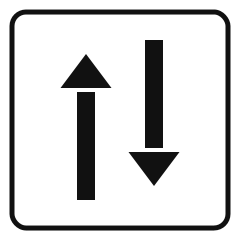
Two-way traffic; keep right unless passing
This sign reminds you that traffic flows both ways on this road. Keep right except when you are passing.
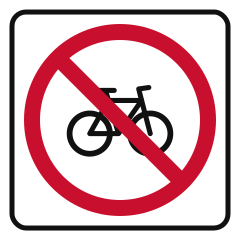
No bicycle riding beyond this point
A bicycle inside a red circle with a slash means cycling is not allowed past this point.
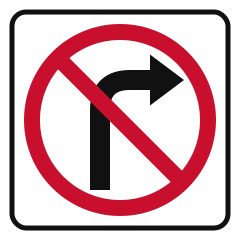
The action shown is not permitted
A red circle and slash shows an action that is not permitted, such as a turn you may not make.
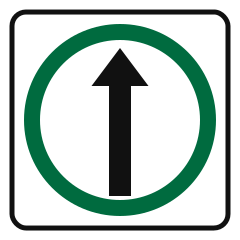
The action shown is permitted
A green circle shows a permitted action. A red circle with a slash shows one that is not permitted.
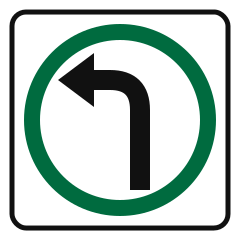
Turn left
If you are in a lane controlled by a lane use sign, you must follow the direction of its arrows. This one means left turn only.
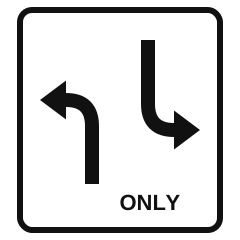
Drivers from both directions must turn left
This lane use sign means vehicles from both directions use the lane to turn left, and no through traffic is allowed in it.
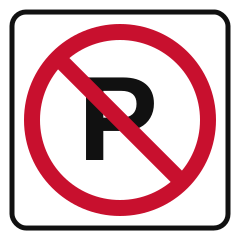
No parking between here and the next sign or intersection
A P in a red circle with a slash means parking is not allowed from the sign to the next sign or intersection. Illegal parking can bring a fine, towing or both.
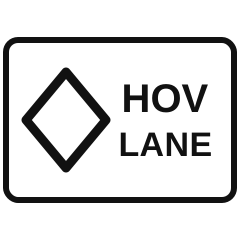
It's for buses and HOVs, and may show minimum riders
Reserved lane signs mark lanes for buses or high occupancy vehicles. Some also show how many people must be in a vehicle to use the HOV lane.
Crosswalk, school and playground zone signs
Practise: Crosswalk, school and playground zone signs
Fluorescent yellow-green
School zone signs, and the school crosswalk ahead sign, are fluorescent yellow-green so they stand out to drivers.
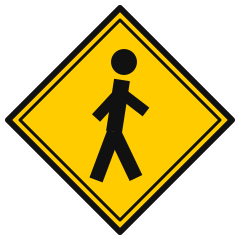
A pedestrian crosswalk ahead
A walking figure on a yellow diamond warns of a pedestrian crosswalk ahead. Be ready to yield to people crossing.
Warning, construction and railway signs
Practise: Warning, construction and railway signs
A winding road ahead
The wavy arrow warns that the road ahead winds back and forth. Slow down and keep to your lane.
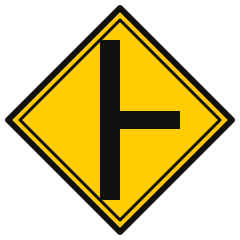
A hidden side road ahead
This sign warns of a side road ahead that may be hard to see. Watch for vehicles entering from it.

Slow to the suggested speed for the sharp curve ahead
This sign warns of a sharp curve ahead and the tab gives the suggested speed. Slow down before you reach the curve.

Merging traffic ahead
This sign warns that traffic will merge into your roadway ahead. Be ready to adjust your speed and space.

The right lane ends ahead
This sign warns that the right lane is ending. Drivers in it must find a safe gap and move over.
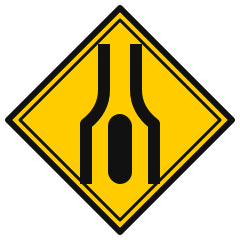
Divided highway ends ahead; keep right
This sign warns that the divided highway is ending and traffic will soon travel in both directions without a median. Keep right.

Two-way traffic ahead
Two arrows pointing in opposite directions warn that you will soon share the road with oncoming traffic.

A narrow structure ahead, often a bridge
This sign warns of a narrow structure ahead, usually a bridge. Slow down and watch for oncoming traffic.

A bump or rough road ahead
This sign warns of a bump or rough section of road. Slow down so you keep control.

The road may be slippery ahead
This sign warns that the road ahead may be slippery. Slow down and avoid sudden braking or steering.

A steep hill ahead, so slow down
This sign warns of a steep hill. Slow down, and remember your vehicle needs more distance to stop going downhill.

There is a stop sign ahead
This yellow warning sign tells you a stop sign is coming up. Begin slowing early so you can stop smoothly.
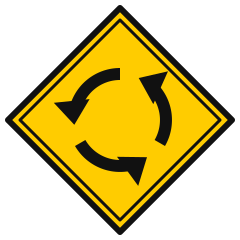
A roundabout ahead
Arrows arranged in a circle warn that you are approaching a roundabout. Slow down and pick your lane early.

Prepare to stop at the signal ahead
This sign warns of traffic lights ahead. When its own lights are flashing, the handbook says to prepare to stop.
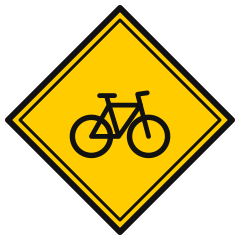
Cyclists may be on the roadway
This sign warns that cyclists may be using the road. Give them room and pass only when it is safe.

Watch for deer ahead
This sign warns that deer may be on or near the road. Scan the ditches and be ready to slow down.
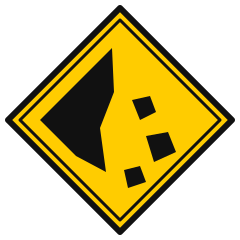
Falling rocks, and rocks on the road ahead
This sign means rocks may fall onto the road, so watch for rocks on the road ahead.

On obstructions near or in the road
Object markers are mounted on obstructions. Pay special attention to them and keep to the side they indicate.
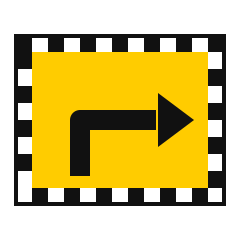
Hazard ahead; turn in the direction shown
This sign warns of a hazard or danger ahead where the road turns. You must turn right or left as shown.
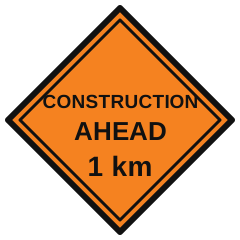
Construction ahead
Orange signs warn of construction and maintenance work. Obey them and stay well back from equipment.

A traffic control person ahead
This orange sign warns that a traffic control person is directing traffic ahead. Be ready to obey their directions.

Obey the posted speed limit; a crew is working
This sign means a crew is working on or near the road. Obey the posted speed limit and give the workers room.

Follow the lighted arrow
A lighted arrow board directs traffic. Follow the direction of the lighted arrow.

A detour ahead
A detour sign warns that traffic will be routed off the usual road. Follow the detour signs.

You must always yield to trains
Railway crossings may have signs, markings and warning devices. Whatever is there, you must always yield to trains.

The vehicle will be moving slowly
This sign marks vehicles that move slowly. Keep your distance and pass only when you are certain it is safe.
FAQ
Yukon road signs chart: common questions
How many sign questions are on the Yukon learner's test?
Yukon does not publish a count. The handbook describes one multiple-choice test on road signs, rules of the road and safe driving practices, and refers to the sign and knowledge tests together. It is widely reported as 40 questions split into a signs part and a rules part, but that is unconfirmed, so check with a Motor Vehicles office.
What do the shapes and colours of Yukon road signs mean?
White rectangles state the law, a green circle permits an action and a red circle with a slash forbids it. Yellow diamonds warn of hazards ahead, orange signs mark construction and maintenance, and fluorescent yellow-green is used for school zones and school crosswalks.
Is this chart the same as the Yukon handbook?
No. It covers the 43 signs in our question bank, in our own words and with simplified drawings. The handbook shows more, such as information and destination signs, the disaster route sign and the winter tires or chains sign, in Chapter 3 of the free Yukon Driver's Basic Handbook on yukon.ca.
Keep practising
- Yukon learner's practice test (printable PDF)100 Yukon Class 7 practice questions on signs, rules and safe driving, with an answer key on separate pages that cites the handbook. Print or save as PDF. Free.
- Yukon Class 7 study guide
- Yukon Class 7 Mock Exam 1 – 30 QuestionsUntimed practice · answers explained
- Yukon Class 7 Mock Exam 2 – 30 QuestionsUntimed practice · answers explained
- Yukon Class 7 Practice Test 130 questions with explanations
- Yukon Class 7 Practice Test 230 questions with explanations
- Yukon Class 7 Practice Test 330 questions with explanations
Practice by topic
- Regulatory, lane use and parking signsSign shapes and colours, stop and yield, speed, do not enter, one way, keep right, no passing, winter tire signs, lane use and turn control signs, parking and reserved lane signs.
- Crosswalk, school and playground zone signsCrosswalk signs, fluorescent yellow-green school signs, the 30 km/h playground zone that applies around the clock, and school zone hours on school days.
- Warning, construction and railway signsYellow diamond warning signs, object markers, orange construction signs, information signs, railway crossing signs and the slow-moving vehicle sign.
- Traffic lights and lane control signalsSteady, flashing and arrow lights, stale green lights, turning on red, advance left-turn arrows, transit signals and lane control signals.
- Road markingsYellow and white lines, passing rules by line type, reversible and two-way left-turn lanes, stop lines, crosswalks, reserved lane diamonds and bicycle lanes.
- You and your vehicleSeat, head restraint and airbag distance, seatbelts and child car seat stages, lights required on Yukon roads, tires, cruise control and winter preparation.
- Intersections and right-of-wayWhere to stop, uncontrolled intersections, two-way and four-way stops, yield signs, left turns on green, traffic circles and roundabouts, and entering a roadway.
- Lanes, turns and passingChoosing a lane, lane tracking for turns, turning and reserved lanes, bicycle lanes, lane changes, passing, merging, freeway ramps, U-turns and turning around.
- Parking rulesWhere parking is illegal and the distances that apply, distance from the curb, wheel position on hills and leaving the vehicle in gear.
- See-think-do: observation, speed and spaceScanning, mirrors and blind spots, the default 50 km/h limit, curves, following distance, stopping distance, gap selection and communicating with other road users.
- Sharing the roadPedestrians, cyclists, motorcycles, large vehicles, school and transit buses, emergency vehicles and workers, construction zones, trains and animals.
- Impairment and high-risk behaviourFitness to drive, emotions, alcohol and cannabis, medications, fatigue, electronic devices, peer pressure and aggressive driving.
- Weather, night driving and emergenciesLow visibility, rain and hydroplaning, ice and snow, being stranded, headlight rules, animals, emergency braking, skids, breakdowns and duties after a crash.
- Graduated licensing: learner and novice stagesGetting a Class 7 learner's licence, co-driver rules, learner and novice restrictions, the road test and graduating to a full Class 5. The handbook says this chapter is background, not test material.
- Your licence, demerits and penaltiesLicence classes, carrying and renewing your licence, new residents, demerit point suspensions, impaired driving consequences and vehicle impoundment. Background material, not tested per the handbook.