Yukon Class 7 overview

Yukon Class 7 Practice Test 11

30 questions on warning, construction and railway signs, weather, night driving and emergencies, sharing the road, see-think-do: observation, speed and space, intersections and right-of-way and more.

  • Set 11 of 12
  • 30 questions
  • Instant feedback
0/30
Practice test 11 · Question 1Score 0/0
Orange diamond showing a black figure holding a flag

What does this sign warn you about?

All 30 questions in this test

Every question and its answer choices. The correct answers and explanations appear when you take the test above.

  1. What does this sign warn you about?

    Orange diamond showing a black figure holding a flag
    1. A traffic control person ahead
    2. A crossing guard at a school
    3. A parade route ahead
    4. A pedestrian crosswalk
  2. Your car breaks down on a remote Yukon highway. What does the handbook say about cellphones?

    1. They may only work in communities
    2. They will call 511 automatically
    3. They are banned outside towns
    4. They work on every Yukon highway
  3. What happens to the force of impact if you double your speed?

    1. It becomes three times greater
    2. It stays the same
    3. It doubles
    4. It becomes four times greater
  4. After a crash, which information must you exchange with the other driver?

    1. Only your employer's name
    2. Only your licence class
    3. Only your phone number and your first name
    4. Name, address, owner, plate and insurance
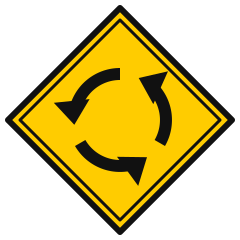
  5. What does this sign warn you about?

    Yellow diamond with three black arrows arranged in a circle
    1. A U-turn area ahead
    2. A roundabout ahead
    3. A parking lot entrance
    4. A detour around a closure
  6. A school bus ahead turns on alternating flashing amber lights. What does this mean?

    1. Pass quickly before it stops
    2. Be prepared to stop; it is about to stop
    3. Children have finished boarding and it will leave
    4. The bus is out of service
  7. A driver is tailgating you. What does the handbook suggest?

    1. Speed up to pull away
    2. Brake sharply to warn them
    3. Slow down slightly to add space in front
    4. Move closer to the car ahead to block them
  8. In an emergency stop with anti-lock brakes (ABS), how should you brake?

    1. Pull the parking brake hard
    2. Brake lightly and let go repeatedly, like pumping
    3. Firm, steady pressure until the vehicle stops
    4. Pump the brake pedal quickly
  9. The road is slippery and uneven. What following distance should you keep?

    1. At least 4 seconds
    2. At least 1 car length
    3. At least 3 seconds
    4. At least 2 seconds
  10. At a two-way stop, which traffic has the right-of-way?

    1. Whoever is turning right
    2. Traffic on the stop sign street
    3. The vehicle that has waited longest
    4. Traffic on the through street
  11. Which lane should you normally travel in on a multi-lane highway?

    1. The lane next to the shoulder only when slow
    2. Whichever lane is emptiest
    3. The far left lane
    4. One of the right-hand lanes
  12. You have just passed a large truck. When is it safe to move back into its lane?

    1. As soon as your rear bumper clears the front of its cab
    2. When the truck driver flashes high beams
    3. When you are one car length ahead of it
    4. When you see its headlights in your rear-view mirror
  13. Which surfaces tend to ice up before other parts of the road?

    1. Roads in direct sun
    2. Freshly paved roads
    3. Gravel shoulders
    4. Bridges and overpasses
  14. The handbook notes a law about headlights on Yukon highways. What is it?

    1. Headlights must be on at all times
    2. Headlights are needed only after dark
    3. Headlights are needed only in winter
    4. High beams must be used at all times
  15. A car is coming straight at you in your lane. What should you try to do?

    1. Brake hard and hold your lane
    2. Steer to the side to avoid a head-on crash
    3. Speed up to pass it quickly before it reaches you
    4. Swerve into the oncoming lane
  16. You are on a narrow road behind a cyclist with a single solid yellow centre line. May you cross it to pass the cyclist?

    1. No, solid lines can never be crossed
    2. Yes, if you can do it safely
    3. Only on roads posted above 70 km/h
    4. Only if the cyclist waves you on
  17. A school bus ahead has flashing red lights and its stop sign swung out. You are coming toward it on an undivided road. What must you do?

    1. Stop
    2. Slow down and pass with care
    3. Sound your horn and proceed
    4. Stop only if behind the bus
  18. You see a vehicle stopped at a crosswalk in the lane beside you. What should you assume?

    1. The driver is waiting to park
    2. The driver has broken down
    3. The light ahead has turned red
    4. A pedestrian is trying to cross
  19. You are in the lane closest to a tow truck stopped on the shoulder with amber lights flashing. What should you do?

    1. Stop behind the tow truck
    2. Slow down and change lanes if traffic permits
    3. Sound your horn as you pass
    4. Keep your speed and stay in your lane
  20. You are judging a gap to go straight across a road at a stop sign. How much time does the handbook say you need for each lane?

    1. About two seconds per lane, plus two seconds for safety
    2. About five seconds per lane, with no extra time for safety
    3. About seven seconds, whatever the width
    4. About one second per lane, plus one second
  21. Where are turn control signs mounted?

    1. Directly above the intersection
    2. On the median after the intersection
    3. Painted on the pavement in each lane
    4. On the right shoulder 100 m before
  22. You see this sign on a rural Yukon highway. What should you do?

    Yellow diamond with a black deer
    1. Pull over to view wildlife
    2. Stop at the next rest area
    3. Use your horn to scare animals
    4. Watch for deer ahead
  23. What does this sign tell you to expect?

    Yellow diamond with a truck on a slope
    1. A runaway lane on the right
    2. A truck stop ahead
    3. Trucks must use the right lane
    4. A steep hill ahead, so slow down
  24. A rider ahead is struggling to control a horse near the road. What should you do?

    1. Flash your high beams
    2. Pass quickly to get by before it bolts
    3. Pull over to the shoulder and stop
    4. Honk to warn the rider
  25. You notice a car close behind you. What following distance does the handbook suggest you keep from the vehicle ahead?

    1. Exactly 3 seconds
    2. At least 4 seconds
    3. At least 2 seconds
    4. At least 6 seconds
  26. What shape and colour are most warning signs?

    1. Orange and triangular
    2. Yellow and diamond-shaped
    3. Green and square
    4. White and rectangular
  27. What does the handbook say about driving with snow or frost on your windows?

    1. It is fine if the windshield is clear
    2. It is allowed at low speeds
    3. It is illegal only on highways
    4. It is illegal unless your windows are clear
  28. You see this sign in a work zone. What does it require of you?

    Orange diamond with a person digging
    1. Stop until a worker waves you on
    2. Obey the posted speed limit; a crew is working
    3. Drive on the shoulder past the crew
    4. Use only the left lane until the end of the zone
  29. What does this sign warn you about?

    Yellow diamond with a straight black arrow and a curved line joining it from the left
    1. A sharp turn to the left
    2. A road that ends ahead
    3. Merging traffic ahead
    4. A lane reserved for buses
  30. You see a hazard ahead but do not need to stop yet. What should you do with your right foot?

    1. Press harder on the gas to get past it sooner
    2. Take it off the gas and cover the brake
    3. Pump the brake quickly
    4. Rest it on the floor

About this practice test

How many questions are in Yukon Class 7 practice test 11?

30 original multiple-choice practice questions covering warning, construction and railway signs, weather, night driving and emergencies, sharing the road, see-think-do: observation, speed and space, intersections and right-of-way, lanes, turns and passing, regulatory, lane use and parking signs. Each answer includes an explanation. This mixed practice set does not reproduce the official exam format or predict an official score.

Are the questions the same every time?

Yes. Practice test 11 always has the same 30 questions, so you can repeat it until you get them all right. The other 11 sets use different questions.

Are these real test questions?

No. The official question bank is not published. These are original questions written from the official handbook, which is what the real Yukon Class 7 test is based on.