You are using high beams and a vehicle is approaching. Within what distance must you dim them?
Yukon Class 7 overview
Yukon Class 7 Practice Test 10
30 questions on weather, night driving and emergencies, lanes, turns and passing, regulatory, lane use and parking signs, sharing the road, intersections and right-of-way and more.
- No sign-up
- Every answer explained
- Independent · not a government site
- Set 10 of 12
- 30 questions
- Instant feedback
0/30
All 30 questions in this test
Every question and its answer choices. The correct answers and explanations appear when you take the test above.
You are using high beams and a vehicle is approaching. Within what distance must you dim them?
- 300 metres
- 100 metres
- 150 metres
- 500 metres
You are turning left from a two-way road onto a one-way road. Where should you end up?
- In any lane, then change lanes
- In the centre lane of the one-way road
- In the right lane of the one-way road
- In the left lane of the one-way road
What does a no-stopping sign tell you?
- No stopping for the next 100 metres only
- No stopping except to drop off passengers
- No stopping between it and the next no-stopping sign
- No stopping on the opposite side of the street
How far back should you stay when following a fire truck?
- At least 75 metres
- At least 50 metres
- At least 300 metres
- At least 150 metres
You are approaching this sign at an intersection. What does it require?

- Give way only to vehicles turning left
- Speed up to merge ahead of cross traffic
- Give the right-of-way to vehicles and pedestrians
- Stop completely every time you reach it
A traffic control person is directing traffic at an intersection with working lights. Whom do you obey?
- The vehicle ahead of you
- The traffic lights
- The traffic control person
- Whichever signal is safer
What does this sign warn you about?
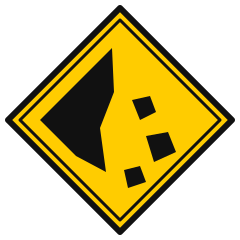
- Rocky soft shoulders ahead
- Falling rocks, and rocks on the road ahead
- Loose gravel from construction
- A landslide that has closed the whole road ahead
A front tire blows out at highway speed. What will the vehicle tend to do?
- Stop suddenly
- Pull toward the side of the flat tire
- Speed up on its own
- Pull away from the side of the flat tire
A passing lane on the highway is about to end. What does the handbook say?
- Trucks must stop to let cars merge
- Faster vehicles must exit at the end
- The left lane always has the right-of-way
- Drivers in both lanes must merge before it ends
You are on a one-way road and see this sign. What does it warn you about?

- A passing lane ahead
- A traffic circle ahead
- A one-way road ahead
- Two-way traffic ahead
The Yukon handbook says you can read any sign in three ways. What are they?
- Its shape, its border and its post
- Its shape, its colour and its message
- Its colour, its distance and its lighting
- Its height, its size and its location
A lane is closed ahead in a construction zone. When should you merge?
- As soon as you can
- After passing the first cone
- At the last possible moment
- Only when a worker tells you
You are going straight through an intersection and a vehicle from the other direction is already in the intersection turning left. What should you do?
- Keep going; you have the right-of-way
- Yield to the turning vehicle
- Swerve to its right without slowing
- Flash your lights so they wait
When you follow a truck or bus, how can you tell you are out of the driver's blind spot?
- You can read its licence plate
- You are within two car lengths
- Its brake lights are visible
- You can see both of its side mirrors
Your car starts to hydroplane on standing water. What should you do?
- Steer sharply toward the shoulder to find grip
- Speed up to get through
- Slow down, drive straight and don't brake
- Brake hard to stop quickly
What does this sign tell you?

- The right lane ends ahead
- A passing lane begins ahead
- The road narrows on both sides
- Traffic merges from the right
You face a yield sign and there is no traffic or pedestrian on the through road. What may you do?
- Stop for three seconds first
- Wait for a vehicle to wave you on
- Enter without stopping
- Stop only if a sign says so
You are following a large truck that blocks your view ahead. What following distance should you allow?
- At least 1 second
- At least 2 seconds
- At least 4 seconds
- At least 3 seconds
At a four-way stop, who goes first?
- The largest vehicle at the stop
- The first vehicle to arrive and stop
- The vehicle going straight through
- The vehicle on the left side
You stop to help at a crash scene. What should you not allow?
- Anyone staying with the injured
- Anyone calling for emergency help
- Anyone smoking or lighting matches
- Anyone setting out warning triangles
You see this sign along the curb. What does it mean?
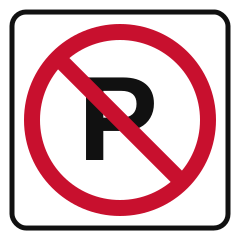
- Parking for one hour during posted times
- No stopping at any time on this block
- Parking only for people with disabilities who have a permit
- No parking between here and the next sign or intersection
Why should you avoid turning your signal on too early?
- It cancels your brake lights
- It wears out the signal bulb
- It is only legal within 10 m of the turn you'll make
- Others may expect you to turn at an earlier road
According to the handbook, on average what share of drivers killed in Yukon are impaired?
- About 50 per cent
- About 25 per cent
- About 75 per cent
- About 10 per cent
An emergency vehicle with flashing lights and siren is behind you. What should you do?
- Speed up to stay ahead of it
- Pull over to the right and stop
- Stop at once in your lane
- Pull over to the left and keep going
How far should you turn your head for a shoulder check?
- A full 180 degrees to the rear
- At least 10 degrees, either side
- Just enough to see your side mirror on that side
- At least 45 degrees, toward where you will move
A signal lights ahead sign has its own lights flashing. What should you do?

- Speed up before the light changes
- Treat the signal ahead as a yield
- Turn on your hazard lights
- Prepare to stop at the signal ahead
You carry a load that sticks out past the back of your vehicle. What must you attach to its end?
- An orange triangle
- A white reflector
- A flashing yellow light
- A red flag
You turn left onto a road that has a centre turning lane. How should you complete the turn?
- Turn into the centre lane and stay there
- Stop in the centre lane, then merge
- Drive in the centre lane until a gap opens
- Arc into the travelled lane, not the centre lane
Where is a U-turn illegal in Yukon?
- At any intersection with a stop sign
- At an intersection with a traffic light
- On any street with parked cars
- On any rural road
Under Yukon law, when is it illegal to smoke in a vehicle?
- When any passenger is under 18
- Only while the vehicle is moving
- Only in government vehicles
- When any passenger is under 12
All Yukon Class 7 practice tests
- Yukon Class 7 Mock Exam 1 – 30 QuestionsUntimed practice · answers explained
- Yukon Class 7 Mock Exam 2 – 30 QuestionsUntimed practice · answers explained
- Yukon Class 7 Mock Exam 3 – 30 QuestionsUntimed practice · answers explained
- Yukon Class 7 Mock Exam 4 – 30 QuestionsUntimed practice · answers explained
- Yukon Class 7 Mock Exam 5 – 30 QuestionsUntimed practice · answers explained
- Regulatory, lane use and parking signsSign shapes and colours, stop and yield, speed, do not enter, one way, keep right, no passing, winter tire signs, lane use and turn control signs, parking and reserved lane signs.
- Crosswalk, school and playground zone signsCrosswalk signs, fluorescent yellow-green school signs, the 30 km/h playground zone that applies around the clock, and school zone hours on school days.
- Warning, construction and railway signsYellow diamond warning signs, object markers, orange construction signs, information signs, railway crossing signs and the slow-moving vehicle sign.
- Traffic lights and lane control signalsSteady, flashing and arrow lights, stale green lights, turning on red, advance left-turn arrows, transit signals and lane control signals.
- Road markingsYellow and white lines, passing rules by line type, reversible and two-way left-turn lanes, stop lines, crosswalks, reserved lane diamonds and bicycle lanes.
About this practice test
How many questions are in Yukon Class 7 practice test 10?
30 original multiple-choice practice questions covering weather, night driving and emergencies, lanes, turns and passing, regulatory, lane use and parking signs, sharing the road, intersections and right-of-way, warning, construction and railway signs, see-think-do: observation, speed and space, impairment and high-risk behaviour, you and your vehicle. Each answer includes an explanation. This mixed practice set does not reproduce the official exam format or predict an official score.
Are the questions the same every time?
Yes. Practice test 10 always has the same 30 questions, so you can repeat it until you get them all right. The other 11 sets use different questions.
Are these real test questions?
No. The official question bank is not published. These are original questions written from the official handbook, which is what the real Yukon Class 7 test is based on.