
Road work has closed the street ahead and you see this sign. What should you do?
SAAQ Class 5: Road work, information and cyclist signs
Orange work-site signs, flagperson signals, work-zone speed limits, detours and lane merges, green and blue guide and service signs, exit signs, and signs for cyclists.
- No sign-up
- Every answer explained
- Independent · not a government site
- 15 questions
- Topic drill
Study reference: SAAQ Driver's Handbook (2nd edition), Ch. 3 Road Signs and Traffic Signals — Road work signs, information signs, signs for cyclists, pp. 169–211
All 15 questions in this test
Every question and its answer choices. The correct answers and explanations appear when you take the test above.
Road work has closed the street ahead and you see this sign. What should you do?
- Drive through slowly with hazards on
- Wait until the workers let you pass
- Take any side street you like
- Follow the marked route around the work
In a work zone you see an orange sign showing a speed limit. How does it compare with a normal white speed sign?
- It has the same force of law
- It is only a suggested speed
- It applies only when workers are visible
- It applies only to heavy trucks
At a work site, the traffic light facing you is green, but a flagperson signals you to stop. What must you do?
- Stop only if workers are on the road
- Sound your horn and go slowly
- Stop as the flagperson signals
- Proceed because the light is green
A steep hill warning sign for cyclists is posted ahead. What grade does it indicate?
- Greater than 8%
- Greater than 10%
- Greater than 6%
- Greater than 4%
On Québec information signs, which colour is reserved for highway exits?
- Blue
- Yellow
- Red
- Brown
A farm vehicle displays this sign on its rear. What does the sign tell other drivers?

- It carries hazardous materials
- It is wider than one lane
- It travels at less than 60 km/h
- It travels at less than 40 km/h
You are on a highway in the lane under this sign. What does it mean for you?
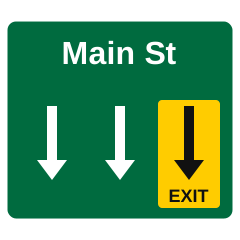
- Your lane must take the exit
- Your lane is for trucks only
- Your lane ends after the exit
- Your lane continues past the exit
On a Québec highway, how many signs announce an exclusive exit lane so drivers can change lanes in time?
- A single sign at the exit
- A pair of signs
- A sequence of three signs
- A sequence of five signs
What does this orange sign warn you about?

- A playground is nearby
- Snow removal is not allowed
- Road work is under way ahead
- A farm crossing is ahead
A sign shows that children must ride with an adult. Which cyclists does this rule cover, and on which roads?
- Under 14, on roads posted over 50 km/h
- Under 12, on roads posted over 70 km/h
- Under 16, on any public roadway
- Under 12, on roads posted over 50 km/h
What information does this orange sign give you?
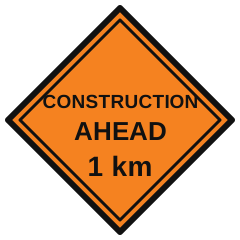
- How far away the work site is
- How long the work site is
- How long the work will last
- The speed limit in the work zone
You see this sign on your way into a work zone. What does it warn you about?

- A school crossing guard is ahead
- A flagperson is directing traffic ahead
- A parade route is ahead
- A railway crossing is ahead
You are caught speeding inside a road construction zone marked by signs. How is the fine affected?
- The fine amount is doubled
- Only demerit points are added
- The fine amount is tripled
- The fine stays the same
What does this orange sign tell you to do?
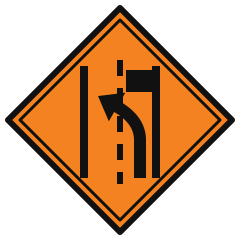
- Use the shoulder to pass the work
- Turn around at the next exit
- Move into the lane that remains open
- Stop and wait for a flagperson
What does this green highway sign tell you?
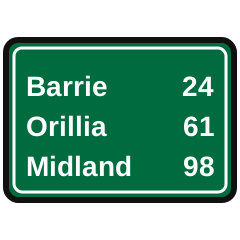
- Populations of each place
- Exit numbers for each place
- Speed limits toward each place
- Distances to the places listed
Road work, information and cyclist signs: key rules to remember
Our summary of what the official handbook says on this topic, in our own words. Read it before or after the practice questions above, then check the original chapter. Read the official chapter ↗
Sign colours (context)
- Orange = road work; yellow = danger warnings; green, brown or blue = information signs.
Road work signs
- Work site signs have an orange background and can be regulatory, information or warning signs.
- Barriers close part or all of a road at the start of a work site.
- Visual markers (direction markers, cones, flares, barrels) show work-site boundaries and lane narrowing, the direction to follow, road painting, or direct traffic.
- Signs give the distance to a work site, the length of the work site in kilometres and the end of the work site.
Work-zone speed limit
- Orange speed limit signs show the maximum speed near a work site and carry the same legal force as the equivalent white sign (yellow signs only recommend a speed).
- Fines for any speeding offence in a road construction zone marked by signs and signals are doubled.
- A diamond-shaped sign announces the new speed limit ahead.
Advance road work signs
- Show a work site ahead and the type of work (road work, equipment above the road, surveying, work on an exit ramp, heavy machinery, length of the site, grader or snowblower in or near a lane, emergency response team).
- A sign on an accompanying vehicle warns of stopped traffic ahead due to work or lane changes; another sign shows a road closed for a sporting event.
Flagperson
- A flagperson uses a two-sided sign (front and back) to direct traffic near a work site; a flag may also be used to slow or stop traffic.
- Flagperson signals shown: stop, proceed, slow down. (The drawings are not described in words; gestures not noted.)
- Flagperson-ahead sign: extreme caution; traffic may be slowed, detoured or stopped because of workers and machinery; a flagperson's orders must be obeyed.
Parking, closures, merges, detours
- Temporary no-parking signs for road work, events or maintenance; may give times, days and area.
- Signs for an area ahead temporarily closed, and for an area closed (with a detour sign).
- Local traffic only: closed to everyone except local residents and business customers; may list services still open.
- Lane merge: one lane temporarily closed; use the lane that stays open.
- Detour: route to follow around a work site; advance detour signs for a closed lane or exit.
- Alternate route: suggested route because work ahead may cause congestion.
- Directional arrow: before road work, shows which way to change lanes or roadways.
Other work-site warnings
- Warning chevron: obstacle on the road that may be passed on the left or right.
- Low shoulder: shoulder lower than the roadway.
- Blasting zone: turn off radio transmitters and cell phones.
- Wet paint: mainly on accompanying vehicles; pavement markings being painted.
- Traffic survey staff on the road; horizontal clearance narrower than the width shown; loose gravel may be thrown; loaded trucks entering from an access road; temporary use (or ban) of the shoulder; duration of work; lane diverted.
Destination guide signs
- Six types of information signs: destination guide, route locator, nearby services, information, tourist facilities, fuel and food on highways.
- Advance sign for a municipality with several exits shows the number of exits or the last exit; succession-of-exits sign gives distance to each upcoming exit.
- Advance exit sign: connecting road number, main destinations, exit number and distance to the exit.
- Exit direction sign repeats the advance sign; its arrow marks the start of the deceleration lane.
- Exit lane only: traffic in that lane must exit. Exclusive exit lanes are always shown by a series of three signs (advance exit, exit direction, exit confirmation) so drivers can change lanes in time.
- Exit confirmation: start of the exit ramp, its direction and exit number.
- Directional sign: main destinations reachable from each branch of the intersection. Distance reminder: distance to the destinations listed.
Route locators
- Route markers for numbered roads, highways, the Trans-Canada, highway names and road names; highway access signs; tourist routes.
- Border signs: one type at the Québec border on roads numbered 100–199, highways and international airport exits; another on roads numbered 200–399 or unnumbered roads.
- Compass-point signs show the general direction of the road and may have a blue background.
- Kilometre post: distance from the starting point of the road or highway.
Services
- Hospital sign: emergency services 24 hours a day, 7 days a week. Also CLSC, emergency parking, emergency telephone, fire hydrant, police stations (Sûreté du Québec or other).
- Distressed vehicle detector: lights up only right after a crash (e.g. a vehicle went through a barrier into a deep ditch on an isolated road); act immediately to help and notify police.
Information signs
- Turnaround: median area only for U-turns.
- Priority turn on flashing green light: the green includes a flashing phase giving priority to turning vehicles.
- Push-button sign: pedestrians or cyclists press the button to get a crossing signal.
- Metric sign: tells U.S. visitors Québec signs are metric.
- Aircraft patrolled sign; runaway lane with arrester bed for vehicles with failed brakes; passing lane; road without services (distance to the next gas stations); exclusive towing company; photo radar / photographic traffic control surveillance.
Tourist and fuel signs
- Government rest areas show a fleur-de-lys; municipal ones say "Halte municipale" instead; may show the distance to the next two rest areas.
- Fuel letters: D = diesel, N = natural gas, P = propane (with 24 h if open around the clock).
Signs for cyclists
- Cyclists may ride on most Québec roads, except highways.
- Four types of cycling facilities: paved shoulders (marked with a solid white line, ride with traffic), shared roadways (light, slow traffic; signs only), bike lanes (part of the roadway, marked or separated, cyclists only), bike paths (cyclists only, often away from traffic).
- Bicycle tab: the regulatory sign applies to cyclists only.
- Children must ride with an adult: cyclists under 12 need an adult with them on a public road whose posted limit is over 50 km/h.
- Cyclist no-passing sign: no riding side by side; start of the zone (separate sign for the end).
- Bicycle symbol at a pedestrian light: cyclists cross on the walk signal.
- Steep uphill/downhill signs: grade over 6% (6 m rise or drop per 100 m).
- Bicycle crossing / bicycles ahead warning; with a tab, cyclists on a paved shoulder along a cycling route.
- Route verte: provincial cycling route over 5,000 km (off-road paths, paved shoulders, quiet roads).
Highway Safety Code provisions
- Only the body maintaining a public road may put up signs or signals, to Ministère des Transports standards.
- Forbidden: putting up a sign on a public road without authorization; displaying one on private property that encroaches on the road, causes confusion or blocks an official sign; driving across private property to avoid a sign or signal.
- Everyone must obey signs and signals, and must obey a peace officer, school crossing guard or work-site flagperson even when their orders contradict the signs or signals.
Slow-moving vehicle sign
- Any road vehicle travelling under 40 km/h must display the orange triangle warning sign (p. 220: orange triangle with reflective dark red edges).
Study the Road work, information and cyclist signs rules as flashcards →
Other topics
- Traffic lights and signal lightsRed, yellow and green lights, arrows, flashing lights, dark signals, pedestrian countdown lights, cyclist lights, lane-use lights, railway signals, work-site lights and bus priority lights.
- Pavement markingsYellow and white lines, broken, solid, double and combined lines, reversible and two-way left-turn lanes, reserved lanes, stop lines, crosswalks, parking markings and pavement symbols.
- Regulatory signsSign colours and shapes, stop, all-way stop and yield signs, speed limits, one-way and lane direction signs, green-circle and red-circle signs, no passing, parking, stopping and reserved-lane signs.
- Warning signsYellow diamond signs for stops and lights ahead, curves, intersections, lane endings, narrowing roads, steep grades, school zones, crossings, slippery or icy surfaces, hazard markers and chevrons.
- Getting your Class 5 licenceMinimum age, the mandatory driving course, the learner's licence and its rules, when you can take the knowledge and road tests, the probationary licence and passenger limits for young drivers.
- Licence conditions and driver obligationsHealth declarations and licence conditions, documents you must carry, change of address, renewal, new residents and non-residents driving in Québec.
- Demerit points and licence revocationDemerit point brackets by licence and age, revocation periods, how long points stay on your record, restricted licences, and the points for common offences.
- Alcohol, drugs and impaired drivingBlood alcohol limits, the zero-alcohol rule for new and young drivers, drug limits, care or control of a vehicle, roadside suspensions, vehicle impoundment and the cost of a first offence.
- Vision, fatigue, distraction and attitudeHow vision, physical problems, fatigue and emotions affect driving, the ban on hand-held electronic devices and its penalties, observation, and keeping your judgment in traffic.
- Your vehicle: registration, equipment and winter tiresVehicle registration and insurance, required lights, brakes, mirrors and windows, studded and winter tire dates, clearing snow, mechanical inspection and doing your own checks.
- Seat belts, lane use and speed limitsSeat belts and child car seats, air bags and headrests, which lane to use, centre left-turn lanes, Québec's default speed limits and safe following distance.
- Passing, turning and traffic circlesWhen passing is allowed or banned, passing cyclists and pedestrians, right and left turns, right turns on red and the Montréal exception, traffic circles, signals and headlight use.
- Right of way, emergency vehicles and school busesYielding to pedestrians and cyclists, stop signs and all-way stops, entering highways and driveways, emergency vehicles, the Move-Over law, city buses, school buses, level crossings and heavy vehicles.
- Work zones, stopping, parking and unlawful practicesDriving near work sites, parking and stopping distances, disabled parking permits, driving on the shoulder, passengers and seat belts, car surfing and street racing.
- Pedestrians, cyclists and motorcyclesRules for pedestrians, cyclists and power-assisted bicycles, foot scooters, motorcycles, mopeds and scooters, and what drivers must do around them.
- Accidents, insurance and finesQuébec's public no-fault insurance, mandatory liability insurance, what to do at the scene of an accident, and fines for common offences, speeding and work-zone speeding.