SAAQ Knowledge Test Practice – Printable PDF
100 original SAAQ Class 5 practice questions from all three sections of the knowledge test, with the answer key on separate pages. Print or save as a PDF.
- No sign-up
- Every answer explained
- Independent · not a government site
- 100 questions
- Answer key included
- Free, no sign-up
Some people prepare best on paper, away from a screen. This page lays out 100 SAAQ Class 5 practice questions you can print or save as a PDF, drawn evenly from all 17 topics in our bank, so the sheet covers the three sections of the real test: the Highway Safety Code, road signs, pavement markings and traffic signals, and safe driving behaviours. The answer key starts on a new page after question 100, so you can work through the questions before you see a single answer.
Every question was written by us from the SAAQ Driver's Handbook, and the key gives the correct choice, a short explanation and the handbook page behind it. The SAAQ does not release its own test questions, so no PDF circulating online is the actual exam. What the SAAQ does publish for free are its study guides: the Driver's Handbook, Driving a Passenger Vehicle and the Guide to Knowledge Test Illustrations. Mark your sheet by section, because on test day you need 75% in each one, then go back to the topic tests for your weakest section and finish with a 30-question mock exam.
SAAQ Knowledge Test Practice – Printable PDF
1.You merge onto the highway and accelerate to cruising speed. What happens to your field of vision?
- It widens only to the sides
- It becomes narrower
- It stays exactly the same
- It becomes wider
2.You see this sign. When you reach the circle, who has the right of way?
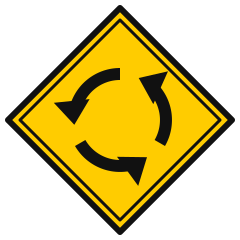
- Vehicles coming from your right
- Vehicles about to enter it
- Vehicles already in the circle
- The larger of the two vehicles
3.You refuse to blow into a screening device when a police officer orders you to. What happens immediately under the Highway Safety Code?
- 24-hour suspension and no impoundment
- 90-day suspension and 30-day impoundment
- 7-day suspension and 7-day impoundment
- A fine only, with no suspension
4.What does this orange sign tell you to do?
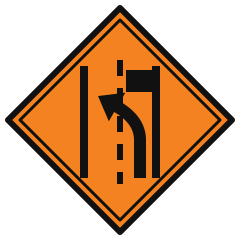
- Use the shoulder to pass the work
- Turn around at the next exit
- Move into the lane that remains open
- Stop and wait for a flagperson
5.What is the minimum time you must hold a learner's licence before you are eligible for the road test?
- 18 months
- 8 months
- 6 months
- 12 months
6.A driver is caught at 120 km/h in a 70 km/h zone, which counts as excessive speeding. What is the fine?
- $795
- $530
- $315
- $265
7.You have just moved to Québec from another province and brought your car with you. How long do you have to apply to register it in Québec?
- One year after you arrive
- Six months after you arrive
- 30 days after you arrive
- 60 days after you arrive
8.You pass a school bus that has its flashing lights on. How many demerit points can this offence cost you?
- 9 points
- 4 points
- 12 points
- 3 points
9.Which simple method can you use to judge whether you are leaving a safe gap behind the vehicle ahead?
- The car-length-per-10 km/h rule
- The two-second rule
- The five-metre rule
- The one-second rule
10.A solid yellow line separates your lane from oncoming traffic. You want to turn left into a private driveway. What is the rule?
- You must drive to an intersection first
- You may cross the line to make the turn
- You may cross only if a sign allows it
- You must make a U-turn further on
11.While riding a bicycle, may you listen to music with headphones?
- Yes, with one earphone
- Yes, at low volume
- No, no headphones at all
- Yes, on bike paths only
12.On a street posted at 50 km/h, you come up behind a group of cyclists in your lane. When may you pass them without leaving that lane?
- When the group has fewer than 15 riders
- When you can keep 50 cm away
- Never, unless a peace officer allows it
- After slowing, if you can keep 1 m away
13.At an intersection you see a set of three vertical lights shaped like red, yellow and green bicycles. Who do they control, and what do the colours mean?
- Pedestrians walking a bicycle across
- Cyclists; colours mean the same as traffic lights
- All vehicles; they replace the main lights
- Cyclists; green means stop and look first
14.You just moved to Québec from Ontario and hold a valid Ontario licence. How long may you drive a car on it?
- Thirty days
- Three months
- Six months
- Twelve months
15.You are on a road with a reversible lane. A red X is lit above the centre lane. What does it mean?
- That lane is closed for repairs today
- That lane is reserved for oncoming traffic
- You may use it only to turn left
- You may use it if you drive with care
16.How many earphones may you wear while driving in Québec?
- One at most
- Two, if the volume is low
- None at all
- Two, for hands-free calls only
17.You see this panel at the edge of the road. What does it warn of?

- Road work starting just ahead
- The end of the paved surface
- A sharp curve ahead to the right
- An obstacle on or beside the roadway
18.A driver is convicted of using a hand-held device for the third time within two years (a second repeat offence). How long is the licence suspended?
- 3 days
- 7 days
- 30 days
- 90 days
19.You are driving at night with high beams on. When must you switch to low beams for an oncoming car?
- Within 60 metres of it
- Within 150 metres of it
- Only when it flashes its lights
- Within 300 metres of it
20.One prescribed limit combines 2.5 ng of THC per ml of blood with alcohol. At what blood alcohol level does it apply?
- 50 mg per 100 ml or more
- 30 mg per 100 ml or more
- 20 mg per 100 ml or more
- 80 mg per 100 ml or more
21.On a Québec highway, how many signs announce an exclusive exit lane so drivers can change lanes in time?
- A single sign at the exit
- A pair of signs
- A sequence of three signs
- A sequence of five signs
22.After you pass the road test, how long must you hold a probationary licence before you can get a regular driver's licence?
- 12 months
- 36 months
- 18 months
- 24 months
23.What fine range applies to a driver who does not wear a properly fastened seat belt?
- $100 to $200
- $200 to $300
- $300 to $600
- $80 to $100
24.You want to add a tinted sun strip along the top of your windshield. What is the maximum width allowed?
- 20 cm
- 15 cm
- 10 cm
- 25 cm
25.You are caught driving at 95 km/h in a 70 km/h zone. How many demerit points does this offence carry?
- 2 points
- 1 point
- 3 points
- 4 points
26.You are driving on a paved country road where no speed limit sign is posted. What is the maximum speed?
- 100 km/h
- 70 km/h
- 90 km/h
- 80 km/h
27.A reserved lane is marked with double broken lines instead of double solid lines. What does that tell you?
- It is reserved only during certain hours
- It is reserved at all times
- It may be used by any car to pass
- It is closed to buses and taxis
28.A cyclist ahead of you holds the left forearm straight up at a right angle. What is the cyclist signalling?
- A left turn
- A lane change to the left
- A stop
- A right turn
29.You are following a large truck and cannot see either of its side mirrors. What does this mean?
- The mirrors are folded in
- You are at a safe distance
- The truck driver can see you
- You are too close to the truck
30.You approach an intersection with a flashing red light and a stop sign. What must you do?
- Stop only if cross traffic is present
- Wait until the light turns solid green
- Stop completely, then yield before going
- Slow down and go if nobody is coming
31.You drive without liability insurance and cause an accident with more than $500 in property damage. What can happen?
- Two demerit points on your record
- A $100 fine with no suspension
- A warning letter and nothing more
- Licence suspension until damage is covered
32.You are driving on a one-way street and pass this sign. What does it mean?
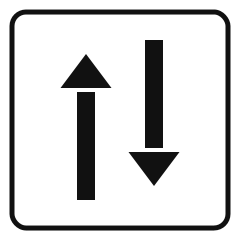
- One-way traffic ends and two-way begins
- Keep right to let faster cars pass
- The street ahead is closed to traffic
- You must turn around and go back
33.You need to run into a store for a minute. Your child is 5 years old. What does the law say?
- You may leave them if the car is locked
- You may not leave the child alone in the car
- You may leave them for up to 5 minutes
- You may leave them with the engine running
34.What does this sign require of you?

- Stop and yield to oncoming vehicles
- Merge left because a lane is ending
- Move onto the shoulder to make room
- No special move, just extra alertness
35.Which of these may a driver legally use while driving?
- A tablet resting in the driver's hand
- A portable satellite radio held in hand
- A dash-mounted CB radio with a hand microphone
- An MP3 player held to change songs
36.You want to pass a slow car, but the driver behind you has already signalled to pass you. What should you do?
- Wait; you may not start your pass
- Pass if you signal right away
- Pass first, since you were ahead
- Speed up to block the other driver
37.For a driver aged 16 to 19, a BAC of just 0.03 raises the risk of a fatal crash by how much?
- Three times
- Two times
- Five times
- Ten times
38.What does this green highway sign tell you?
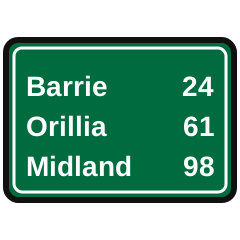
- Populations of each place
- Exit numbers for each place
- Speed limits toward each place
- Distances to the places listed
39.You are 17 and applying for your first licence. Besides your identification, what must you provide?
- Proof that you own a vehicle
- A signed note from your employer
- A letter from your high school
- Written consent from a parent or guardian
40.A police officer stops you because your 10-year-old passenger is not buckled up. What fine range do you face as the driver?
- $80 to $100
- $300 to $600
- $30 to $60
- $200 to $300
41.To register a vehicle and drive it on Québec's public roads, what is the minimum third-party liability insurance the owner must hold?
- $50,000
- $1,000,000
- $200,000
- $25,000
42.Maya is 21 and has just received her full Class 5 driver's licence. Which demerit point total would trigger revocation for her?
- 4 points
- 12 points
- 8 points
- 15 points
43.You are driving four adult friends to the cottage. Who in the car must wear a seat belt?
- Only you, as the driver
- Only the people in the front seats
- Everyone, in the front and the back
- Only you and the front passenger
44.Walking home, you notice the crosswalk at a corner with a stop sign is white, while one in the middle of the block is yellow. Why the difference?
- White marks crossings without a signal
- Yellow marks crossings without lights or stop signs
- White marks crossings used by cyclists
- Yellow marks crossings near schools only
45.A 15-year-old rides a moped. What rule applies to carrying passengers?
- They may carry a passenger aged 15 or older
- They may carry one passenger in daylight
- They may not carry any passenger
- They may carry a passenger with a helmet
46.On a multi-lane highway, a police car is stopped on the right shoulder with its lights flashing. What does the Move-Over law require?
- Move left only if you see an officer
- Stop on the shoulder behind it
- Stay in the right lane at full speed
- Slow down and move to the left lane if safe
47.Above your lane a red X is lit and next to it a yellow horizontal arrow is flashing. What is expected of you?
- Change lanes with care in the arrow's direction
- Stop and wait for the arrow to turn green
- Stay in your lane; the arrow is for trucks
- Speed up to clear the lane before it closes
48.At what age can the SAAQ require you to take a proficiency exam or undergo a health assessment because of your age?
- 75 or older
- 70 or older
- 65 or older
- 80 or older
49.What does this sign mean?
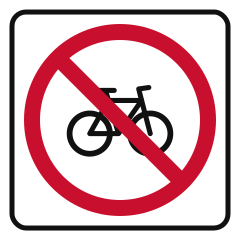
- This lane is reserved for bicycles
- A bicycle crossing is ahead
- Bicycles are not allowed on this road
- Cyclists must walk their bikes here
50.You are looking for a parking spot near a corner. How far from the intersection must you stay?
- At least 3 metres
- At least 8 metres
- At least 5 metres
- At least 10 metres
51.Signs like this one give the grade of the slope ahead. From what grade are they used?

- 12% or more
- 10% or more
- 3% or more
- 6% or more
52.While driving, you hold your cell phone in your hand, but it is switched off. How does the law treat this?
- It is allowed if you are not looking at it
- It is allowed because the phone is off
- It is allowed if it is in airplane mode
- You are presumed to be using it
53.On a 50 km/h street, oncoming traffic leaves you no room to give a cyclist the required space. What must you do?
- Pass slowly with whatever space you have
- Stay in your lane, slow down and wait behind
- Pass using the paved shoulder on the right
- Sound your horn so the cyclist moves over
54.Under the Criminal Code, you can be charged if your blood alcohol concentration is over what level?
- 0.10 (100 mg per 100 ml)
- 0.02 (20 mg per 100 ml)
- 0.05 (50 mg per 100 ml)
- 0.08 (80 mg per 100 ml)
55.On Québec information signs, which colour is reserved for highway exits?
- Blue
- Yellow
- Red
- Brown
56.You are 18, newly on a probationary licence, and want to drive four friends home at 1 a.m. When is this allowed?
- When someone licensed 2+ years sits in front
- When one passenger has a learner's licence
- When all passengers wear seat belts
- When you stay under the speed limit
57.A driver convicted of excessive speeding already has three earlier excessive-speeding convictions in the past 10 years. What happens to the fine?
- It is doubled
- It is tripled
- It stays the same
- It increases by $1,000
58.How many rearview mirrors must an ordinary car have, at a minimum?
- Two: one on each side of the car
- Three: inside and on both sides
- One: inside the car only
- Two: inside and on the driver's side
59.Your learner's licence is revoked because you reached 4 demerit points. What is the minimum time before you can get a new one?
- Three months
- Twelve months
- Six months
- One month
60.You are driving in a group of three cars on a road with a 90 km/h limit. What must the group do?
- Stay close so the group is not split up
- Leave room between cars so others can pass
- Keep below 70 km/h to stay together
- Drive in the left lane with hazard lights on
61.On a Québec road, what does a yellow line between two lanes tell you about the traffic in them?
- One lane is reserved for buses and taxis
- Both lanes go the same direction
- Traffic in them goes opposite ways
- The road is about to narrow
62.To count as a power-assisted bicycle, what limits must its electric motor meet?
- 750 W, assisting up to 40 km/h
- 1000 W, assisting up to 50 km/h
- 500 W, assisting no faster than 32 km/h
- 250 W, assisting up to 25 km/h
63.You missed your exit on the highway. Are you allowed to back up along the shoulder or the ramp?
- Yes, if traffic is light
- Yes, on the shoulder only
- No, reversing is banned there
- Yes, with your hazard lights on
64.A street has a no-parking sign for snow removal with orange lights attached. The lights are off. What does that mean?
- The rule applies only at night
- The sign's parking ban is not in effect
- Parking is banned all day until removal ends
- Only residents may park there
65.You move to a new apartment in another city. How long do you have to give the SAAQ your new address?
- 60 days
- 10 days
- 6 months
- 30 days
66.You see this sign at a street corner. What does it tell you?

- Traffic may move only in the arrow's direction
- Your lane ends; merge the way it points
- Two-way traffic is ahead on this street
- You must turn in the arrow's direction
67.You want to park on the side of the street directly across from a fire station. What is the minimum distance?
- 15 metres
- 8 metres
- 3 metres
- 5 metres
68.The advance level crossing sign is used where a railway crossing is close to an intersection. Within what distances?
- Under 50 m urban, under 125 m rural
- Under 100 m urban, under 250 m rural
- Under 50 m urban, under 150 m rural
- Under 30 m urban, under 100 m rural
69.Eighteen months after a first hand-held phone ticket, a driver is caught again. What applies for this first repeat offence?
- At least $1,000 and a 30-day suspension
- At least $600 and a 7-day suspension
- At least $600 and a 3-day suspension
- At least $300 and a 3-day suspension
70.No sign is posted at the intersection. Where in Québec are you still not allowed to turn right on a red light?
- In every school zone
- On every one-way street
- On the island of Montréal
- In Québec City
71.A probationary licence holder is caught driving after one beer. What Highway Safety Code penalty applies?
- 24-hour suspension and a warning
- 30-day suspension, 2 points, $100 fine
- 90-day suspension, 4 points, $300–$600 fine
- 7-day suspension, 3 points, $200 fine
72.A steep hill warning sign for cyclists is posted ahead. What grade does it indicate?
- Greater than 8%
- Greater than 10%
- Greater than 6%
- Greater than 4%
73.When you apply for a first driver's licence, how many pieces of identification must you present?
- Three
- Four
- One
- Two
74.A Québec resident is injured in a car crash that was partly their own fault. Who compensates them for their bodily injuries?
- Only the other driver, through a lawsuit
- No one, since they were partly at fault
- The SAAQ, regardless of fault
- The at-fault driver's private insurer
75.At a disaster site you notice an emergency vehicle showing a green flashing light. What does the green light indicate?
- A command post
- A tow truck at work
- An oversize load escort
- A snow removal vehicle
76.A 40-year-old driver reaches the 15-point bracket for the second time within two years. How long is the revocation?
- 12 months
- 6 months
- 3 months
- 24 months
77.How far back should you move the driver's seat to reduce the risk of injury if the air bag deploys?
- At least 25 cm from the air bag cover to your chest
- At least 15 cm from the air bag cover to your chest
- At least 40 cm from the air bag cover to your chest
- At least 10 cm from the air bag cover to your chest
78.A centre lane is bordered on each side by a solid and a broken yellow line, with yellow turn arrows painted in it. How may you use it?
- To park briefly for deliveries
- As a regular through lane
- Only to turn left, from either direction
- To pass slower vehicles in either direction
79.Your scooter has a 125 cc engine. Where are you not allowed to ride it?
- On city streets
- On roads posted at 70 km/h
- On rural roads at night
- On highways and their ramps
80.You are on a divided road with a raised median. A school bus on the other side has its red lights flashing. What must you do?
- Continue with care; you need not stop
- Stop at least 5 metres from the bus
- Stop until its lights turn off
- Slow to 20 km/h until you pass it
81.A yellow light is flashing over an intersection on your route. How should you proceed?
- Stop completely as at a stop sign
- Stop and wait for a green light
- Keep your speed; it only warns cross traffic
- Slow down and yield to anyone already crossing
82.Your doctor diagnoses a condition that could affect your driving. How soon must you tell the SAAQ?
- Within 7 days
- At your next renewal
- Within 90 days
- Within 30 days
83.At a red light you see a sign banning right turns on red, with a tab underneath listing certain hours. What does the tab mean?
- The ban is lifted on weekends only
- Right on red is allowed only in those hours
- The ban applies only during the hours shown
- Fines are doubled during those hours
84.A friend offers to lend you a radar detector for a road trip in Québec. What does the law say?
- Having one on board is prohibited
- It is legal if it is switched off
- It is legal outside city limits
- It is legal if mounted on the dash
85.You are in the right lane and see this sign. What must you do?

- Speed up to get ahead of the left lane
- Yield, then move into the remaining lane
- Stop at the end of the lane and wait
- Keep going; the left lane must let you in
86.You had a few drinks at a party. Which of these actually lowers the amount of alcohol in your body?
- Waiting for time to pass
- Going for a brisk walk
- Eating a large meal
- Taking a cold shower
87.On a multi-lane one-way road, when may you pass another vehicle on its right?
- When the right lane is moving faster
- When it has its hazard lights on
- When it is driving below the limit
- When it is turning left
88.A driver with no previous offence is caught with a BAC of 0.17. Besides the 90-day licence suspension, how long is the vehicle impounded?
- 90 days
- 30 days
- It is not impounded
- 7 days
89.You see this sign on your way into a work zone. What does it warn you about?

- A school crossing guard is ahead
- A flagperson is directing traffic ahead
- A parade route is ahead
- A railway crossing is ahead
90.You are 18 and have had your probationary licence for 4 months. At 1 a.m., how many passengers aged 19 or under (not family) may you carry?
- Three
- Two
- None
- One
91.An injured driver is sitting in a crashed car. There is no fire and traffic has been stopped. Should you move them?
- No, leave them where they are
- Yes, lay them flat on the road
- Yes, sit them on the shoulder
- Yes, move them into your own car
92.Between which dates may a passenger car in Québec be driven on studded tires?
- October 1 to April 30
- November 1 to April 15
- December 1 to March 15
- October 15 to May 1
93.Your licence is revoked for the first time because of demerit points, and driving is how you earn your living. How can you try to get a restricted licence?
- Pay a reinstatement fee at a service centre
- Take a defensive driving course
- File a motion with the Court of Québec
- Ask your employer to write to the SAAQ
94.This sign is posted on a Québec highway. Unless another speed is posted, what is the lowest speed you may travel there?
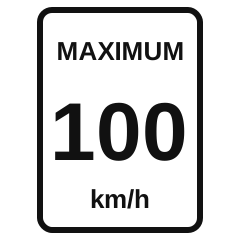
- 50 km/h
- 70 km/h
- 40 km/h
- 60 km/h
95.Diagonal broken white lines are painted inside a reserved lane just before an intersection. What do they allow drivers in the next lane to do?
- Enter it only to turn at the next corner
- Stop in it to drop off passengers
- Use it to pass slower traffic before the light
- Enter it whenever traffic is light
96.When must a motorcyclist have the white headlight on?
- Only on highways
- Only at night
- At all times while riding
- Only in rain, fog or falling snow
97.A fire truck with its siren on is approaching while you wait at an intersection. Which action should you avoid?
- Turning in front of it
- Reducing your speed
- Keeping to the right
- Stopping if necessary
98.You reach an intersection where the traffic lights are completely dark because of a power failure. No other sign or signal has been set up. How must you treat it?
- As if there were stop signs in every direction
- As if the lights were flashing yellow
- As if the main road had the right of way
- As an uncontrolled intersection with no rules
99.You are visiting Québec from another province with a valid licence. What is the longest you may drive without a Québec licence?
- Six consecutive months
- Three consecutive months
- As long as your licence is valid
- Twelve consecutive months
100.Which sign shape is reserved for marking school zones?
- Triangle
- Pentagon
- Diamond
- Octagon
Answer key with explanations
1. B — It becomes narrower
The faster a vehicle goes, the more your visual field shrinks, much like when you stare at a single object.
Vision, fatigue, distraction and attitude · Based on: SAAQ Driver's Handbook (2nd edition), Ch. 1 The Driver, p. 60
2. C — Vehicles already in the circle
This sign warns of a traffic circle ahead; before entering, you must yield to drivers already travelling in the circle.
Passing, turning and traffic circles · Based on: SAAQ Driver's Handbook (2nd edition), Ch. 4 Traffic Rules, p. 235
3. B — 90-day suspension and 30-day impoundment
Refusing an officer's order brings an immediate 90-day licence suspension and a 30-day vehicle impoundment (90 days for a repeat).
Alcohol, drugs and impaired driving · Based on: SAAQ Driver's Handbook (2nd edition), Ch. 1 The Driver, p. 56
4. C — Move into the lane that remains open
A lane merge sign means one lane is temporarily closed and drivers must use the lane that stays open.
Road work, information and cyclist signs · Based on: SAAQ Driver's Handbook (2nd edition), Ch. 3 Road Signs and Traffic Signals, p. 176
5. D — 12 months
You must hold a learner's licence for at least 12 months, and the road test requires that you have reached that minimum.
Getting your Class 5 licence · Based on: SAAQ Driver's Handbook (2nd edition), Ch. 1 The Driver, p. 17, 19
6. B — $530
At 50 km/h over the fine is $15 + 10 x $25 = $265, and it is doubled for excessive speeding, giving $530.
Accidents, insurance and fines · Based on: SAAQ Driver's Handbook (2nd edition), Ch. 5 Accidents, p. 305
7. B — Six months after you arrive
New residents must apply to register their vehicle within six months of settling in Québec.
Your vehicle: registration, equipment and winter tires · Based on: SAAQ Driver's Handbook (2nd edition), Ch. 2 The Vehicle, p. 75
8. A — 9 points
Failing to stop for a school bus or minibus with flashing lights or stop sign on, or passing it illegally, carries 9 demerit points.
Demerit points and licence revocation · Based on: SAAQ Driver's Handbook (2nd edition), Ch. 1 The Driver, p. 310
9. B — The two-second rule
The two-second rule helps you estimate a following distance that lets you stop safely if the vehicle ahead brakes suddenly.
Seat belts, lane use and speed limits · Based on: SAAQ Driver's Handbook (2nd edition), Ch. 4 Traffic Rules, p. 224
10. B — You may cross the line to make the turn
Solid lines generally may not be crossed, but the handbook allows crossing to turn left onto another road or into a private driveway.
Pavement markings · Based on: SAAQ Driver's Handbook (2nd edition), Ch. 3 Road Signs and Traffic Signals, p. 220
11. C — No, no headphones at all
Drivers may wear one earphone, but cyclists may not wear any type of headphones while riding.
Pedestrians, cyclists and motorcycles · Based on: SAAQ Driver's Handbook (2nd edition), Ch. 4 Traffic Rules, p. 265
12. D — After slowing, if you can keep 1 m away
Under the current rules, you may pass a group of cyclists in the same lane if you can do it safely after slowing down, keeping at least 1 m from them where the limit is 50 km/h or less (1.5 m above 50 km/h).
Right of way, emergency vehicles and school buses · Based on: SAAQ Driver's Handbook (2nd edition), Ch. 4 Traffic Rules, p. 237; Guide de la route 4th ed. (2024), p. 241
13. B — Cyclists; colours mean the same as traffic lights
Cyclist lights regulate bicycle traffic, and their red, yellow and green bicycles carry the same meanings as ordinary traffic lights.
Traffic lights and signal lights · Based on: SAAQ Driver's Handbook (2nd edition), Ch. 3 Road Signs and Traffic Signals, p. 107
14. C — Six months
A new resident with a valid licence may drive a passenger vehicle for six months before a Québec licence is required.
Licence conditions and driver obligations · Based on: SAAQ Driver's Handbook (2nd edition), Ch. 1 The Driver, p. 41
15. B — That lane is reserved for oncoming traffic
Overhead signals over a reversible lane show who may use it: a green arrow means you may, a red X means it is for traffic coming the other way.
Regulatory signs · Based on: SAAQ Driver's Handbook (2nd edition), Ch. 3 Road Signs and Traffic Signals, p. 132
16. A — One at most
Drivers may wear only one earphone; wearing two is not allowed.
Work zones, stopping, parking and unlawful practices · Based on: SAAQ Driver's Handbook (2nd edition), Ch. 4 Traffic Rules, p. 257
17. D — An obstacle on or beside the roadway
Hazard markers flag obstacles such as boulders or bridge railings; the diagonal bands point to the side you must use to get by.
Warning signs · Based on: SAAQ Driver's Handbook (2nd edition), Ch. 3 Road Signs and Traffic Signals, p. 163
18. B — 7 days
Within a two-year reference period, suspensions climb from 3 days (first repeat) to 7 days (second repeat) to 30 days (third or later).
Vision, fatigue, distraction and attitude · Based on: SAAQ Driver's Handbook (2nd edition), Ch. 1 The Driver, p. 65
19. B — Within 150 metres of it
In Québec, you must dim to low beams when you come within 150 m of an oncoming vehicle or of a vehicle ahead, or on a well-lit road.
Passing, turning and traffic circles · Based on: SAAQ Driver's Handbook (2nd edition), Ch. 4 Traffic Rules, p. 236
20. A — 50 mg per 100 ml or more
The combined limit is 2.5 ng of THC per ml together with a BAC of 50 mg per 100 ml or more.
Alcohol, drugs and impaired driving · Based on: SAAQ Driver's Handbook (2nd edition), Ch. 1 The Driver, p. 54
21. C — A sequence of three signs
Exclusive exit lanes are always shown by three signs (advance exit, exit direction and exit confirmation) to give drivers time to change lanes.
Road work, information and cyclist signs · Based on: SAAQ Driver's Handbook (2nd edition), Ch. 3 Road Signs and Traffic Signals, p. 182
22. D — 24 months
A probationary licence must be held, and valid, for 24 months before you can obtain a regular driver's licence.
Getting your Class 5 licence · Based on: SAAQ Driver's Handbook (2nd edition), Ch. 1 The Driver, p. 19
23. B — $200 to $300
Driving or riding without a properly fastened seat belt is fined $200 to $300 under the Highway Safety Code.
Accidents, insurance and fines · Based on: SAAQ Driver's Handbook (2nd edition), Ch. 5 Accidents, p. 302
24. B — 15 cm
No darkening material is allowed on the windshield except a strip no more than 15 cm wide along its upper edge.
Your vehicle: registration, equipment and winter tires · Based on: SAAQ Driver's Handbook (2nd edition), Ch. 2 The Vehicle, p. 91
25. A — 2 points
Going 21 to 30 km/h over the limit carries 2 demerit points, whatever the speed zone.
Demerit points and licence revocation · Based on: SAAQ Driver's Handbook (2nd edition), Ch. 1 The Driver, p. 308
26. C — 90 km/h
On roads with a concrete or asphalt surface the default maximum is 90 km/h unless a sign shows something else.
Seat belts, lane use and speed limits · Based on: SAAQ Driver's Handbook (2nd edition), Ch. 4 Traffic Rules, p. 223
27. A — It is reserved only during certain hours
Double solid lines mark a lane reserved at all times, while double broken lines mark a lane reserved only for certain hours.
Pavement markings · Based on: SAAQ Driver's Handbook (2nd edition), Ch. 3 Road Signs and Traffic Signals, p. 117
28. D — A right turn
A right turn may be signalled by raising the left forearm at a right angle or by holding the right arm out horizontally.
Pedestrians, cyclists and motorcycles · Based on: SAAQ Driver's Handbook (2nd edition), Ch. 4 Traffic Rules, p. 264
29. D — You are too close to the truck
If you cannot see a truck's side mirrors, its driver cannot see you, so you are following too closely and should drop back.
Right of way, emergency vehicles and school buses · Based on: SAAQ Driver's Handbook (2nd edition), Ch. 4 Traffic Rules, p. 247
30. C — Stop completely, then yield before going
A flashing red light works with stop signs: you must stop and yield to any vehicle entering or close enough to cause a crash.
Traffic lights and signal lights · Based on: SAAQ Driver's Handbook (2nd edition), Ch. 3 Road Signs and Traffic Signals, p. 105
31. D — Licence suspension until damage is covered
Your licence is suspended, and vehicles in your name may not be used, until the SAAQ receives a payment guarantee or proof of settlement.
Licence conditions and driver obligations · Based on: SAAQ Driver's Handbook (2nd edition), Ch. 1 The Driver, p. 38
32. A — One-way traffic ends and two-way begins
This regulatory sign marks the point where the one-way section ends, so expect oncoming traffic from here on.
Regulatory signs · Based on: SAAQ Driver's Handbook (2nd edition), Ch. 3 Road Signs and Traffic Signals, p. 129
33. B — You may not leave the child alone in the car
Québec law forbids leaving a child under age 7 unattended in a vehicle.
Work zones, stopping, parking and unlawful practices · Based on: SAAQ Driver's Handbook (2nd edition), Ch. 4 Traffic Rules, p. 251
34. D — No special move, just extra alertness
A roadway-narrows sign means the road gets narrower but keeps the same number of lanes, so you stay alert rather than change lanes.
Warning signs · Based on: SAAQ Driver's Handbook (2nd edition), Ch. 3 Road Signs and Traffic Signals, p. 158
35. C — A dash-mounted CB radio with a hand microphone
Equipment installed on or in the dashboard where only the microphone or receiver is held, such as a CB or walkie-talkie, is not prohibited.
Vision, fatigue, distraction and attitude · Based on: SAAQ Driver's Handbook (2nd edition), Ch. 1 The Driver, p. 64
36. A — Wait; you may not start your pass
Passing is prohibited when a vehicle behind you has signalled its intention to pass or has already started to do so.
Passing, turning and traffic circles · Based on: SAAQ Driver's Handbook (2nd edition), Ch. 4 Traffic Rules, p. 227
37. A — Three times
Young drivers are more affected by alcohol: at 0.03, a 16–19-year-old is three times more likely to be in a fatal accident.
Alcohol, drugs and impaired driving · Based on: SAAQ Driver's Handbook (2nd edition), Ch. 1 The Driver, p. 66
38. D — Distances to the places listed
A distance reminder sign shows how far you must travel to reach each of the destinations listed.
Road work, information and cyclist signs · Based on: SAAQ Driver's Handbook (2nd edition), Ch. 3 Road Signs and Traffic Signals, p. 183
39. D — Written consent from a parent or guardian
Applicants under 18 need the written consent of a person with parental authority.
Getting your Class 5 licence · Based on: SAAQ Driver's Handbook (2nd edition), Ch. 1 The Driver, p. 15
40. A — $80 to $100
Driving with a passenger under 16 who is not secured by a seat belt or approved restraint carries an $80 to $100 fine.
Accidents, insurance and fines · Based on: SAAQ Driver's Handbook (2nd edition), Ch. 5 Accidents, p. 302
41. A — $50,000
The Automobile Insurance Act requires every vehicle owner to carry at least $50,000 in third-party liability coverage.
Your vehicle: registration, equipment and winter tires · Based on: SAAQ Driver's Handbook (2nd edition), Ch. 2 The Vehicle, p. 78
42. C — 8 points
Fully licensed drivers under age 23 have their licence revoked when they reach 8 or more demerit points.
Demerit points and licence revocation · Based on: SAAQ Driver's Handbook (2nd edition), Ch. 1 The Driver, p. 21, 47
43. C — Everyone, in the front and the back
Every occupant of a moving motor vehicle, front or back seat, must wear a properly fastened seat belt.
Seat belts, lane use and speed limits · Based on: SAAQ Driver's Handbook (2nd edition), Ch. 4 Traffic Rules, p. 215
44. B — Yellow marks crossings without lights or stop signs
Crosswalks at intersections with traffic lights or stop signs are white; elsewhere, pedestrian crosswalks are marked in yellow.
Pavement markings · Based on: SAAQ Driver's Handbook (2nd edition), Ch. 3 Road Signs and Traffic Signals, p. 118
45. C — They may not carry any passenger
Operators of motorcycles, mopeds or motorized scooters who are under 16 are not allowed to carry passengers.
Pedestrians, cyclists and motorcycles · Based on: SAAQ Driver's Handbook (2nd edition), Ch. 4 Traffic Rules, p. 267
46. D — Slow down and move to the left lane if safe
On a multi-lane road, you must reduce speed and change to the left lane once it is safe, then return to the right lane after passing.
Right of way, emergency vehicles and school buses · Based on: SAAQ Driver's Handbook (2nd edition), Ch. 4 Traffic Rules, p. 243
47. A — Change lanes with care in the arrow's direction
The flashing yellow horizontal arrow, usually paired with the red X, tells you to move carefully to the next lane because a lane is closed ahead.
Traffic lights and signal lights · Based on: SAAQ Driver's Handbook (2nd edition), Ch. 3 Road Signs and Traffic Signals, p. 108
48. B — 70 or older
Being 70 years of age or older is one of the cases in which the SAAQ may require an exam or health assessment.
Licence conditions and driver obligations · Based on: SAAQ Driver's Handbook (2nd edition), Ch. 1 The Driver, p. 37
49. C — Bicycles are not allowed on this road
A red circle with a diagonal bar forbids whatever is shown inside it, so cyclists may not use this road.
Regulatory signs · Based on: SAAQ Driver's Handbook (2nd edition), Ch. 3 Road Signs and Traffic Signals, p. 125, 140
50. C — At least 5 metres
You may not park or stop less than 5 m from an intersection, pedestrian crosswalk, bicycle crossing or level crossing.
Work zones, stopping, parking and unlawful practices · Based on: SAAQ Driver's Handbook (2nd edition), Ch. 4 Traffic Rules, p. 252
51. D — 6% or more
Steep grade signs are used when a slope is at least 6%, a drop of 6 metres over 100 metres; the higher the number, the steeper the hill.
Warning signs · Based on: SAAQ Driver's Handbook (2nd edition), Ch. 3 Road Signs and Traffic Signals, p. 159
52. D — You are presumed to be using it
The ban applies to devices whether or not they are on; simply holding one while driving means you are presumed to be using it.
Vision, fatigue, distraction and attitude · Based on: SAAQ Driver's Handbook (2nd edition), Ch. 1 The Driver, p. 63
53. B — Stay in your lane, slow down and wait behind
If the required gap cannot be given, you must stay in your lane, reduce speed and wait behind the cyclist until it is possible to pass.
Passing, turning and traffic circles · Based on: SAAQ Driver's Handbook (2nd edition), Ch. 4 Traffic Rules, p. 225
54. D — 0.08 (80 mg per 100 ml)
The Criminal Code limit is 80 mg of alcohol per 100 ml of blood; going over it can lead to arrest and conviction.
Alcohol, drugs and impaired driving · Based on: SAAQ Driver's Handbook (2nd edition), Ch. 1 The Driver, p. 51, 53
55. B — Yellow
In the sign colour table, yellow is reserved for highway exits, while brown is used for public tourist attractions and red for emergency facilities.
Road work, information and cyclist signs · Based on: SAAQ Driver's Handbook (2nd edition), Ch. 3 Road Signs and Traffic Signals, p. 124
56. A — When someone licensed 2+ years sits in front
The passenger limit is lifted when a passenger who has held a licence for two or more years sits in the front seat, able to help and advise.
Getting your Class 5 licence · Based on: SAAQ Driver's Handbook (2nd edition), Ch. 1 The Driver, p. 20
57. B — It is tripled
With three or more previous excessive-speeding convictions within 10 years, the fine for a new excessive speeding offence is tripled.
Accidents, insurance and fines · Based on: SAAQ Driver's Handbook (2nd edition), Ch. 5 Accidents, p. 304
58. D — Two: inside and on the driver's side
Cars need at least an inside mirror at the top centre of the windshield and an outside mirror on the driver's side.
Your vehicle: registration, equipment and winter tires · Based on: SAAQ Driver's Handbook (2nd edition), Ch. 2 The Vehicle, p. 91
59. A — Three months
Four or more points on a new driver's record lead to revocation for at least three months, during which no new licence can be issued.
Demerit points and licence revocation · Based on: SAAQ Driver's Handbook (2nd edition), Ch. 1 The Driver, p. 17, 48
60. B — Leave room between cars so others can pass
When travelling in a convoy where the maximum is 70 km/h or higher, leave enough space between vehicles to let other drivers pass.
Seat belts, lane use and speed limits · Based on: SAAQ Driver's Handbook (2nd edition), Ch. 4 Traffic Rules, p. 224
61. C — Traffic in them goes opposite ways
Yellow markings separate lanes of traffic moving in opposite directions; white lines separate lanes going the same way.
Pavement markings · Based on: SAAQ Driver's Handbook (2nd edition), Ch. 3 Road Signs and Traffic Signals, p. 113–115
62. C — 500 W, assisting no faster than 32 km/h
The motor may not exceed 500 watts and must stop providing power once the bicycle reaches 32 km/h.
Pedestrians, cyclists and motorcycles · Based on: SAAQ Driver's Handbook (2nd edition), Ch. 4 Traffic Rules, p. 266
63. C — No, reversing is banned there
Driving in reverse is prohibited on highways and on their access and exit ramps.
Right of way, emergency vehicles and school buses · Based on: SAAQ Driver's Handbook (2nd edition), Ch. 4 Traffic Rules, p. 246
64. B — The sign's parking ban is not in effect
With regulated parking lights, the restriction on the sign applies only while the orange lights are on.
Traffic lights and signal lights · Based on: SAAQ Driver's Handbook (2nd edition), Ch. 3 Road Signs and Traffic Signals, p. 108
65. D — 30 days
The address on your licence must be your principal residence, and the Highway Safety Code gives you 30 days to report a change.
Licence conditions and driver obligations · Based on: SAAQ Driver's Handbook (2nd edition), Ch. 1 The Driver, p. 39
66. A — Traffic may move only in the arrow's direction
A one-way sign means traffic on that street is allowed in only the direction shown by the arrow.
Regulatory signs · Based on: SAAQ Driver's Handbook (2nd edition), Ch. 3 Road Signs and Traffic Signals, p. 128
67. B — 8 metres
Facing a police or fire station from the opposite side, you must stay at least 8 m away; on the station's own side the minimum is 5 m.
Work zones, stopping, parking and unlawful practices · Based on: SAAQ Driver's Handbook (2nd edition), Ch. 4 Traffic Rules, p. 252
68. A — Under 50 m urban, under 125 m rural
This sign warns of a level crossing less than 50 metres from an intersection in urban areas, or less than 125 metres in rural areas.
Warning signs · Based on: SAAQ Driver's Handbook (2nd edition), Ch. 3 Road Signs and Traffic Signals, p. 157
69. C — At least $600 and a 3-day suspension
A repeat within the two-year reference period doubles the minimum fine to $600, adds five more points and brings an immediate 3-day suspension the first time.
Vision, fatigue, distraction and attitude · Based on: SAAQ Driver's Handbook (2nd edition), Ch. 1 The Driver, p. 65
70. C — On the island of Montréal
Right turns on red are permitted elsewhere in Québec unless a sign forbids them, but they are not allowed on the island of Montréal.
Passing, turning and traffic circles · Based on: SAAQ Driver's Handbook (2nd edition), Ch. 4 Traffic Rules, p. 234
71. C — 90-day suspension, 4 points, $300–$600 fine
Breaking the zero-alcohol rule as a learner, probationary or under-22 driver brings a 90-day suspension, 4 demerit points and a $300–$600 fine.
Alcohol, drugs and impaired driving · Based on: SAAQ Driver's Handbook (2nd edition), Ch. 1 The Driver, p. 56, 300
72. C — Greater than 6%
These signs mark a slope steeper than 6%, meaning a rise or drop of more than 6 metres for every 100 metres.
Road work, information and cyclist signs · Based on: SAAQ Driver's Handbook (2nd edition), Ch. 3 Road Signs and Traffic Signals, p. 206
73. D — Two
Two IDs are needed: one proving identity or status (such as a birth certificate or passport) and a second, which can be a health insurance card.
Getting your Class 5 licence · Based on: SAAQ Driver's Handbook (2nd edition), Ch. 1 The Driver, p. 15
74. C — The SAAQ, regardless of fault
Québec's public plan compensates every Quebecer for bodily injury in a road accident without determining who was responsible.
Accidents, insurance and fines · Based on: SAAQ Driver's Handbook (2nd edition), Ch. 5 Accidents, p. 287
75. A — A command post
On emergency vehicles at a disaster site, green lights mark the command post; since 2021 an authorized firefighter may also use a flashing green light in a personal vehicle on the way to a call. Amber is for service and escort vehicles.
Your vehicle: registration, equipment and winter tires · Based on: SAAQ Driver's Handbook (2nd edition), Ch. 2 The Vehicle, p. 87; Guide de la route 4th ed. (2024), pp. 87, 275
76. B — 6 months
Revocation for the 8, 12 or 15-point bracket lasts 3, 6 or 12 months for a first, second or third time within the previous two years.
Demerit points and licence revocation · Based on: SAAQ Driver's Handbook (2nd edition), Ch. 1 The Driver, p. 49
77. A — At least 25 cm from the air bag cover to your chest
Keep a distance of at least 25 cm between the centre of the steering-wheel air bag cover and the middle of your chest.
Seat belts, lane use and speed limits · Based on: SAAQ Driver's Handbook (2nd edition), Ch. 4 Traffic Rules, p. 217
78. C — Only to turn left, from either direction
This is a two-way left-turn lane: traffic in both directions may use it, and the yellow arrows show only left turns are allowed from it.
Pavement markings · Based on: SAAQ Driver's Handbook (2nd edition), Ch. 3 Road Signs and Traffic Signals, p. 117
79. D — On highways and their ramps
Motorcycles, mopeds and motorized scooters of 125 cc or less are banned from highways and their access and exit ramps.
Pedestrians, cyclists and motorcycles · Based on: SAAQ Driver's Handbook (2nd edition), Ch. 4 Traffic Rules, p. 268
80. A — Continue with care; you need not stop
The duty to stop for a school bus applies on the same roadway, but not when the roadway is separated by a median or other divider.
Right of way, emergency vehicles and school buses · Based on: SAAQ Driver's Handbook (2nd edition), Ch. 4 Traffic Rules, p. 245
81. D — Slow down and yield to anyone already crossing
A flashing yellow light requires you to slow down and go after yielding to road users already in the intersection.
Traffic lights and signal lights · Based on: SAAQ Driver's Handbook (2nd edition), Ch. 3 Road Signs and Traffic Signals, p. 105
82. D — Within 30 days
Any change in your state of health that could affect driving must be reported to the SAAQ within 30 days.
Licence conditions and driver obligations · Based on: SAAQ Driver's Handbook (2nd edition), Ch. 1 The Driver, p. 35
83. C — The ban applies only during the hours shown
When the ban on turning right at a red light is limited to certain periods, those periods appear on the tab; outside them the ban does not apply.
Regulatory signs · Based on: SAAQ Driver's Handbook (2nd edition), Ch. 3 Road Signs and Traffic Signals, p. 134
84. A — Having one on board is prohibited
Québec prohibits driving a vehicle that has a radar detector on board, whether or not it is in use.
Work zones, stopping, parking and unlawful practices · Based on: SAAQ Driver's Handbook (2nd edition), Ch. 4 Traffic Rules, p. 257
85. B — Yield, then move into the remaining lane
Lane-ending signs require drivers in the lane that ends to change lanes after giving the right of way to vehicles in the lane that continues.
Warning signs · Based on: SAAQ Driver's Handbook (2nd edition), Ch. 3 Road Signs and Traffic Signals, p. 158
86. A — Waiting for time to pass
The liver removes alcohol at a fixed rate, so walks, showers or food cannot speed it up; only time eliminates alcohol.
Vision, fatigue, distraction and attitude · Based on: SAAQ Driver's Handbook (2nd edition), Ch. 1 The Driver, p. 67
87. D — When it is turning left
Passing on the right is generally avoided; it is allowed for a vehicle turning left or heading for a highway exit, or one doing maintenance in the left lane.
Passing, turning and traffic circles · Based on: SAAQ Driver's Handbook (2nd edition), Ch. 4 Traffic Rules, p. 227
88. B — 30 days
At 0.16 or more, the vehicle is immediately seized for 30 days on a first offence, and 90 days for a repeat offence.
Alcohol, drugs and impaired driving · Based on: SAAQ Driver's Handbook (2nd edition), Ch. 1 The Driver, p. 56
89. B — A flagperson is directing traffic ahead
This sign warns of a flagperson ahead; traffic may be slowed, detoured or stopped, and the flagperson's orders must be obeyed.
Road work, information and cyclist signs · Based on: SAAQ Driver's Handbook (2nd edition), Ch. 3 Road Signs and Traffic Signals, p. 174
90. D — One
Between midnight and 5 a.m., a probationary driver aged 19 or under with 6 months or less of experience may carry only one passenger aged 19 or under.
Getting your Class 5 licence · Based on: SAAQ Driver's Handbook (2nd edition), Ch. 1 The Driver, p. 20
91. A — No, leave them where they are
Never move an injured person unless there is an imminent danger of fire or of a collision with another vehicle.
Accidents, insurance and fines · Based on: SAAQ Driver's Handbook (2nd edition), Ch. 5 Accidents, p. 295
92. D — October 15 to May 1
Studded tires are allowed on passenger vehicles and taxis from October 15 to May 1, as long as they are fitted on both ends of an axle.
Your vehicle: registration, equipment and winter tires · Based on: SAAQ Driver's Handbook (2nd edition), Ch. 2 The Vehicle, p. 92
93. C — File a motion with the Court of Québec
A restricted licence requires a court motion where you prove to a judge that you need to drive for work; the SAAQ issues it on the judge's order.
Demerit points and licence revocation · Based on: SAAQ Driver's Handbook (2nd edition), Ch. 1 The Driver, p. 50
94. D — 60 km/h
Québec highways have a 60 km/h minimum and a 100 km/h maximum unless signs say otherwise.
Seat belts, lane use and speed limits · Based on: SAAQ Driver's Handbook (2nd edition), Ch. 4 Traffic Rules, p. 223
95. A — Enter it only to turn at the next corner
These diagonal lines tell drivers in the adjacent lane that they may share the reserved lane provided they turn at the next intersection.
Pavement markings · Based on: SAAQ Driver's Handbook (2nd edition), Ch. 3 Road Signs and Traffic Signals, p. 117
96. C — At all times while riding
Motorcycles, mopeds and motorized scooters must keep the white headlight on at all times when being ridden.
Pedestrians, cyclists and motorcycles · Based on: SAAQ Driver's Handbook (2nd edition), Ch. 4 Traffic Rules, p. 267
97. A — Turning in front of it
Never turn in front of an emergency vehicle or follow it closely; it is better to backtrack if needed.
Right of way, emergency vehicles and school buses · Based on: SAAQ Driver's Handbook (2nd edition), Ch. 4 Traffic Rules, p. 242
98. A — As if there were stop signs in every direction
When traffic lights are defective or off, you act as though stop signs controlled every approach, unless a suitable sign or signal replaces the lights.
Traffic lights and signal lights · Based on: SAAQ Driver's Handbook (2nd edition), Ch. 3 Road Signs and Traffic Signals, p. 103
99. A — Six consecutive months
Non-residents may drive for up to six consecutive months if their licence comes from a jurisdiction that gives Québec residents the same right.
Licence conditions and driver obligations · Based on: SAAQ Driver's Handbook (2nd edition), Ch. 1 The Driver, p. 43
100. B — Pentagon
Certain shapes are reserved: the octagon for stop signs and the five-sided pentagon for school zones, while diamonds are used for danger and work-site signs.
Regulatory signs · Based on: SAAQ Driver's Handbook (2nd edition), Ch. 3 Road Signs and Traffic Signals, p. 122
Original practice questions by Canada Exam Prep, written from the official handbook. Not official test questions. Free to print for personal study.
FAQ
SAAQ knowledge test PDF: common questions
Does the SAAQ publish the knowledge test questions as a PDF?
No. The real questions are not public. The SAAQ offers free PDFs of the Driver's Handbook, Driving a Passenger Vehicle and the Guide to Knowledge Test Illustrations. Practice question PDFs, including this one, come from third parties.
How do I save this page as a PDF?
Press the Print or save as PDF button and choose Save as PDF as the printer. On a phone, the same option is in the share or print menu. Menus, buttons and ads are removed from the printed version.
Are the driving course module tests included?
No. Modules belong to the driving course at your school, and their content is not public. This sheet follows the SAAQ Driver's Handbook, which is what the knowledge test at the SAAQ service outlet is based on.
Keep practising
- SAAQ road signs testPractise the signs section of the SAAQ Class 5 knowledge test: 60 questions on Québec road signs, pavement markings and traffic lights, with explanations.
- Québec road signs chartEvery sign drawing from our SAAQ question bank on one page with its meaning: regulatory, warning, school zone, road work and information signs for Class 5.
- How to get a Quebec driver's licence
- SAAQ Class 5 study guide
- SAAQ road test guide
- SAAQ Class 5 Mock Exam 1 – 30 QuestionsUntimed practice · answers explained
- SAAQ Class 5 Mock Exam 2 – 30 QuestionsUntimed practice · answers explained
- SAAQ Class 5 Practice Test 130 questions with explanations
- SAAQ Class 5 Practice Test 230 questions with explanations
- SAAQ Class 5 Practice Test 330 questions with explanations
Practice by topic
- Traffic lights and signal lightsRed, yellow and green lights, arrows, flashing lights, dark signals, pedestrian countdown lights, cyclist lights, lane-use lights, railway signals, work-site lights and bus priority lights.
- Pavement markingsYellow and white lines, broken, solid, double and combined lines, reversible and two-way left-turn lanes, reserved lanes, stop lines, crosswalks, parking markings and pavement symbols.
- Regulatory signsSign colours and shapes, stop, all-way stop and yield signs, speed limits, one-way and lane direction signs, green-circle and red-circle signs, no passing, parking, stopping and reserved-lane signs.
- Warning signsYellow diamond signs for stops and lights ahead, curves, intersections, lane endings, narrowing roads, steep grades, school zones, crossings, slippery or icy surfaces, hazard markers and chevrons.
- Road work, information and cyclist signsOrange work-site signs, flagperson signals, work-zone speed limits, detours and lane merges, green and blue guide and service signs, exit signs, and signs for cyclists.
- Getting your Class 5 licenceMinimum age, the mandatory driving course, the learner's licence and its rules, when you can take the knowledge and road tests, the probationary licence and passenger limits for young drivers.
- Licence conditions and driver obligationsHealth declarations and licence conditions, documents you must carry, change of address, renewal, new residents and non-residents driving in Québec.
- Demerit points and licence revocationDemerit point brackets by licence and age, revocation periods, how long points stay on your record, restricted licences, and the points for common offences.
- Alcohol, drugs and impaired drivingBlood alcohol limits, the zero-alcohol rule for new and young drivers, drug limits, care or control of a vehicle, roadside suspensions, vehicle impoundment and the cost of a first offence.
- Vision, fatigue, distraction and attitudeHow vision, physical problems, fatigue and emotions affect driving, the ban on hand-held electronic devices and its penalties, observation, and keeping your judgment in traffic.
- Your vehicle: registration, equipment and winter tiresVehicle registration and insurance, required lights, brakes, mirrors and windows, studded and winter tire dates, clearing snow, mechanical inspection and doing your own checks.
- Seat belts, lane use and speed limitsSeat belts and child car seats, air bags and headrests, which lane to use, centre left-turn lanes, Québec's default speed limits and safe following distance.
- Passing, turning and traffic circlesWhen passing is allowed or banned, passing cyclists and pedestrians, right and left turns, right turns on red and the Montréal exception, traffic circles, signals and headlight use.
- Right of way, emergency vehicles and school busesYielding to pedestrians and cyclists, stop signs and all-way stops, entering highways and driveways, emergency vehicles, the Move-Over law, city buses, school buses, level crossings and heavy vehicles.
- Work zones, stopping, parking and unlawful practicesDriving near work sites, parking and stopping distances, disabled parking permits, driving on the shoulder, passengers and seat belts, car surfing and street racing.
- Pedestrians, cyclists and motorcyclesRules for pedestrians, cyclists and power-assisted bicycles, foot scooters, motorcycles, mopeds and scooters, and what drivers must do around them.
- Accidents, insurance and finesQuébec's public no-fault insurance, mandatory liability insurance, what to do at the scene of an accident, and fines for common offences, speeding and work-zone speeding.