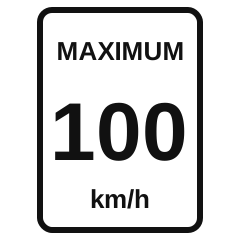
This sign is posted on a Québec highway. Unless another speed is posted, what is the lowest speed you may travel there?
SAAQ Class 5 Practice Test 5
30 questions on seat belts, lane use and speed limits, warning signs, road work, information and cyclist signs, demerit points and licence revocation, traffic lights and signal lights and more.
- No sign-up
- Every answer explained
- Independent · not a government site
- Set 5 of 9
- 30 questions
- Instant feedback
All 30 questions in this test
Every question and its answer choices. The correct answers and explanations appear when you take the test above.
This sign is posted on a Québec highway. Unless another speed is posted, what is the lowest speed you may travel there?
- 50 km/h
- 70 km/h
- 40 km/h
- 60 km/h
Signs like this one give the grade of the slope ahead. From what grade are they used?

- 12% or more
- 10% or more
- 3% or more
- 6% or more
You are driving your neighbour's 7-year-old, who is about 120 cm tall. How must the child ride in your car?
- With the adult seat belt in the front seat
- On a booster only if you take the highway
- In a car seat suited to their weight and height
- With the adult seat belt in the back seat
You are caught speeding inside a road construction zone marked by signs. How is the fine affected?
- The fine amount is doubled
- Only demerit points are added
- The fine amount is tripled
- The fine stays the same
You are 30 and have 14 demerit points. A new conviction adds 2 more and your licence is revoked. How many points remain on your record afterward?
- 16 points
- 2 points
- 0 points
- 1 point
On a two-lane road (one lane each way), a work vehicle's signal arrow has only its centre bar lit. What does that indicate?
- The vehicle is about to turn
- A work site on this road or its shoulder
- The left lane is blocked ahead
- Traffic may pass on either side
In a city, a lane has parallel broken yellow lines on both sides and its direction changes at different times. What kind of lane is it?
- A two-way left-turn lane
- A reversible lane
- A reserved bus lane
- A slow-moving vehicle lane
You turn left from a two-way road onto another two-way road. Which lane should you turn into?
- The lane closest to the curb
- Any lane that is clear
- The far right lane of the road
- The nearest lane, furthest to the left
You use a space reserved for people with a disability for a passenger car. Where must the SAAQ permit be?
- On the dashboard, face down
- Hung from the rear-view mirror
- In the glove box with your licence
- Taped to the rear window
At a red light you see a sign banning right turns on red, with a tab underneath listing certain hours. What does the tab mean?
- The ban is lifted on weekends only
- Right on red is allowed only in those hours
- The ban applies only during the hours shown
- Fines are doubled during those hours
You are walking along a country road that has no sidewalk. Where should you walk?
- On the shoulder, with your back to traffic
- In the middle of the lane
- On whichever side has less traffic
- On the shoulder, facing oncoming traffic
A friend offers to install a radar detector in your car. What does Québec law say?
- It is legal if it stays switched off
- Installing or driving with one is prohibited
- It is legal everywhere except in work zones
- It is legal for cars from other provinces
In which direction does traffic flow around a Québec traffic circle?
- Clockwise
- Clockwise in the inner lane
- Either way, as you prefer
- Counterclockwise
Two snowmobiles collide on a trail far from any road and one rider is injured. Is the injury covered by Québec's public automobile insurance plan?
- Yes, all Québec residents are covered
- Only if the rider was not at fault
- No, since no moving car was involved
- Yes, if the trail crosses a public road
A vehicle is seized after its driver is caught street racing for a second time. How long is it impounded?
- 90 days
- 60 days
- 30 days
- 7 days
You see this panel at the edge of the road. What does it warn of?

- Road work starting just ahead
- The end of the paved surface
- A sharp curve ahead to the right
- An obstacle on or beside the roadway
What does this orange sign tell you to do?
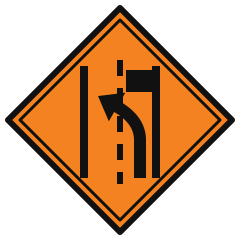
- Use the shoulder to pass the work
- Turn around at the next exit
- Move into the lane that remains open
- Stop and wait for a flagperson
A 40-year-old driver reaches the 15-point bracket for the second time within two years. How long is the revocation?
- 12 months
- 6 months
- 3 months
- 24 months
You are 18, newly on a probationary licence, and want to drive four friends home at 1 a.m. When is this allowed?
- When someone licensed 2+ years sits in front
- When one passenger has a learner's licence
- When all passengers wear seat belts
- When you stay under the speed limit
You have had several drinks. What is the only thing that will remove the alcohol from your body?
- Strong coffee
- A cold shower
- Time
- A brisk walk
You drive without liability insurance and cause an accident with more than $500 in property damage. What can happen?
- Two demerit points on your record
- A $100 fine with no suspension
- A warning letter and nothing more
- Licence suspension until damage is covered
You refuse to blow into a screening device when a police officer orders you to. What happens immediately under the Highway Safety Code?
- 24-hour suspension and no impoundment
- 90-day suspension and 30-day impoundment
- 7-day suspension and 7-day impoundment
- A fine only, with no suspension
Leaving a child alone in a motor vehicle is fined $60 to $100 when the child is under what age?
- 7
- 10
- 5
- 12
You are on a multi-lane road and a red X is lit above your lane. What must you do?
- Slow down but stay in the lane
- Leave the lane; do not drive or stop in it
- Use the lane only to pass
- Stop in the lane until it turns green
You merge onto the highway and accelerate to cruising speed. What happens to your field of vision?
- It widens only to the sides
- It becomes narrower
- It stays exactly the same
- It becomes wider
Your licence has been invalid for more than three years. What must you do before you can drive again?
- Pass a vision test only
- Redo the full driving course
- Pass the knowledge and road tests
- Pay the missed fees only
You and another car stop at an all-way stop. The other car stopped there before you did. Who goes first?
- You, because you are on the right
- The other car
- Whichever car is bigger
- You, if you are going straight
How many rearview mirrors must an ordinary car have, at a minimum?
- Two: one on each side of the car
- Three: inside and on both sides
- One: inside the car only
- Two: inside and on the driver's side
On a street with a 50 km/h limit, a city bus at a stop signals to pull back into your lane. What must you do?
- Honk to warn the bus driver
- Pass the bus quickly on the left
- Keep going, since you are in the lane
- Yield and let the bus re-enter
A 16-year-old wants to ride a power-assisted bicycle. Besides a helmet, what do they need?
- A bicycle registration sticker
- No other document
- A moped or passenger-vehicle licence
- A signed note from a parent
All SAAQ Class 5 practice tests
- SAAQ Class 5 Mock Exam 1 – 30 QuestionsUntimed practice · answers explained
- SAAQ Class 5 Mock Exam 2 – 30 QuestionsUntimed practice · answers explained
- SAAQ Class 5 Mock Exam 3 – 30 QuestionsUntimed practice · answers explained
- SAAQ Class 5 Mock Exam 4 – 30 QuestionsUntimed practice · answers explained
- SAAQ Class 5 Mock Exam 5 – 30 QuestionsUntimed practice · answers explained
- Traffic lights and signal lightsRed, yellow and green lights, arrows, flashing lights, dark signals, pedestrian countdown lights, cyclist lights, lane-use lights, railway signals, work-site lights and bus priority lights.
- Pavement markingsYellow and white lines, broken, solid, double and combined lines, reversible and two-way left-turn lanes, reserved lanes, stop lines, crosswalks, parking markings and pavement symbols.
- Regulatory signsSign colours and shapes, stop, all-way stop and yield signs, speed limits, one-way and lane direction signs, green-circle and red-circle signs, no passing, parking, stopping and reserved-lane signs.
- Warning signsYellow diamond signs for stops and lights ahead, curves, intersections, lane endings, narrowing roads, steep grades, school zones, crossings, slippery or icy surfaces, hazard markers and chevrons.
- Road work, information and cyclist signsOrange work-site signs, flagperson signals, work-zone speed limits, detours and lane merges, green and blue guide and service signs, exit signs, and signs for cyclists.
About this practice test
How many questions are in SAAQ Class 5 practice test 5?
30 original multiple-choice practice questions covering seat belts, lane use and speed limits, warning signs, road work, information and cyclist signs, demerit points and licence revocation, traffic lights and signal lights, pavement markings, passing, turning and traffic circles, work zones, stopping, parking and unlawful practices, regulatory signs, pedestrians, cyclists and motorcycles, your vehicle: registration, equipment and winter tires, accidents, insurance and fines, getting your class 5 licence, alcohol, drugs and impaired driving, licence conditions and driver obligations, vision, fatigue, distraction and attitude, right of way, emergency vehicles and school buses. Each answer includes an explanation. This mixed practice set does not reproduce the official exam format or predict an official score.
Are the questions the same every time?
Yes. Practice test 5 always has the same 30 questions, so you can repeat it until you get them all right. The other 8 sets use different questions.
Are these real test questions?
No. The official question bank is not published. These are original questions written from the official handbook, which is what the real SAAQ Class 5 test is based on.