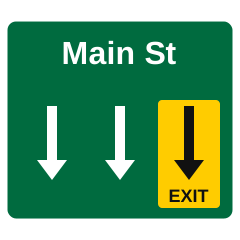
You are on a highway in the lane under this sign. What does it mean for you?
SAAQ Class 5 Practice Test 9
30 questions on road work, information and cyclist signs, your vehicle: registration, equipment and winter tires, accidents, insurance and fines, pedestrians, cyclists and motorcycles, warning signs and more.
- No sign-up
- Every answer explained
- Independent · not a government site
- Set 9 of 9
- 30 questions
- Instant feedback
All 30 questions in this test
Every question and its answer choices. The correct answers and explanations appear when you take the test above.
You are on a highway in the lane under this sign. What does it mean for you?
- Your lane must take the exit
- Your lane is for trucks only
- Your lane ends after the exit
- Your lane continues past the exit
During which period must passenger vehicles registered in Québec be fitted with winter tires?
- November 15 to April 15
- December 15 to March 1
- October 15 to May 1
- December 1 to March 15
After parking near an accident scene, how should you first warn approaching drivers?
- Flash your high beams
- Sound your horn repeatedly
- Turn on your hazard lights
- Leave your doors open
Three friends on motorcycles are riding in the same traffic lane. How should they ride?
- Single file, in the lane centre
- Two side by side, one behind
- In a zigzag formation
- Side by side across the lane
You hit an animal on a rural road and cannot reach its owner. You must report the collision to the nearest police station if the animal weighs more than:
- 25 kg
- 10 kg
- 100 kg
- 50 kg
This sign is used when the road ahead has what layout?

- Three or more curves within 150 m of each other
- One sharp curve of more than 90°
- Two curves within 300 m of each other
- A long, steep slope with one bend
You are caught driving 35 km/h over the limit in a road construction zone marked by signs. How is the fine calculated?
- A flat $1,000 fine applies
- The normal amount is doubled
- The normal amount is tripled
- The normal amount applies
When you park at the side of a street, what is the maximum distance allowed between your vehicle and the edge of the roadway?
- 1 metre
- 15 centimetres
- 50 centimetres
- 30 centimetres
Traffic is backed up on the highway and the shoulder looks clear. When may you drive on the shoulder?
- Only in a necessity or when a sign allows it
- Whenever traffic is stopped
- When you have your hazard lights on
- When you are about to take an exit
A yellow light is flashing over an intersection on your route. How should you proceed?
- Stop completely as at a stop sign
- Stop and wait for a green light
- Keep your speed; it only warns cross traffic
- Slow down and yield to anyone already crossing
A spectator is injured during an automobile race on a track closed to other traffic. What does the public plan provide?
- Compensation only if the driver was at fault
- No compensation, because races are excluded
- Full compensation, like any road accident
- Compensation only for spectators
You are driving on a rural road posted at 90 km/h and come up behind a cyclist. How much room must you give when you pass?
- At least 1.5 metres
- At least 1 metre
- At least 3 metres
- At least 2 metres
You are stopped at a red light where a right turn on red is allowed, and the driver behind you honks. What is true?
- You must turn or move to another lane
- You must turn if no pedestrians are in view
- You never have to turn right on red
- You must turn once the way is clear
You are on a two-lane highway and pass this sign. What does it indicate?

- Slow vehicles must keep to the right
- A passing lane begins ahead
- A no-passing zone begins here
- Passing is allowed on the right only
At an intersection you see this sign for your direction of travel. Which statement is correct?
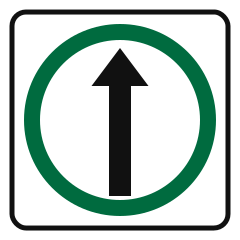
- You must go straight; nothing else is allowed
- You may go straight after a full stop
- You may go straight or turn right
- Going straight is suggested, not required
In early January you rent a passenger car at a Montréal rental agency. What does the law say about its tires?
- Rental cars are exempt from winter tires
- Winter tires are needed only outside cities
- It must have winter tires, like any car
- Winter tires are needed only for taxis
Which colour of flashing or rotating light is reserved for police vehicles in Québec?
- Amber
- Blue
- Red
- Green
You park on a steep street. Besides setting the parking brake, what should you do?
- Leave the car in neutral
- Point the wheels straight ahead
- Turn the wheels toward the middle of the road
- Turn the wheels so the car would roll toward the curb
You missed your exit on the highway. Are you allowed to back up along the shoulder or the ramp?
- Yes, if traffic is light
- Yes, on the shoulder only
- No, reversing is banned there
- Yes, with your hazard lights on
Which simple method can you use to judge whether you are leaving a safe gap behind the vehicle ahead?
- The car-length-per-10 km/h rule
- The two-second rule
- The five-metre rule
- The one-second rule
You want to add a tinted sun strip along the top of your windshield. What is the maximum width allowed?
- 20 cm
- 15 cm
- 10 cm
- 25 cm
On a two-way road, you approach a tow truck stopped on the shoulder with its lights flashing. Under the Move-Over law, what should you do?
- Keep your speed and stay in your lane
- Stop on the shoulder right behind the tow truck
- Use your horn as you go by
- Slow down and move toward the centre line
No sign is posted at the intersection. Where in Québec are you still not allowed to turn right on a red light?
- In every school zone
- On every one-way street
- On the island of Montréal
- In Québec City
A school bus ahead has its red lights flashing and its stop sign out. How far from it must you stop?
- At least 20 metres
- At least 3 metres
- At least 5 metres
- At least 10 metres
The advance level crossing sign is used where a railway crossing is close to an intersection. Within what distances?
- Under 50 m urban, under 125 m rural
- Under 100 m urban, under 250 m rural
- Under 50 m urban, under 150 m rural
- Under 30 m urban, under 100 m rural
A police officer stops you because your 10-year-old passenger is not buckled up. What fine range do you face as the driver?
- $80 to $100
- $300 to $600
- $30 to $60
- $200 to $300
On a street posted at 50 km/h, you come up behind a group of cyclists in your lane. When may you pass them without leaving that lane?
- When the group has fewer than 15 riders
- When you can keep 50 cm away
- Never, unless a peace officer allows it
- After slowing, if you can keep 1 m away
When you apply for a first driver's licence, how many pieces of identification must you present?
- Three
- Four
- One
- Two
Québec's public no-fault insurance plan for bodily injury has been in effect since which year?
- 1990
- 1985
- 1961
- 1978
You are following a large truck and cannot see either of its side mirrors. What does this mean?
- The mirrors are folded in
- You are at a safe distance
- The truck driver can see you
- You are too close to the truck
All SAAQ Class 5 practice tests
- SAAQ Class 5 Mock Exam 1 – 30 QuestionsUntimed practice · answers explained
- SAAQ Class 5 Mock Exam 2 – 30 QuestionsUntimed practice · answers explained
- SAAQ Class 5 Mock Exam 3 – 30 QuestionsUntimed practice · answers explained
- SAAQ Class 5 Mock Exam 4 – 30 QuestionsUntimed practice · answers explained
- SAAQ Class 5 Mock Exam 5 – 30 QuestionsUntimed practice · answers explained
- Traffic lights and signal lightsRed, yellow and green lights, arrows, flashing lights, dark signals, pedestrian countdown lights, cyclist lights, lane-use lights, railway signals, work-site lights and bus priority lights.
- Pavement markingsYellow and white lines, broken, solid, double and combined lines, reversible and two-way left-turn lanes, reserved lanes, stop lines, crosswalks, parking markings and pavement symbols.
- Regulatory signsSign colours and shapes, stop, all-way stop and yield signs, speed limits, one-way and lane direction signs, green-circle and red-circle signs, no passing, parking, stopping and reserved-lane signs.
- Warning signsYellow diamond signs for stops and lights ahead, curves, intersections, lane endings, narrowing roads, steep grades, school zones, crossings, slippery or icy surfaces, hazard markers and chevrons.
- Road work, information and cyclist signsOrange work-site signs, flagperson signals, work-zone speed limits, detours and lane merges, green and blue guide and service signs, exit signs, and signs for cyclists.
About this practice test
How many questions are in SAAQ Class 5 practice test 9?
30 original multiple-choice practice questions covering road work, information and cyclist signs, your vehicle: registration, equipment and winter tires, accidents, insurance and fines, pedestrians, cyclists and motorcycles, warning signs, work zones, stopping, parking and unlawful practices, traffic lights and signal lights, passing, turning and traffic circles, regulatory signs, right of way, emergency vehicles and school buses, seat belts, lane use and speed limits, getting your class 5 licence. Each answer includes an explanation. This mixed practice set does not reproduce the official exam format or predict an official score.
Are the questions the same every time?
Yes. Practice test 9 always has the same 30 questions, so you can repeat it until you get them all right. The other 8 sets use different questions.
Are these real test questions?
No. The official question bank is not published. These are original questions written from the official handbook, which is what the real SAAQ Class 5 test is based on.