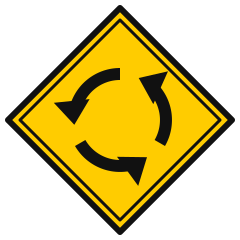
You see this sign. When you reach the circle, who has the right of way?
SAAQ Class 5: Passing, turning and traffic circles
When passing is allowed or banned, passing cyclists and pedestrians, right and left turns, right turns on red and the Montréal exception, traffic circles, signals and headlight use.
- No sign-up
- Every answer explained
- Independent · not a government site
- 17 questions
- Topic drill
Study reference: SAAQ Driver's Handbook (2nd edition), Ch. 4 Traffic Rules — Passing, turning, traffic circles, indicating your intentions and presence, pp. 224–236
All 17 questions in this test
Every question and its answer choices. The correct answers and explanations appear when you take the test above.
You see this sign. When you reach the circle, who has the right of way?
- Vehicles coming from your right
- Vehicles about to enter it
- Vehicles already in the circle
- The larger of the two vehicles
You are driving on a rural road posted at 90 km/h and come up behind a cyclist. How much room must you give when you pass?
- At least 1.5 metres
- At least 1 metre
- At least 3 metres
- At least 2 metres
You turn left from a two-way road onto another two-way road. Which lane should you turn into?
- The lane closest to the curb
- Any lane that is clear
- The far right lane of the road
- The nearest lane, furthest to the left
You are climbing a hill in the right-hand slow lane and the line between you and the main lane is solid. What does that mean for you?
- You may not move back into the main lane
- Only trucks must stay in your lane
- You must stop at the end of the lane
- You may pass downhill traffic
You turn right onto a road that has two lanes in your direction. Which lane should you finish your turn in?
- The far left lane
- The bicycle lane if it is free
- Whichever lane is empty
- The far right lane
In which direction does traffic flow around a Québec traffic circle?
- Clockwise
- Clockwise in the inner lane
- Either way, as you prefer
- Counterclockwise
You want to pass a slow car, but the driver behind you has already signalled to pass you. What should you do?
- Wait; you may not start your pass
- Pass if you signal right away
- Pass first, since you were ahead
- Speed up to block the other driver
On a 50 km/h street, oncoming traffic leaves you no room to give a cyclist the required space. What must you do?
- Pass slowly with whatever space you have
- Stay in your lane, slow down and wait behind
- Pass using the paved shoulder on the right
- Sound your horn so the cyclist moves over
The car ahead is very slow and the paved shoulder on the right is wide and empty. May you use the shoulder to pass?
- Yes, if no one is on the shoulder
- No, never
- Yes, if you signal first
- Yes, below 50 km/h
On a 70 km/h road with no sidewalk, a person is walking on the shoulder toward you. What minimum distance must you leave as you meet them?
- 1.5 metres
- 50 centimetres
- 1 metre
- 3 metres
You are stopped at a red light where a right turn on red is allowed, and the driver behind you honks. What is true?
- You must turn or move to another lane
- You must turn if no pedestrians are in view
- You never have to turn right on red
- You must turn once the way is clear
Where must you avoid passing if it means using the lane for oncoming traffic?
- On a straight road with a broken line
- When approaching a level crossing
- When the oncoming lane is clear far ahead
- On a flat stretch in clear daylight
After a full stop at a red light, in what order should you look before turning right?
- Ahead, then left only
- Left, ahead, right, then left again
- Left, right, then ahead before going
- Right, left, then right again
You are on a city street with a 50 km/h limit and want to pass a cyclist. What is the minimum space you must leave?
- 1.5 metres
- 1 metre
- 2 metres
- 50 centimetres
On a multi-lane one-way road, when may you pass another vehicle on its right?
- When the right lane is moving faster
- When it has its hazard lights on
- When it is driving below the limit
- When it is turning left
You are driving at night with high beams on. When must you switch to low beams for an oncoming car?
- Within 60 metres of it
- Within 150 metres of it
- Only when it flashes its lights
- Within 300 metres of it
No sign is posted at the intersection. Where in Québec are you still not allowed to turn right on a red light?
- In every school zone
- On every one-way street
- On the island of Montréal
- In Québec City
Passing, turning and traffic circles: key rules to remember
Our summary of what the official handbook says on this topic, in our own words. Read it before or after the practice questions above, then check the original chapter. Read the official chapter ↗
Passing (before you pass)
- Only pass where passing is allowed (broken line between lanes).
- Check that the left lane is clear and that no vehicle from behind is about to move into it.
- The lane you move into must be free for a long enough distance.
- Signal with your turn signals before passing.
Passing (general)
- Avoid passing in fog or whenever visibility is reduced.
- Pass on the left; return to the right-hand lane once you have finished.
Passing a bicycle
- Minimum gap when passing a cyclist: 1 m on a road with a limit of 50 km/h or less.
- Minimum gap when passing a cyclist: 1.5 m on a road with a limit over 50 km/h.
- If there is not enough room: stay in your lane, slow down and wait behind the cyclist until you can pass.
Passing a pedestrian
- Same gaps apply when meeting an oncoming pedestrian or passing one walking on the roadway or shoulder: 1 m (limit 50 km/h or less), 1.5 m (limit over 50 km/h).
Being passed
- Do not speed up while someone is passing you; slowing down a little is a courtesy.
Passing prohibited (using the oncoming lane)
- Do not pass using the oncoming lane: approaching or at the top of a hill; in a curve; approaching or crossing a marked pedestrian crosswalk, a level crossing or a tunnel; anywhere signs or markings prohibit it.
Passing prohibited (traffic around you)
- No passing when there are vehicles in the left lane, or when a vehicle behind you has signalled it will pass or has started to pass.
- On a road with two or more one-way lanes: avoid weaving and avoid passing on the right.
- Passing on the right is allowed only to pass a vehicle turning left or heading for a highway exit ramp, or a vehicle doing maintenance work in the left lane.
- You may never leave the roadway (for example drive on the shoulder) to pass.
Passing in a slow lane
- Where signs mark a far-right lane for slow vehicles, slow drivers must use it; any vehicle may use it, not only trucks.
- Slow lanes are mostly in mountainous areas; some are longer than 2 km, and a broken line may let downhill traffic pass for part of the length.
- In the right-hand slow lane, you may not move back into the main lane where a solid line is painted.
Turning (general)
- Before turning: make sure it is safe, signal, yield to pedestrians and cyclists crossing the road you are entering, and yield to vehicles on the cross road, oncoming vehicles and vehicles in or approaching the intersection.
- Turn as soon as the way is clear.
- If you cannot get into the turning lane, go on and turn at another intersection.
Right turns
- Move to the far right side of the road or the right-turn lane, go straight to where the roads meet, then turn sharply into the far right lane of the other road.
- Do not cut into the left lane, a bicycle lane or a reserved lane.
Left turns
- Two-way onto two-way: from the centre of your lane (or the left lane / left-turn lane), go straight to where the roads meet, then when clear turn into the nearest lane for your direction (the one furthest left).
- Two-way onto one-way: from the left lane or turning lane, enter the far left lane of the one-way road.
- One-way onto two-way: from the far left lane or turning lane, turn into the nearest lane (furthest left) for your direction.
- One-way onto one-way: from the far left lane or turning lane, turn into the far left lane of the other road.
- With two turning lanes, finish the turn in the matching lane of the other road.
Several vehicles turning at once
- On roads with more than one lane each way, each driver must steer into the correct lane: right turners into the right lane, left turners into the furthest-left lane for their direction without drifting into the right lane.
Turning right on a red light
- Step 1, Stop: complete stop at the stop line or before the pedestrian crossing, without blocking the crossing.
- Step 2, Look twice: check it is allowed (no prohibiting sign, or outside the hours on the sign's tab, and not on the island of Montréal).
- Turning right on red is not allowed on the island of Montréal.
- Yield to pedestrians and cyclists in or about to enter the intersection; pedestrians facing a green light or a pedestrian light that lets them cross always have the right of way.
- Look left, ahead, right (mirror and blind spot), then left again; yield to vehicles so you do not impede traffic.
- Take extra care with children, elderly people, people with reduced mobility or slow crossers.
- Step 3, Decide: a right turn on red is never mandatory; do it only if the way is clear.
Traffic circles
- A traffic circle has one to three lanes around a central island; traffic flows counterclockwise.
- Always enter from the right.
- Yield to drivers already in the circle; yield to pedestrians at a crosswalk.
- Slow down on approach and be ready to stop for a pedestrian crossing or a vehicle already in the circle on your left.
- Inside the circle: do not pass or stop except in an emergency (e.g. to avoid a collision).
- To exit: signal, then leave the circle watching for pedestrians.
Signalling
- Signal continuously, over a sufficient distance, before changing lanes, making a U-turn (unless prohibited), passing, turning, or entering the road from the shoulder or a parking area.
Hazard lights
- Use hazard lights if you must drive very slowly.
- Use them only for safety reasons (e.g. a broken-down or stalled vehicle on the road at night).
Headlights
- At night or in poor weather, headlights and running lights must be on.
- At night switch from high to low beams within 150 m of an oncoming vehicle, within 150 m of a vehicle ahead, and on well-lit roads.
Study the Passing, turning and traffic circles rules as flashcards →
Other topics
- Traffic lights and signal lightsRed, yellow and green lights, arrows, flashing lights, dark signals, pedestrian countdown lights, cyclist lights, lane-use lights, railway signals, work-site lights and bus priority lights.
- Pavement markingsYellow and white lines, broken, solid, double and combined lines, reversible and two-way left-turn lanes, reserved lanes, stop lines, crosswalks, parking markings and pavement symbols.
- Regulatory signsSign colours and shapes, stop, all-way stop and yield signs, speed limits, one-way and lane direction signs, green-circle and red-circle signs, no passing, parking, stopping and reserved-lane signs.
- Warning signsYellow diamond signs for stops and lights ahead, curves, intersections, lane endings, narrowing roads, steep grades, school zones, crossings, slippery or icy surfaces, hazard markers and chevrons.
- Road work, information and cyclist signsOrange work-site signs, flagperson signals, work-zone speed limits, detours and lane merges, green and blue guide and service signs, exit signs, and signs for cyclists.
- Getting your Class 5 licenceMinimum age, the mandatory driving course, the learner's licence and its rules, when you can take the knowledge and road tests, the probationary licence and passenger limits for young drivers.
- Licence conditions and driver obligationsHealth declarations and licence conditions, documents you must carry, change of address, renewal, new residents and non-residents driving in Québec.
- Demerit points and licence revocationDemerit point brackets by licence and age, revocation periods, how long points stay on your record, restricted licences, and the points for common offences.
- Alcohol, drugs and impaired drivingBlood alcohol limits, the zero-alcohol rule for new and young drivers, drug limits, care or control of a vehicle, roadside suspensions, vehicle impoundment and the cost of a first offence.
- Vision, fatigue, distraction and attitudeHow vision, physical problems, fatigue and emotions affect driving, the ban on hand-held electronic devices and its penalties, observation, and keeping your judgment in traffic.
- Your vehicle: registration, equipment and winter tiresVehicle registration and insurance, required lights, brakes, mirrors and windows, studded and winter tire dates, clearing snow, mechanical inspection and doing your own checks.
- Seat belts, lane use and speed limitsSeat belts and child car seats, air bags and headrests, which lane to use, centre left-turn lanes, Québec's default speed limits and safe following distance.
- Right of way, emergency vehicles and school busesYielding to pedestrians and cyclists, stop signs and all-way stops, entering highways and driveways, emergency vehicles, the Move-Over law, city buses, school buses, level crossings and heavy vehicles.
- Work zones, stopping, parking and unlawful practicesDriving near work sites, parking and stopping distances, disabled parking permits, driving on the shoulder, passengers and seat belts, car surfing and street racing.
- Pedestrians, cyclists and motorcyclesRules for pedestrians, cyclists and power-assisted bicycles, foot scooters, motorcycles, mopeds and scooters, and what drivers must do around them.
- Accidents, insurance and finesQuébec's public no-fault insurance, mandatory liability insurance, what to do at the scene of an accident, and fines for common offences, speeding and work-zone speeding.