SAAQ Class 5 overview

SAAQ Class 5: Regulatory signs

Sign colours and shapes, stop, all-way stop and yield signs, speed limits, one-way and lane direction signs, green-circle and red-circle signs, no passing, parking, stopping and reserved-lane signs.

  • 16 questions
  • Topic drill
0/16
Regulatory signs · Question 1Score 0/0
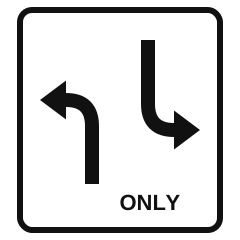
A white rectangle with two curved arrows pointing opposite ways and the word ONLY

This sign is posted over the centre lane of a busy street. What is that lane for?

Study reference: SAAQ Driver's Handbook (2nd edition), Ch. 3 Road Signs and Traffic Signals — Road signs: shapes and colours, regulatory signs, pp. 120–148

All 16 questions in this test

Every question and its answer choices. The correct answers and explanations appear when you take the test above.

  1. This sign is posted over the centre lane of a busy street. What is that lane for?

    A white rectangle with two curved arrows pointing opposite ways and the word ONLY
    1. Buses and taxis during rush hours
    2. Passing slower vehicles in either direction
    3. Left turns by traffic from either direction
    4. Emergency vehicles answering a call
  2. Which sign shape is reserved for marking school zones?

    1. Triangle
    2. Pentagon
    3. Diamond
    4. Octagon
  3. At a red light you see a sign banning right turns on red, with a tab underneath listing certain hours. What does the tab mean?

    1. The ban is lifted on weekends only
    2. Right on red is allowed only in those hours
    3. The ban applies only during the hours shown
    4. Fines are doubled during those hours
  4. You are driving on a one-way street and pass this sign. What does it mean?
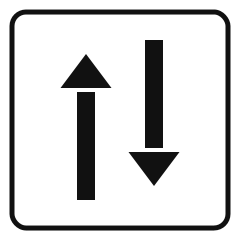
    A white square with two black arrows, one pointing up and one pointing down
    1. One-way traffic ends and two-way begins
    2. Keep right to let faster cars pass
    3. The street ahead is closed to traffic
    4. You must turn around and go back
  5. At an intersection you see this sign for your direction of travel. Which statement is correct?
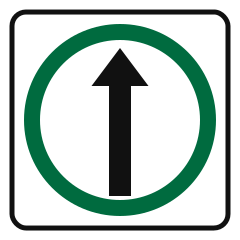
    A white square with a black upward arrow inside a green circle
    1. You must go straight; nothing else is allowed
    2. You may go straight after a full stop
    3. You may go straight or turn right
    4. Going straight is suggested, not required
  6. This sign is posted at the start of a traffic island. What must you do?

    A white square with a black arrow curving to the right around a black rounded shape
    1. Pass the obstacle on either side
    2. Pass the obstacle on its left side
    3. Pass the obstacle on its right side
    4. Stop and wait before the obstacle
  7. You are on a road with a reversible lane. A red X is lit above the centre lane. What does it mean?

    1. That lane is closed for repairs today
    2. That lane is reserved for oncoming traffic
    3. You may use it only to turn left
    4. You may use it if you drive with care
  8. In Québec, which colours are generally used on regulatory signs?

    1. Yellow and black
    2. Black and white
    3. Orange and black
    4. Green and white
  9. What does this sign mean?

    A red circle with a white horizontal bar across the middle, on a white square
    1. No parking at any time on this road
    2. Stop here and wait for a signal
    3. The road is closed to trucks only
    4. No vehicle may enter this road or lane
  10. You approach an intersection and this sign is facing you. What must you do?

    A red eight-sided sign with white capital letters
    1. Yield only to vehicles on your right
    2. Come to a full stop before entering
    3. Stop only if cross traffic is coming
    4. Slow down and go if the way is clear
  11. You are about to enter a road and this sign is posted on your side. What does it require?

    A white downward-pointing triangle with a thick red border
    1. Merge first; others must make room
    2. Yield to traffic on that road
    3. Sound your horn before entering
    4. Stop fully every time, then enter
  12. You want to turn around at an intersection where this sign is posted. What does it tell you?

    A white square with a black U-shaped arrow crossed by a red circle and slash
    1. U-turns are allowed only on green
    2. You may not make a U-turn here
    3. Move left now to prepare for a U-turn
    4. A U-turn is fine after a full stop
  13. A no U-turn sign has a tab reading “Excepté véhicules autorisés”. Who may still make a U-turn there?

    1. Residents of the street and their visitors
    2. Emergency, public security and road work vehicles
    3. Taxis, city buses and delivery vehicles
    4. Any driver outside of rush hours
  14. You see this sign at a street corner. What does it tell you?

    A black rectangle with a white arrow and the words ONE WAY
    1. Traffic may move only in the arrow's direction
    2. Your lane ends; merge the way it points
    3. Two-way traffic is ahead on this street
    4. You must turn in the arrow's direction
  15. What does this sign mean?

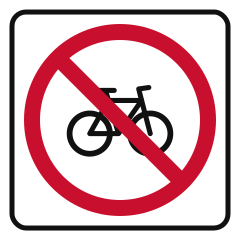
    A white square with a black bicycle, crossed by a red circle and slash
    1. This lane is reserved for bicycles
    2. A bicycle crossing is ahead
    3. Bicycles are not allowed on this road
    4. Cyclists must walk their bikes here
  16. You are on a two-lane highway and pass this sign. What does it indicate?

    A white square with two cars, one black and one red, crossed by a red circle and slash
    1. Slow vehicles must keep to the right
    2. A passing lane begins ahead
    3. A no-passing zone begins here
    4. Passing is allowed on the right only

Regulatory signs: key rules to remember

Our summary of what the official handbook says on this topic, in our own words. Read it before or after the practice questions above, then check the original chapter. Read the official chapter ↗

Road signs (overview)

  • Signs use pictograms and wording; small tabs are often added under a sign to make its message more specific.
  • Four sign families: regulatory, warning, information, road work.
  • Regulatory signs state the obligations and restrictions the Highway Safety Code places on you.

Types of signs; shapes and colours

  • Warning signs flag stretches where obstacles or hazards call for extra care; they may tell you to slow down, stop or change direction.
  • Information signs give destinations, distances, directions, street names, services, points of interest.
  • Road work signs mark construction or maintenance and how to get through; they can be regulatory, warning or information signs.
  • Colour scheme follows North American practice. In general: black and white = regulatory; yellow = danger warning; orange = road work; green, brown or blue = information.

Shapes and colours table

  • Diamond shape = danger (warning) and work-site signs.
  • Octagon is reserved for stop signs; pentagon is reserved for school zones.
  • Regulatory, warning and road work signs use arrows and symbols; information signs use written information.
  • Regulatory table: red octagon = stop only; red-and-white triangle = yield only; black horizontal rectangle = reserved for one-way signs.
  • Warning table: fluorescent yellow-green pentagon = beginning of a school zone; fluorescent yellow-green (second shape in table, not given in text) = advance school zone / school crossing signs; yellow = danger, orange = work site; red-and-white = warning chevrons.
  • Information table: blue = highways (autoroutes), green = roads; blue = tourist information / private tourist services; brown = public tourist attractions; red = emergency facilities; yellow = highway exits.

Pictograms

  • Pictograms (symbols, arrows, silhouettes) replace words.
  • Prohibition symbol: red circle with a red diagonal bar — whatever is inside is forbidden.
  • Mandatory symbol: green circle — whatever is inside is compulsory.

Stop, all-way stop, do not enter

  • Stop sign: come to a complete stop at the intersection.
  • All-way stop tab (under stop signs): traffic from every direction must stop; the tab's shape shows the intersection layout (+, T, Y).
  • Do not enter: no vehicle of any type may enter that road or lane, because entering could cause a head-on collision; a tab may spell out the meaning.

Yield, traffic circle yield, yield to oncoming, stop line

  • Yield: give the right of way to vehicles on the road you are entering.
  • Traffic circle yield: give way to vehicles already in the circle. Aim is to merge without stopping and without hindering those in the circle; stop only when there is no other choice. Not slowing at all, or always stopping, both disrupt traffic.
  • Yield to oncoming traffic sign: used at work sites without a flagperson, single-lane two-way sections and some narrow bridges.
  • Stop line: painted line where vehicles must stop.

Speed limit, one-way

  • Speed limit signs show the legal maximum and minimum speeds; the last digit is always zero.
  • An area tab with a speed limit sign sets the maximum for all similar streets in a generally urban area; installed on every access road into that area.
  • A school zone speed sign shows the maximum plus the hours, days and months it applies.
  • One-way: traffic only in the arrow's direction. "Beginning of one-way" sign: two-way ends, one-way starts.

Two-way traffic, obstruction, lane direction

  • Two-way traffic sign (regulatory): one-way ends, two-way begins.
  • Obstruction signs: pass the obstacle on the right, on the left, or on either side, as shown.
  • Lane direction signs: be in the proper lane for your intended direction; a split arrow (two or three heads) means any of the directions shown is allowed.

Lane direction combinations, two-way left turn, reversible lane

  • Two-way left-turn sign: centre lane is reserved for left turns from either direction.
  • Many combination signs assign a movement to each lane (e.g. right lane straight, left lane left).
  • Reversible lane: direction changes with time of day or traffic. Overhead signals: green arrow = you may use the lane; red X = lane is for oncoming traffic.

Mandatory or prohibited movement at intersections

  • Green circle here means you MUST do the movement shown; no other manoeuvre is allowed.
  • Mandatory: straight only; left only; right only; straight or right; straight or left; right or left.
  • Prohibited (red circle and bar): no straight through; no left; no right; no U-turn at an intersection or median.
  • No right turn on red sign: if the ban is limited to certain times, the times are on a tab.
  • Tabs can limit a mandatory/prohibited movement to certain periods or exempt categories of vehicles.
  • "Excepté véhicules autorisés" tab under a no-U-turn sign: emergency vehicles, public security vehicles and road construction/maintenance vehicles may still make U-turns.

No passing, controlled parking

  • No-passing sign marks the start of a no-passing zone; a tab under it can mark the end of the zone.
  • Controlled parking signs show where parking is banned or allowed; may specify vehicle categories, minutes, hours, days, months, and extent (arrow).
  • Reserved parking for people with physical disabilities.
  • Tow-away tab: vehicles in violation may be towed.
  • Some municipalities use a sign to ban winter parking or restrict vehicle categories.
  • A sign used with orange lights bans parking during road maintenance operations.
  • Pay parking sign; tab showing where the pay-and-display machine is.

No stopping, crossings, other

  • No stopping: stopping is forbidden in the zone shown; same arrows/indications as parking signs.
  • Crossing signs mark places where pedestrians may cross. Be ready to stop as soon as a pedestrian enters the crosswalk or shows intent (walking toward it, waiting, eye contact, hand gesture); you must stop to let the pedestrian cross safely.
  • Crosswalk types: pedestrian, school, people with physical disabilities, visually impaired people, playground, pedestrian-and-bicycle.
  • Other: no littering; radar detectors banned on board; gas tanks must be closed and sealed to board a ferry; seat belt mandatory.

Mandatory routes; trucks

  • Mandatory route signs for trucks, motorcycles, cars; a tab arrow shows the direction.
  • Trucks in transit (no local deliveries in the area) must follow the mandatory truck route; tool vehicles and equipment transport vehicles too. Exempt: tow trucks, farm vehicles/machinery, oversize vehicles with a special permit giving access.
  • A sign can allow trucks onto a normally banned road for local deliveries.
  • Lane sign for trucks/tool/equipment vehicles; a tab gives total distance when the obligation runs over 2 km.

Access prohibited; hazardous materials; railway; weight

  • Access-prohibited signs (red circle) exist for cars, motorcycles, bicycles, pedestrians, equestrians, ATVs, snowmobiles, buses of various kinds, in-line skaters, RVs, vehicles with trailers, and combinations.
  • Truck prohibition applies when load, size or number of axles exceeds the road's limits; may exempt local deliveries if shown.
  • Hazardous materials signs: mandatory route, prohibited road, mandatory lane, prohibited lane; can concern individual motorists carrying unusual amounts of fuel, explosives or chemicals.
  • Level crossing stop exemption signs: vehicles normally required to stop (buses, hazardous-material carriers) need not stop; used near abandoned or rarely used tracks with special safety measures.
  • No stopping on railway tracks.
  • Weight restriction: vehicles over the posted gross weight may not use certain bridges/overpasses; tabs can show distance to the structure or that only one such vehicle may be on it at a time.

Thaw, slow traffic, brake check, inspection

  • Thaw period load limits must be obeyed.
  • Slow-moving traffic lane: slow vehicles must use the right lane; applies to ANY slow-moving vehicle although the symbol is a truck.
  • Brake check: vehicles or combinations of 3,000 kg or more must stop in the indicated area to check brakes; a sign inside the area says at most 30 m remain before the exit stop sign.
  • Inspection station: trucks, tow trucks, equipment transport and tool vehicles, and vehicles with a trailer or semitrailer over 10 m long must stop. When lights flash, straight trucks or road tractors over 4,500 kg net weight must stop.

Reserved lanes

  • Elongated white diamond in the top-left corner on a red or black background = reserved lane.
  • Black background: vehicles in the reserved lane travel with the flow of traffic. Red background: lane is for oncoming traffic or alternating traffic in either direction.
  • Signs list user types and periods; arrow shows which lane. A separate sign marks the end of reserved lanes.
  • Carpool symbol: number on a vehicle outline = minimum occupants required to use the lane.

Study the Regulatory signs rules as flashcards →

Other topics

Full practice tests