You are driving in a group of three cars on a road with a 90 km/h limit. What must the group do?
SAAQ Class 5 overview
SAAQ Class 5: Seat belts, lane use and speed limits
Seat belts and child car seats, air bags and headrests, which lane to use, centre left-turn lanes, Québec's default speed limits and safe following distance.
- No sign-up
- Every answer explained
- Independent · not a government site
- 16 questions
- Topic drill
0/16
Study reference: SAAQ Driver's Handbook (2nd edition), Ch. 4 Traffic Rules — Protection, traffic lane divisions, lane use, speed limits and distance between vehicles, pp. 215–224
All 16 questions in this test
Every question and its answer choices. The correct answers and explanations appear when you take the test above.
You are driving in a group of three cars on a road with a 90 km/h limit. What must the group do?
- Stay close so the group is not split up
- Leave room between cars so others can pass
- Keep below 70 km/h to stay together
- Drive in the left lane with hazard lights on
How far back should you move the driver's seat to reduce the risk of injury if the air bag deploys?
- At least 25 cm from the air bag cover to your chest
- At least 15 cm from the air bag cover to your chest
- At least 40 cm from the air bag cover to your chest
- At least 10 cm from the air bag cover to your chest
You are on a road with two lanes in each direction and you are not passing anyone. Which lane should you use?
- The left-hand lane
- The lane nearest the centre line
- The right-hand lane
- Whichever lane is faster
This sign is posted on a Québec highway. Unless another speed is posted, what is the lowest speed you may travel there?
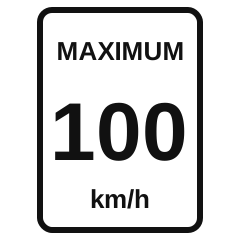
- 50 km/h
- 70 km/h
- 40 km/h
- 60 km/h
You are driving through a school zone and no other speed limit is posted. What is the maximum speed?
- 50 km/h
- 30 km/h
- 60 km/h
- 40 km/h
You are driving your neighbour's 7-year-old, who is about 120 cm tall. How must the child ride in your car?
- With the adult seat belt in the front seat
- On a booster only if you take the highway
- In a car seat suited to their weight and height
- With the adult seat belt in the back seat
To reduce the risk of injury from a deploying air bag, children of what age and under should always ride in the back seat?
- 8 and under
- 10 and under
- 14 and under
- 12 and under
You are on a one-way urban boulevard with two lanes and a 70 km/h limit. Which lane may you drive in?
- Right lane, except to pass
- Either lane
- Right lane, unless turning left
- Left lane, to keep the right clear
You are driving on a paved country road where no speed limit sign is posted. What is the maximum speed?
- 100 km/h
- 70 km/h
- 90 km/h
- 80 km/h
You turn onto a gravel road with no speed sign. What is the maximum speed allowed?
- 80 km/h
- 70 km/h
- 60 km/h
- 50 km/h
Which simple method can you use to judge whether you are leaving a safe gap behind the vehicle ahead?
- The car-length-per-10 km/h rule
- The two-second rule
- The five-metre rule
- The one-second rule
Traffic is crawling and you are in the middle of an intersection. Which of these is prohibited while you are there?
- Changing lanes
- Slowing down
- Checking your mirrors
- Signalling a turn
You are the driver. Up to what age are you responsible for making sure your passengers wear their seat belts properly?
- Under 14
- Under 16
- Under 18
- Under 12
You are driving four adult friends to the cottage. Who in the car must wear a seat belt?
- Only you, as the driver
- Only the people in the front seats
- Everyone, in the front and the back
- Only you and the front passenger
You are driving with a newborn baby. How should the baby be seated?
- Forward-facing seat in the back
- In an adult's arms in the back
- Rear-facing infant seat in the front
- Rear-facing infant seat in the back
On a two-way street with five lanes, what is the centre lane used for?
- Passing slower vehicles in either direction
- Emergency vehicles only
- Buses and taxis only
- Left turns only, in both directions
Seat belts, lane use and speed limits: key rules to remember
Our summary of what the official handbook says on this topic, in our own words. Read it before or after the practice questions above, then check the original chapter. Read the official chapter ↗
Seat belts
- Seat belts are mandatory for every occupant, front and back, of a moving motor vehicle.
- No one may drive if the driver's or a passenger's seat belt is missing, unusable or altered.
- The driver is responsible for making sure passengers under 16 wear their belt properly.
- Child restraint: the old rule used a sitting height under 63 cm (seat to top of head). The handbook says a new rule took effect April 18, 2019, but words it two ways: children "at least 145 cm tall or 9 years old" may use the belt, vs children "145 cm tall or less or under 9 years old" must be in a car seat. RESOLVED by the Guide de la route 4th ed. (2024), p. 215: a child shorter than 145 cm OR younger than 9 must be in a restraint or booster seat. Questions still use a child clearly under both thresholds.
- The car seat/booster must suit the child's weight and height and be installed per the manufacturer's instructions.
- Exception: in taxis and police vehicles the child uses the available seat belt.
Exemptions; air bags
- SAAQ may issue a medical exemption certificate (full or partial, or allowing added devices).
- Taxi drivers on the job are exempt on roads with a municipal speed limit or unnumbered roads.
- No belt required while backing up, or for a passenger in a police wagon.
- Front air bags protect head, neck and chest in head-on crashes. Air bags plus seat belts cut severe head injury risk by 75% and severe chest injury by 66%.
- Other types: curtain, side, knee, inflatable seat belts. Deployed by an electronic module only in serious crashes; they deflate through tiny holes.
Reducing air bag risk
- Infants: always in a rear-facing infant seat secured in the back seat (middle if the vehicle allows).
- Children 12 and under: always in the back seat, in a seat suited to weight and height where required.
- Always wear your belt.
- Driver's seat back so there are at least 25 cm between the centre of the air bag cover and the middle of your chest.
- SAAQ may authorize deactivation if a driver/passenger is at risk (Declaration of Requirement for Air Bag Deactivation form).
Headrests
- Only 10% of drivers adjust their headrest correctly; a headrest too low (behind the neck) gives little protection in a rear-end crash (whiplash).
- Best protection: headrest no more than 7 cm from the back of your head, and its middle level with your eyes or the top of your ears.
Traffic lane divisions (covered by pavement-markings topic)
- Broken lines may be crossed when safe; solid lines generally not (exceptions listed). Not used for questions here.
Lane use: two or more lanes of two-way traffic
- Drive in the right-hand lane. Use the left lane only to pass or avoid an obstacle, after checking it is free.
Centre left-turn lane; closed lane; one-way lanes
- On two-way roads with three or five lanes, the centre lane is reserved for left turns only, for both directions; travel in the right-hand lanes and use the centre only to turn left.
- If your lanes are closed/obstructed, you may use the nearest free oncoming lane after yielding to vehicles in it.
- Two one-way lanes: generally keep to the far right.
Three one-way lanes; particular cases; medians; intersections
- Three lanes: generally use one of the right-hand lanes.
- On highways, the far left lane may be used to pass, turn left, avoid obstacles or move toward an exit lane.
- You may slow in the left lane if signalling a left turn or a stop on the left side.
- Where the speed limit is under 80 km/h (e.g. urban boulevard), either lane may be used; going faster than the next lane is not passing.
- Do not cross medians/dividers except where signs allow. Use designated ramps to enter/exit highways.
- In an intersection it is prohibited to stop, block a lane or change lanes.
Speed limits
- Applies on public roads, private roads open to public traffic and shopping-centre lots.
- Highways: 60 km/h minimum, 100 km/h maximum.
- Concrete or asphalt roads: 90 km/h maximum.
- Gravel roads: 70 km/h maximum.
- School zones: 50 km/h maximum unless a sign shows another speed.
- Cities, towns, villages: 50 km/h maximum unless otherwise posted.
- Slow down at night, in fog, rain, snow, on slippery or uncleared roads, and near road work; but do not drive so slowly that you hinder traffic.
Distance between vehicles
- Keep a distance that lets you stop without a crash if you brake suddenly; consider speed, density, weather, road surface.
- The "two-second rule" can be used to estimate following distance.
- Convoys on roads with a maximum of 70 km/h or more: leave enough space between vehicles to let other drivers pass.
- (Passing rules start on p. 224 — covered by the passing-turning topic.)
Study the Seat belts, lane use and speed limits rules as flashcards →
Other topics
- Traffic lights and signal lightsRed, yellow and green lights, arrows, flashing lights, dark signals, pedestrian countdown lights, cyclist lights, lane-use lights, railway signals, work-site lights and bus priority lights.
- Pavement markingsYellow and white lines, broken, solid, double and combined lines, reversible and two-way left-turn lanes, reserved lanes, stop lines, crosswalks, parking markings and pavement symbols.
- Regulatory signsSign colours and shapes, stop, all-way stop and yield signs, speed limits, one-way and lane direction signs, green-circle and red-circle signs, no passing, parking, stopping and reserved-lane signs.
- Warning signsYellow diamond signs for stops and lights ahead, curves, intersections, lane endings, narrowing roads, steep grades, school zones, crossings, slippery or icy surfaces, hazard markers and chevrons.
- Road work, information and cyclist signsOrange work-site signs, flagperson signals, work-zone speed limits, detours and lane merges, green and blue guide and service signs, exit signs, and signs for cyclists.
- Getting your Class 5 licenceMinimum age, the mandatory driving course, the learner's licence and its rules, when you can take the knowledge and road tests, the probationary licence and passenger limits for young drivers.
- Licence conditions and driver obligationsHealth declarations and licence conditions, documents you must carry, change of address, renewal, new residents and non-residents driving in Québec.
- Demerit points and licence revocationDemerit point brackets by licence and age, revocation periods, how long points stay on your record, restricted licences, and the points for common offences.
- Alcohol, drugs and impaired drivingBlood alcohol limits, the zero-alcohol rule for new and young drivers, drug limits, care or control of a vehicle, roadside suspensions, vehicle impoundment and the cost of a first offence.
- Vision, fatigue, distraction and attitudeHow vision, physical problems, fatigue and emotions affect driving, the ban on hand-held electronic devices and its penalties, observation, and keeping your judgment in traffic.
- Your vehicle: registration, equipment and winter tiresVehicle registration and insurance, required lights, brakes, mirrors and windows, studded and winter tire dates, clearing snow, mechanical inspection and doing your own checks.
- Passing, turning and traffic circlesWhen passing is allowed or banned, passing cyclists and pedestrians, right and left turns, right turns on red and the Montréal exception, traffic circles, signals and headlight use.
- Right of way, emergency vehicles and school busesYielding to pedestrians and cyclists, stop signs and all-way stops, entering highways and driveways, emergency vehicles, the Move-Over law, city buses, school buses, level crossings and heavy vehicles.
- Work zones, stopping, parking and unlawful practicesDriving near work sites, parking and stopping distances, disabled parking permits, driving on the shoulder, passengers and seat belts, car surfing and street racing.
- Pedestrians, cyclists and motorcyclesRules for pedestrians, cyclists and power-assisted bicycles, foot scooters, motorcycles, mopeds and scooters, and what drivers must do around them.
- Accidents, insurance and finesQuébec's public no-fault insurance, mandatory liability insurance, what to do at the scene of an accident, and fines for common offences, speeding and work-zone speeding.