SAAQ Class 5 overview

SAAQ Class 5: Warning signs

Yellow diamond signs for stops and lights ahead, curves, intersections, lane endings, narrowing roads, steep grades, school zones, crossings, slippery or icy surfaces, hazard markers and chevrons.

  • 16 questions
  • Topic drill
0/16
Warning signs · Question 1Score 0/0
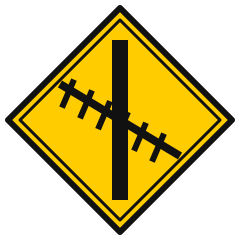
A yellow diamond with a black road line crossed at an angle by a line with short ties

What does this sign warn of?

Study reference: SAAQ Driver's Handbook (2nd edition), Ch. 3 Road Signs and Traffic Signals — Warning signs, pp. 148–169

All 16 questions in this test

Every question and its answer choices. The correct answers and explanations appear when you take the test above.

  1. What does this sign warn of?

    A yellow diamond with a black road line crossed at an angle by a line with short ties
    1. Railway tracks crossing the road ahead
    2. A bridge with a metal grid surface
    3. A side road joining at an angle
    4. Grooved pavement on the road ahead
  2. You are in the right lane and see this sign. What must you do?

    A yellow diamond with a straight black line on the left and a right-hand line that bends in to meet it
    1. Speed up to get ahead of the left lane
    2. Yield, then move into the remaining lane
    3. Stop at the end of the lane and wait
    4. Keep going; the left lane must let you in
  3. You see this panel at the edge of the road. What does it warn of?

    A tall yellow panel with black diagonal stripes
    1. Road work starting just ahead
    2. The end of the paved surface
    3. A sharp curve ahead to the right
    4. An obstacle on or beside the roadway
  4. What does this five-sided sign mark?

    A fluorescent yellow-green five-sided sign with two black child figures
    1. The end of a school zone
    2. The beginning of a school zone
    3. A school bus stop ahead
    4. A playground crosswalk
  5. You are driving on a rural road and see this sign. What should you expect?

    A yellow diamond with a small red octagon above a black upward arrow
    1. A traffic light just ahead
    2. A railway crossing ahead
    3. Road work with a flagperson
    4. A stop sign further ahead
  6. It is a Tuesday in October at 8:15 a.m. You enter a school zone where no other speed limit is posted. What is the maximum speed?

    1. 60 km/h
    2. 50 km/h
    3. 30 km/h
    4. 40 km/h
  7. The advance level crossing sign is used where a railway crossing is close to an intersection. Within what distances?

    1. Under 50 m urban, under 125 m rural
    2. Under 100 m urban, under 250 m rural
    3. Under 50 m urban, under 150 m rural
    4. Under 30 m urban, under 100 m rural
  8. What does the number on the yellow tab below this curve sign show?

    A yellow diamond with a curved black arrow above a yellow rectangle showing a number and km/h
    1. The distance to the curve in metres
    2. The legal minimum speed in the curve
    3. The speed limit for heavy trucks only
    4. The recommended speed for the curve
  9. You see this sign while driving on a two-way road. What should you prepare to do?

    A yellow diamond with two black lines that split apart around a rounded centre shape
    1. Keep to the right of the median ahead
    2. Stop where the road ends ahead
    3. Share your lane with oncoming cars
    4. Pass the median on either side
  10. Signs like this one give the grade of the slope ahead. From what grade are they used?

    A yellow diamond with a black truck on a sloping black triangle
    1. 12% or more
    2. 10% or more
    3. 3% or more
    4. 6% or more
  11. What does this sign warn you about?

    A yellow diamond with a black traffic light showing red, yellow and green circles
    1. A pedestrian crosswalk ahead
    2. A level crossing with gates
    3. An all-way stop ahead
    4. Traffic lights ahead
  12. An advance speed limit sign warns of a zone ahead where the limit has been lowered by at least how much?

    1. 20 km/h
    2. 50 km/h
    3. 10 km/h
    4. 30 km/h
  13. What does this sign warn of?

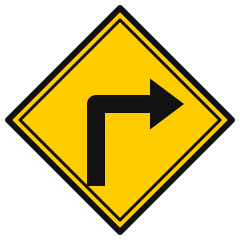
    A yellow diamond with a black arrow that goes up and then bends at a right angle to the right
    1. A mandatory right turn ahead
    2. A curve of more than 90° to the right
    3. A gentle curve to the right ahead
    4. A side road joining from the right
  14. This sign is used when the road ahead has what layout?

    A yellow diamond with a black arrow that zig-zags in S-shaped curves
    1. Three or more curves within 150 m of each other
    2. One sharp curve of more than 90°
    3. Two curves within 300 m of each other
    4. A long, steep slope with one bend
  15. A warning sign tells you only one lane is open to traffic ahead. At most, how wide is that roadway?

    1. 8 metres
    2. 6 metres
    3. 4 metres
    4. 10 metres
  16. What does this sign require of you?

    A yellow diamond with two black lines that bend inward toward each other
    1. Stop and yield to oncoming vehicles
    2. Merge left because a lane is ending
    3. Move onto the shoulder to make room
    4. No special move, just extra alertness

Warning signs: key rules to remember

Our summary of what the official handbook says on this topic, in our own words. Read it before or after the practice questions above, then check the original chapter. Read the official chapter ↗

Warning signs (overview)

  • Warning signs do not all call for the same response: depending on the case you may have to change lanes, stop, slow down, or simply be more alert.

Advance stop/yield; changes to signs

  • Advance stop sign: a stop sign is coming up.
  • Advance yield sign: a yield sign is coming up. Another version announces a yield-to-oncoming-traffic sign.
  • "Change to signs" warnings: alert you that traffic control at an intersection is changing; tabs give the date a stop sign is removed or comes into effect, the date lights are removed or start operating, the date a new lower speed limit starts, or flag a new yield sign, new lights, or a change in one-way direction. A tab under a speed limit sign flags a changed limit.
  • The word STOP may replace ARRÊT on these signs.

Traffic lights ahead; prepare to stop; advance speed limit

  • Advance warning of traffic lights ahead.
  • Prepare to stop sign with flashing yellow lights: traffic lights or a level crossing where you might not expect them; flashing means the signal is about to turn red — be ready to stop.
  • Advance speed limit sign: zone ahead where the limit is lower by at least 30 km/h.
  • Before a school zone with time-limited speed, a tab gives the times, days and months.

Two-way traffic ahead; divided roadway

  • Two-way traffic ahead (warning, yellow).
  • Divided roadway ahead: must be entered by the right only.
  • A version says you may pass an obstacle on either side.
  • End of divided roadway sign.

Advance lane direction; curves

  • Advance lane direction signs show which lanes to use for each movement at the next intersection.
  • Curve signs: curve left; sharp curve left; reverse curve; sharp reverse curve.
  • Winding road: three or more curves in a row, each within 150 m of the next; a tab shows the distance covered by the curves if it is over 1 km.
  • A separate sign warns of a curve of more than 90°. Same sign types exist for right-hand curves.
  • Recommended speed tab: advised speed for getting around an obstacle or hazard.
  • Highway exit recommended speed: leaves enough margin for emergency braking in the curve on wet pavement.

Merging, parallel lanes, intersections

  • Merge sign: traffic joins your lane. A version warns of a bus lane merging ahead.
  • Parallel lanes sign: one or more separate adjacent lanes, so no lane change is needed for at least 1 km. Merging/parallel lanes can be on either side.
  • Intersection pictograms show the layout ahead: crossroad, T-intersection, Y-intersection, T in a curve, drawn as the driver sees it.

Large median, roundabout, narrow passage, clearance

  • Warning that the road crosses another road whose lanes are split by a very wide median.
  • Traffic circle (roundabout) ahead.
  • Narrow bridge/tunnel: narrower than the approach.
  • One-lane narrow passage: only one lane open, roadway at most 6 m wide.
  • Overhead clearance: diamond = advance warning; square = posted on the bridge, overpass or tunnel itself.

Level crossings, restricted visibility

  • Advance level crossing sign: used where a level crossing is less than 50 m from an intersection in urban areas, or less than 125 m in rural areas.
  • Other signs warn of a level crossing ahead and show the angle at which the tracks cross the road.
  • A sign warns truck drivers to slow down a lot because of the crossing's design.
  • Restricted visibility: limited or no visibility because of an abrupt slope.

Roadway narrows vs lane ending

  • Roadway narrows (both sides, right, or left): road gets narrower but the number of lanes stays the same; no particular manoeuvre required, only extra alertness.
  • Lane ending: the lane ends; drivers in it must change lanes after yielding to vehicles in the lane that continues. Pavement markings may accompany it. Can be left or right. A tab can give the distance to the end of the lane.
  • The two signs must not be confused.

Lane/road ends; steep grade

  • Lane or road ends sign.
  • Steep grade signs show the slope in percent when it is 6% or more (6 m drop over 100 m); higher percent = steeper.
  • Steep grades call for caution from heavy-vehicle drivers but can also be risky for others, especially if winding or slippery.
  • Variants: maximum grade in percent; slope longer than 1 km; two successive slopes with different grades (total distance shown if over 1 km).

Reserved lane ahead; school bus stop ahead

  • Reserved lane ahead: flashing lights mean the rule is in effect; tab gives the period.
  • A sign warns that the cross-street lane is reserved, so right-turning drivers must use the adjacent lane.
  • School bus stop ahead: used only where a curve or hill hides a stopped bus; be ready to stop and watch for children.

Beginning of a school zone; crossings

  • School zone = road segment next to an elementary or secondary school.
  • From September to June, school zone maximum is 50 km/h, Monday to Friday, 7 a.m. to 5 p.m.
  • If the municipality sets a lower limit, a speed limit sign with times, days and months goes with the school zone sign.
  • The end of the school zone is shown by a sign giving the speed limit that applies outside it.
  • Advance crossing signs: pedestrian crosswalk, school zone or school crosswalk, playground, people with physical disabilities, visually impaired people, bicycle crossing.

More crossing signs

  • Pedestrians and cyclists; truck crossing; logging trucks; snowmobile crossing; ATV crossing; equestrian crossing; successive ATV and snowmobile crossings; wild animals in the area; farm animal crossing.

Shared roadway, end of highway, hazard markers

  • Designated shared roadway: cyclists and drivers share a road recognized as a bikeway; expect more cyclists, be careful and courteous. Advance sign for a change from a bike lane/path to a shared roadway.
  • Advance end of highway signs: distance left and the road layout where the highway ends.
  • Hazard markers: obstacles on the road or shoulder (e.g. boulders, bridge railings) or a narrowing; the diagonal bands point to the side you must use to get past.

Hazard marker variants, directional arrows, delineators, alignment markers

  • Hazard markers for passing on either side, on the right, or on the left.
  • Directional arrow: especially dangerous point in a very sharp curve or at a T-intersection.
  • Delineators along the road edge warn of sharp curves, helpful at night, in poor visibility, on wet or snowy pavement.
  • Alignment markers (chevrons): mark a sharp curve; a chevron pattern in a curve means it is extremely sharp.
  • A sign in the centre of a traffic circle shows the direction of travel in the circle.

Slippery and surface signs

  • Slippery when wet; shoreline road slippery from spray; motorcyclist version for especially slippery wet surface.
  • Icy pavement: road, bridge or overpass may ice up or frost near freezing temperatures.
  • Flooded roadway: water may cover the road in places.
  • Pavement change: grooved pavement or a metal grid bridge deck.
  • End of paved surface: gravel or dirt begins.

Other warnings

  • Bumpy road: surface irregularities.
  • Falling rocks: rocks or landslides possible from an unstable slope beside the road.
  • Drawbridge ahead; low-flying aircraft; airport, seaplane base, heliport.
  • No entry ahead for trucks except local delivery.
  • Risk of getting stuck (usually at runaway-lane arrester beds).
  • Fog warning and blowing snow warning: flashing lights mean fog / wind-blown snow is present.
  • Be visible: headlights and tail lights must be on in the tunnel.
  • Road work signs have an orange background (regulatory, information or warning). Barriers close part or all of the road at the start of a work site. Visual markers mark work site limits and lane narrowing, show direction, warn of painting in progress.

Study the Warning signs rules as flashcards →

Other topics

Full practice tests