A solid yellow line separates your lane from oncoming traffic. You want to turn left into a private driveway. What is the rule?
SAAQ Class 5 overview
SAAQ Class 5 Mock Exam 5
Same format as the real test. Answers stay hidden until you submit. The official time limit is not published; the timer is a practice setting.
- No sign-up
- Every answer explained
- Independent · not a government site
- 30 questions
- untimed
- Pass mark 23/30
0/30
All 30 questions in this test
Every question and its answer choices. The correct answers and explanations appear when you take the test above.
A solid yellow line separates your lane from oncoming traffic. You want to turn left into a private driveway. What is the rule?
- You must drive to an intersection first
- You may cross the line to make the turn
- You may cross only if a sign allows it
- You must make a U-turn further on
You disagree with an SAAQ decision on your accident compensation. Within how long must you apply for a review?
- 30 days of being notified
- 10 days of being notified
- 60 days of being notified
- 90 days of being notified
Your licence carries condition A. What does it require?
- Driving only an automatic vehicle
- Wearing glasses or contacts to drive
- Using an alcohol ignition interlock
- Driving only during daylight
On a 50 km/h street, oncoming traffic leaves you no room to give a cyclist the required space. What must you do?
- Pass slowly with whatever space you have
- Stay in your lane, slow down and wait behind
- Pass using the paved shoulder on the right
- Sound your horn so the cyclist moves over
A sign shows that children must ride with an adult. Which cyclists does this rule cover, and on which roads?
- Under 14, on roads posted over 50 km/h
- Under 12, on roads posted over 70 km/h
- Under 16, on any public roadway
- Under 12, on roads posted over 50 km/h
The advance level crossing sign is used where a railway crossing is close to an intersection. Within what distances?
- Under 50 m urban, under 125 m rural
- Under 100 m urban, under 250 m rural
- Under 50 m urban, under 150 m rural
- Under 30 m urban, under 100 m rural
On a road with a solid centre line, you come up behind a vehicle displaying this sign on its rear. What does the rule allow?

- Passing only where a broken line begins
- Passing only on the right shoulder
- Sounding the horn so it pulls over
- Crossing the solid line to pass it, when safe
You see this sign on your way into a work zone. What does it warn you about?

- A school crossing guard is ahead
- A flagperson is directing traffic ahead
- A parade route is ahead
- A railway crossing is ahead
At a work site, the traffic light facing you is green, but a flagperson signals you to stop. What must you do?
- Stop only if workers are on the road
- Sound your horn and go slowly
- Stop as the flagperson signals
- Proceed because the light is green
Above your lane a red X is lit and next to it a yellow horizontal arrow is flashing. What is expected of you?
- Change lanes with care in the arrow's direction
- Stop and wait for the arrow to turn green
- Stay in your lane; the arrow is for trucks
- Speed up to clear the lane before it closes
How long is a Class 5 learner's licence valid once it is issued?
- 6 months
- 12 months
- 24 months
- 18 months
Which demerit point bracket applies to a regular licence holder who is 23 or 24 years old?
- 10 points
- 15 points
- 8 points
- 12 points
You are driving on a rural road posted at 90 km/h and come up behind a cyclist. How much room must you give when you pass?
- At least 1.5 metres
- At least 1 metre
- At least 3 metres
- At least 2 metres
You are installing optional fog lights on your car. How high may they be mounted?
- At least 30 cm above the headlights
- Never higher than the headlights
- Above the headlights, on the roof
- Anywhere on the rear bumper
You are driving in a 50 km/h zone. Going over the limit by how much counts as excessive speeding?
- 30 km/h or more
- 50 km/h or more
- 60 km/h or more
- 40 km/h or more
Traffic is sent onto a temporary detour around a work site. What hazard should you watch for at the road edge?
- Shoulders lower than the road surface
- Pavement that is always freshly painted
- Shoulders wider than usual
- Extra lanes opening on the right
You received your learner's licence in January. What is the earliest you can sit the SAAQ knowledge test?
- After holding it at least 10 months
- After holding it at least 12 months
- After holding it at least 3 months
- After holding it at least 6 months
Three friends on motorcycles are riding in the same traffic lane. How should they ride?
- Single file, in the lane centre
- Two side by side, one behind
- In a zigzag formation
- Side by side across the lane
What does this sign warn of?
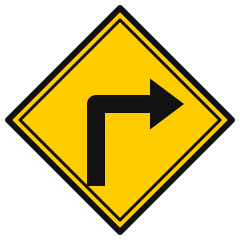
- A mandatory right turn ahead
- A curve of more than 90° to the right
- A gentle curve to the right ahead
- A side road joining from the right
You are caught driving 35 km/h over the limit in a road construction zone marked by signs. How is the fine calculated?
- A flat $1,000 fine applies
- The normal amount is doubled
- The normal amount is tripled
- The normal amount applies
An ambulance with its siren and flashing lights is coming up behind you. What should you do?
- Pull left so it can pass on the right
- Speed up to get out of its way
- Slow down, keep right and stop if needed
- Stop at once in your lane
You are behind a slow car on a two-way road divided by two solid yellow lines side by side. May you cross them to pass?
- Yes, if no car is coming
- Yes, but only during daylight
- Yes, if the car is under the limit
- No, these lines may not be crossed to pass
Your car has five seat belts. How many passengers may you carry?
- As many as fit safely inside
- Six, if one is a small child
- Seven, on short trips only
- No more than one per seat belt
Between which dates may a passenger car in Québec be driven on studded tires?
- October 1 to April 30
- November 1 to April 15
- December 1 to March 15
- October 15 to May 1
A driver is caught using a hand-held phone for the first time. What penalty applies?
- 4 demerit points and a $200 to $300 fine
- 5 demerit points and a $100 to $200 fine
- 3 demerit points and a $100 to $200 fine
- 5 demerit points and a $300 to $600 fine
A driver is caught street racing. What happens to their licence right away?
- It is suspended for 30 days
- It is suspended for 90 days
- It is suspended for 7 days
- It is cancelled for one year
You approach an intersection with a flashing red light and a stop sign. What must you do?
- Stop only if cross traffic is present
- Wait until the light turns solid green
- Stop completely, then yield before going
- Slow down and go if nobody is coming
A driver is caught at 120 km/h in a 70 km/h zone, which counts as excessive speeding. What is the fine?
- $795
- $530
- $315
- $265
Diagonal broken white lines are painted inside a reserved lane just before an intersection. What do they allow drivers in the next lane to do?
- Enter it only to turn at the next corner
- Stop in it to drop off passengers
- Use it to pass slower traffic before the light
- Enter it whenever traffic is light
What does this sign mean?
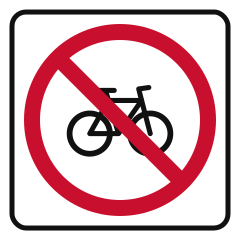
- This lane is reserved for bicycles
- A bicycle crossing is ahead
- Bicycles are not allowed on this road
- Cyclists must walk their bikes here
Keep practising
- SAAQ Class 5 Mock Exam 1 – 30 QuestionsUntimed practice · answers explained
- SAAQ Class 5 Mock Exam 2 – 30 QuestionsUntimed practice · answers explained
- SAAQ Class 5 Mock Exam 3 – 30 QuestionsUntimed practice · answers explained
- SAAQ Class 5 Mock Exam 4 – 30 QuestionsUntimed practice · answers explained
- SAAQ Class 5 Practice Test 130 questions with explanations
- SAAQ Class 5 Practice Test 230 questions with explanations
- SAAQ Class 5 Practice Test 330 questions with explanations
- SAAQ Class 5 Practice Test 430 questions with explanations