You had a few drinks at a party. Which of these actually lowers the amount of alcohol in your body?
SAAQ Class 5 overview
SAAQ Class 5 Practice Test 7
30 questions on vision, fatigue, distraction and attitude, demerit points and licence revocation, right of way, emergency vehicles and school buses, work zones, stopping, parking and unlawful practices, passing, turning and traffic circles and more.
- No sign-up
- Every answer explained
- Independent · not a government site
- Set 7 of 9
- 30 questions
- Instant feedback
0/30
All 30 questions in this test
Every question and its answer choices. The correct answers and explanations appear when you take the test above.
You had a few drinks at a party. Which of these actually lowers the amount of alcohol in your body?
- Waiting for time to pass
- Going for a brisk walk
- Eating a large meal
- Taking a cold shower
For a fully licensed driver aged 25 or older, revocation happens when the record reaches how many points?
- 10 points
- 12 points
- 15 points
- 20 points
An ambulance with its siren and flashing lights is coming up behind you. What should you do?
- Pull left so it can pass on the right
- Speed up to get out of its way
- Slow down, keep right and stop if needed
- Stop at once in your lane
Your car has five seat belts. How many passengers may you carry?
- As many as fit safely inside
- Six, if one is a small child
- Seven, on short trips only
- No more than one per seat belt
You need to run into a store for a minute. Your child is 5 years old. What does the law say?
- You may leave them if the car is locked
- You may not leave the child alone in the car
- You may leave them for up to 5 minutes
- You may leave them with the engine running
On a 70 km/h road with no sidewalk, a person is walking on the shoulder toward you. What minimum distance must you leave as you meet them?
- 1.5 metres
- 50 centimetres
- 1 metre
- 3 metres
You are on a road with two lanes in each direction and you are not passing anyone. Which lane should you use?
- The left-hand lane
- The lane nearest the centre line
- The right-hand lane
- Whichever lane is faster
You turn onto a gravel road with no speed sign. What is the maximum speed allowed?
- 80 km/h
- 70 km/h
- 60 km/h
- 50 km/h
You are the first driver to arrive at a collision on a rural road. About how far away should you park on the shoulder?
- About 5 metres
- About 100 metres
- About 30 metres
- About 150 metres
In a work zone you see an orange sign showing a speed limit. How does it compare with a normal white speed sign?
- It has the same force of law
- It is only a suggested speed
- It applies only when workers are visible
- It applies only to heavy trucks
A farm vehicle displays this sign on its rear. What does the sign tell other drivers?

- It carries hazardous materials
- It is wider than one lane
- It travels at less than 60 km/h
- It travels at less than 40 km/h
Above your lane a red X is lit and next to it a yellow horizontal arrow is flashing. What is expected of you?
- Change lanes with care in the arrow's direction
- Stop and wait for the arrow to turn green
- Stay in your lane; the arrow is for trucks
- Speed up to clear the lane before it closes
After a mechanical inspection, your car is found to need minor repairs. How long do you have to get them done?
- 30 days
- 24 hours
- 48 hours
- 7 days
One prescribed limit combines 2.5 ng of THC per ml of blood with alcohol. At what blood alcohol level does it apply?
- 50 mg per 100 ml or more
- 30 mg per 100 ml or more
- 20 mg per 100 ml or more
- 80 mg per 100 ml or more
Your licence carries condition A. What does it require?
- Driving only an automatic vehicle
- Wearing glasses or contacts to drive
- Using an alcohol ignition interlock
- Driving only during daylight
You hold a learner's licence and your fully licensed father is with you. It is 12:30 a.m. May you drive him home?
- Yes, because a licensed adult is beside you
- Yes, as long as you keep under 50 km/h
- Yes, if the trip is shorter than 10 km
- No, learners may not drive from midnight to 5 a.m.
Which sign shape is reserved for marking school zones?
- Triangle
- Pentagon
- Diamond
- Octagon
On a Québec road, what does a yellow line between two lanes tell you about the traffic in them?
- One lane is reserved for buses and taxis
- Both lanes go the same direction
- Traffic in them goes opposite ways
- The road is about to narrow
What is the minimum time you must hold a learner's licence before you are eligible for the road test?
- 18 months
- 8 months
- 6 months
- 12 months
On a road with a solid centre line, you come up behind a vehicle displaying this sign on its rear. What does the rule allow?
- Passing only where a broken line begins
- Passing only on the right shoulder
- Sounding the horn so it pulls over
- Crossing the solid line to pass it, when safe
You are installing optional fog lights on your car. How high may they be mounted?
- At least 30 cm above the headlights
- Never higher than the headlights
- Above the headlights, on the roof
- Anywhere on the rear bumper
Your light turns green, but a cyclist and two pedestrians are still finishing their crossing in front of you. What should you do?
- Go, because green gives you priority
- Let them clear the intersection first
- Sound your horn so they hurry
- Steer around them slowly
What does this sign require of you?

- Stop and yield to oncoming vehicles
- Merge left because a lane is ending
- Move onto the shoulder to make room
- No special move, just extra alertness
To count as a power-assisted bicycle, what limits must its electric motor meet?
- 750 W, assisting up to 40 km/h
- 1000 W, assisting up to 50 km/h
- 500 W, assisting no faster than 32 km/h
- 250 W, assisting up to 25 km/h
A pedestrian wants to get to the opposite corner of an intersection. When may they cross diagonally?
- Whenever the light is green in their direction
- Only when a sign or signal allows it
- Only at night
- Whenever no cars are coming
You drive a taxi for work. What happens if you are found driving the taxi with any alcohol in your body?
- You get a warning with no penalty
- You may not drive it for 24 hours
- You may not drive it for 90 days
- You may drive it if under 0.05
What does this sign warn of?
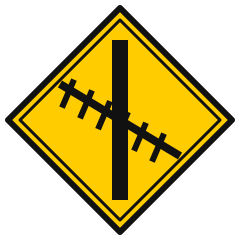
- Railway tracks crossing the road ahead
- A bridge with a metal grid surface
- A side road joining at an angle
- Grooved pavement on the road ahead
The car ahead is very slow and the paved shoulder on the right is wide and empty. May you use the shoulder to pass?
- Yes, if no one is on the shoulder
- No, never
- Yes, if you signal first
- Yes, below 50 km/h
You see this sign at a street corner. What does it tell you?

- Traffic may move only in the arrow's direction
- Your lane ends; merge the way it points
- Two-way traffic is ahead on this street
- You must turn in the arrow's direction
Eighteen months after a first hand-held phone ticket, a driver is caught again. What applies for this first repeat offence?
- At least $1,000 and a 30-day suspension
- At least $600 and a 7-day suspension
- At least $600 and a 3-day suspension
- At least $300 and a 3-day suspension
All SAAQ Class 5 practice tests
- SAAQ Class 5 Mock Exam 1 – 30 QuestionsUntimed practice · answers explained
- SAAQ Class 5 Mock Exam 2 – 30 QuestionsUntimed practice · answers explained
- SAAQ Class 5 Mock Exam 3 – 30 QuestionsUntimed practice · answers explained
- SAAQ Class 5 Mock Exam 4 – 30 QuestionsUntimed practice · answers explained
- SAAQ Class 5 Mock Exam 5 – 30 QuestionsUntimed practice · answers explained
- Traffic lights and signal lightsRed, yellow and green lights, arrows, flashing lights, dark signals, pedestrian countdown lights, cyclist lights, lane-use lights, railway signals, work-site lights and bus priority lights.
- Pavement markingsYellow and white lines, broken, solid, double and combined lines, reversible and two-way left-turn lanes, reserved lanes, stop lines, crosswalks, parking markings and pavement symbols.
- Regulatory signsSign colours and shapes, stop, all-way stop and yield signs, speed limits, one-way and lane direction signs, green-circle and red-circle signs, no passing, parking, stopping and reserved-lane signs.
- Warning signsYellow diamond signs for stops and lights ahead, curves, intersections, lane endings, narrowing roads, steep grades, school zones, crossings, slippery or icy surfaces, hazard markers and chevrons.
- Road work, information and cyclist signsOrange work-site signs, flagperson signals, work-zone speed limits, detours and lane merges, green and blue guide and service signs, exit signs, and signs for cyclists.
About this practice test
How many questions are in SAAQ Class 5 practice test 7?
30 original multiple-choice practice questions covering vision, fatigue, distraction and attitude, demerit points and licence revocation, right of way, emergency vehicles and school buses, work zones, stopping, parking and unlawful practices, passing, turning and traffic circles, seat belts, lane use and speed limits, accidents, insurance and fines, road work, information and cyclist signs, traffic lights and signal lights, your vehicle: registration, equipment and winter tires, alcohol, drugs and impaired driving, licence conditions and driver obligations, getting your class 5 licence, regulatory signs, pavement markings, warning signs, pedestrians, cyclists and motorcycles. Each answer includes an explanation. This mixed practice set does not reproduce the official exam format or predict an official score.
Are the questions the same every time?
Yes. Practice test 7 always has the same 30 questions, so you can repeat it until you get them all right. The other 8 sets use different questions.
Are these real test questions?
No. The official question bank is not published. These are original questions written from the official handbook, which is what the real SAAQ Class 5 test is based on.