A GDL driver's licence is automatically suspended when they reach how many demerit points?
Alberta Class 7 overview
Alberta Class 7 Practice Test 6
30 questions on licensing and the gdl program, speed limits, school and playground zones, pavement markings and lanes, responsible and proactive driving, sharing the road and more.
- No sign-up
- Every answer explained
- Independent · not a government site
- Set 6 of 13
- 30 questions
- Instant feedback
0/30
All 30 questions in this test
Every question and its answer choices. The correct answers and explanations appear when you take the test above.
A GDL driver's licence is automatically suspended when they reach how many demerit points?
- 8
- 6
- 10
- 15
Which of these is NOT one of the standard school zone time periods?
- 6:00 p.m. to 7:00 p.m.
- 11:30 a.m. to 1:30 p.m.
- 3:00 p.m. to 4:30 p.m.
- 8:00 a.m. to 9:30 a.m.
White arrows painted in a lane show:
- Where to park
- The direction of the wind
- The way to the nearest highway or freeway exit
- The movements permitted from that lane
What following distance is recommended for large vehicles such as motor homes?
- Three seconds
- At least four seconds
- Two seconds
- Ten seconds
Where do you take the Class 7 knowledge test in Alberta?
- Online at home
- At an Alberta registry agent office
- At any licensed driving school
- At a police station
At a railway crossing with a stop sign, where must you stop?
- On the tracks
- No closer than 30 metres from the nearest rail
- Within 1 metre of the rail
- Between 5 and 15 metres from the nearest rail
You pass a stopped police car with lights flashing on a street posted at 50 km/h, in the next lane. What is your maximum speed?
- 40 km/h
- 60 km/h
- 30 km/h
- 50 km/h
What does this sign mean?

- 50 km/h is the minimum speed
- You must drive exactly 50 km/h
- The recommended speed for trucks and buses on this road
- 50 km/h is the maximum allowed in ideal conditions
You are waiting in the intersection to turn left. How should your front wheels be pointed?
- It does not matter
- Turned left, ready to go when the gap opens
- Straight ahead, until you begin the turn
- Turned right
In a vehicle with an automatic transmission, which gear should you use to start the engine and when leaving the vehicle parked?
- Reverse
- Drive
- Park
- Neutral
You are approaching a green light and the pedestrian signal shows the 'WALK' symbol. What does this tell you?
- You must yield to every pedestrian on the corner
- The light is about to turn red
- The light is malfunctioning
- The light will probably stay green as you go through
At a four-way stop, who should go first?
- The largest vehicle
- The vehicle that arrived and stopped first
- The vehicle going straight through the intersection
- The vehicle on the left
What does this sign mean?
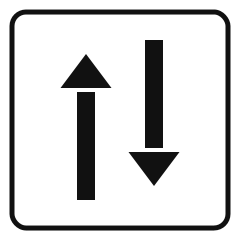
- Divided highway ends
- Passing lane ahead
- Two-way traffic
- Lanes may change direction
You are on a four-lane undivided highway approaching a stopped school bus with red lights flashing from the opposite direction. What must you do?
- Continue, because you are in the opposite direction
- Slow to 30 km/h
- Stop only if you are in the lane next to the bus
- Stop — all lanes in both directions must stop
Do right-of-way rules apply in parking lots?
- No, parking lots are private property with their own rules
- Only if there are painted lines
- Yes, the same right-of-way rules apply
- Only to pedestrians
What causes most skids?
- Driver error, such as speed too high for conditions
- Other drivers who follow too closely
- Sudden mechanical failure of the vehicle's brakes or steering
- Worn or faded paint on the road surface
When should you reduce speed for a curve?
- Only if the road is wet
- In the middle of the curve
- Before entering the curve
- At the end of the curve
What is the length of a first demerit-point suspension?
- One year
- Three months
- One month
- One week
A red X is lit above your lane. What does it mean?
- Do not drive in that lane; oncoming traffic is using it
- The lane is reserved for buses
- You may use the lane to pass
- The lane is closed for construction only at night
Before turning right at an intersection, why should you shoulder check to the right?
- To check for traffic coming from the left
- It is not needed for right turns
- To check for cyclists and pedestrians beside you
- To see the traffic light
What does a solid white line between two lanes mean?
- The lane ends ahead
- Lane changing is permitted
- The lane is for buses
- Lane changing is not permitted
The railway crossing gate is going up but the lights are still flashing. What should you do?
- Stay stopped until gates are up and lights stop
- Cross while the gate is still rising
- Drive around the end of the gate
- Cross as long as you can't see or hear a train coming
About how much more fuel do you use for every 10 km/h you drive above 90 km/h?
- About 10 per cent
- About 1 per cent
- It makes no difference
- About 25 per cent
After passing on a two-lane highway, when is it safe to return to your lane?
- After you count to two from starting the pass
- When you see it in your inside mirror and have shoulder checked
- As soon as your front bumper is ahead of its front bumper
- When the driver you passed flashes their headlights
Turning left from a two-way road onto another two-way road, which lane do you end up in?
- The curb lane
- The lane just left of the yellow line, then move right
- The lane nearest to and right of the yellow line
- Any lane that is open
What does 'overdriving your headlights' mean?
- Driving too fast to stop within your headlight range
- Leaving your headlights on during the day, draining the battery
- Using high beams on city streets
- Driving with only one working headlight
How many demerit points for speeding 31 to 50 km/h over the limit?
- 3
- 4
- 6
- 2
How long do convictions and suspensions remain on your driving record (driver's abstract)?
- 2 years
- For life
- 10 years
- 5 years
After parallel parking, how far from the curb may your wheels be?
- No more than 2 metres
- No more than 1 metre
- No more than 50 cm
- No more than 25 cm
Is using a hands-free phone while driving a safe practice according to the guide?
- Yes, on highways
- No, stop in a safe, legal place to make or take calls
- Yes, hands-free is safe if both hands stay on the wheel
- Yes, if the call is short
All Alberta Class 7 practice tests
- Alberta Class 7 Mock Exam 1 – 30 QuestionsTimed practice · 30 minutes · answers explained
- Alberta Class 7 Mock Exam 2 – 30 QuestionsTimed practice · 30 minutes · answers explained
- Alberta Class 7 Mock Exam 3 – 30 QuestionsTimed practice · 30 minutes · answers explained
- Alberta Class 7 Mock Exam 4 – 30 QuestionsTimed practice · 30 minutes · answers explained
- Alberta Class 7 Mock Exam 5 – 30 QuestionsTimed practice · 30 minutes · answers explained
- Licensing and the GDL programClass 7 learner rules, the knowledge test, Class 5-GDL probation, licence classes, new residents and documents you must carry.
- Traffic lights and signalsSolid, flashing and arrow lights, right and left turns on red, pedestrian signals and lane reversal signals.
- Road signsSign shapes and colours, regulatory, permissive and prohibitive signs, warning, guide and construction signs.
- Speed limits, school and playground zonesDefault speed limits, school zone and playground zone times and speeds, and when you may not pass.
- Pavement markings and lanesYellow and white lines, passing zones, arrows, diamonds, painted islands, bicycle lanes and stop lines.
About this practice test
How many questions are in Alberta Class 7 practice test 6?
30 original multiple-choice practice questions covering licensing and the gdl program, speed limits, school and playground zones, pavement markings and lanes, responsible and proactive driving, sharing the road, road signs, turning, turn lanes and u-turns, driving basics and parking, traffic lights and signals, right-of-way and intersections, emergencies and difficult conditions, highways, passing and merging, demerits, suspensions and impaired driving. Each answer includes an explanation. This mixed practice set does not reproduce the official exam format or predict an official score.
Are the questions the same every time?
Yes. Practice test 6 always has the same 30 questions, so you can repeat it until you get them all right. The other 12 sets use different questions.
Are these real test questions?
No. The official question bank is not published. These are original questions written from the official handbook, which is what the real Alberta Class 7 test is based on.