Alberta Road Signs and Their Meanings
Every road sign in our Alberta Class 7 question bank on one page, with what each one means and what to do, grouped like the Driver's Guide.
- No sign-up
- Every answer explained
- Independent · not a government site
- 41 signs
- Free, no sign-up
This chart collects every sign drawing from our Alberta Class 7 question bank on one page, grouped the way the Driver's Guide teaches them: signal lights, regulatory and warning signs, school and playground zone signs, and pavement markings. Each sign has a short meaning and the action the rule expects from you.
Use it as a quick review before a practice test, then drill the road signs topic test until you score 100%. Alberta's Class 7 test does not publish a separate signs section, but signs, signals and markings come up throughout it. The drawings are our own simplified versions, so learn the shape, colour and symbol.
Road signs
Practise: Road signs
Stop completely, then go when it is safe
The red octagon is a STOP sign. Come to a complete stop and do not proceed until it is safe.

Slow down and give the right-of-way
The yield sign means let traffic not facing the sign and pedestrians go first. Stop only if you need to.

Do not enter
This sign means do not enter. It is often posted at the wrong end of a one-way street or ramp.

Traffic flows only in the direction of the arrow
A one-way sign shows that traffic on the road moves only in the direction of the arrow.
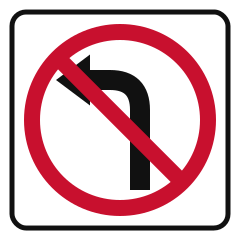
Left turns are not allowed
A red circle and slash over an action means it is prohibited. Here, no left turn.
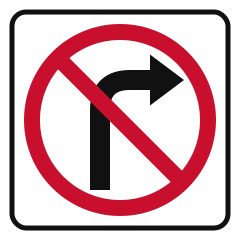
Right turns are not allowed
The red circle and slash over a right-turn arrow means no right turn.

U-turns are not allowed
A U-shaped arrow inside a red circle and slash means U-turns are prohibited.
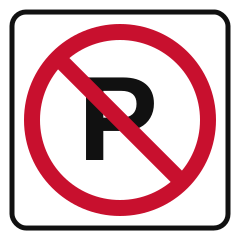
Parking is not allowed
The red circle and slash over P means no parking. An arrow or times below may show where and when it applies.

Do not pass
Two vehicles inside a red circle and slash means passing is not permitted.

50 km/h is the maximum allowed in ideal conditions
Speed limit signs show the maximum under ideal conditions. Slower may be required when conditions are poor.

Keep to the right of the divider ahead
This traffic direction sign means a divider is ahead and you must keep to its right.
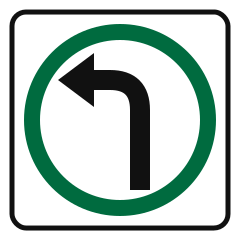
Left turn only
A green circle means the action shown is permitted — here, turning left only.
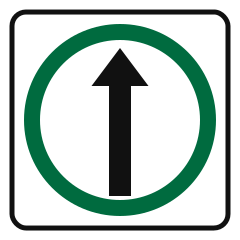
Straight through only
A green circle around a straight arrow means you may only go straight through.
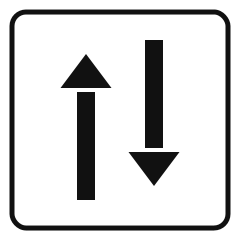
Two-way traffic
This traffic direction sign tells you the road carries traffic in both directions.

School zone
The fluorescent yellow-green pentagon is the school sign. With a speed tab it marks a school zone; without one, a school area.
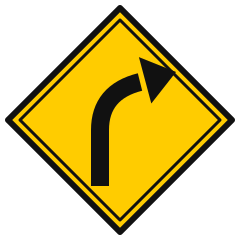
A curve to the right ahead
Yellow diamonds warn of road conditions. This one shows the road curves right ahead.
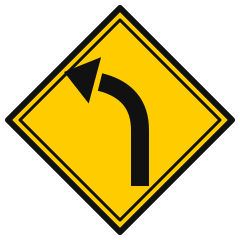
A curve to the left ahead
This warning sign shows the road curves to the left ahead. Slow down before the curve.
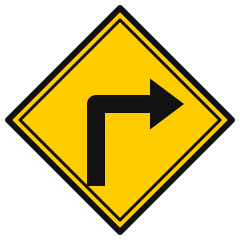
A sharp turn to the right
A right-angled arrow warns of a sharp turn. Slow down before you reach it.

A winding road ahead
The wavy arrow warns that the road winds through several curves.

A stop sign ahead
This warning sign tells you a stop sign is ahead so you can prepare to stop.
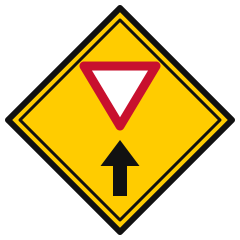
A yield sign ahead
This sign gives advance warning of a yield sign ahead.

Traffic control signals ahead
This sign warns that traffic control signals (lights) are ahead.
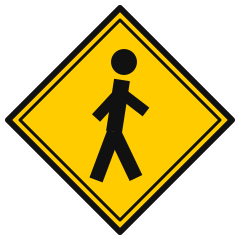
A pedestrian crossing ahead
Watch for people crossing the road ahead and be ready to yield.

Traffic merging from the side
The merging traffic sign warns that two roadways join ahead. Merging is a shared responsibility.

The right lane ends ahead
This sign warns that the right lane ends; drivers in it must merge left safely.

A divided highway begins
The lines separating around a median show a divided highway is beginning.
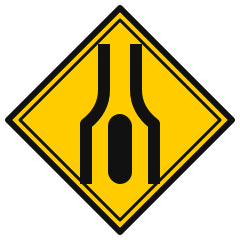
A divided highway ends
The lines coming together after the median show the divided highway ends; expect two-way traffic.

A steep hill ahead
The truck on a slope warns of a steep hill. Check your speed and use a lower gear if needed.

Road is slippery when wet
This warning means the road surface becomes slippery when wet. Slow down in rain.

A bump in the road
This sign warns of a bump in the road surface. Slow down to keep control.
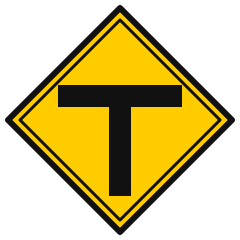
Your road ends at a T intersection
The T shape warns that your road ends at an intersecting road ahead; you must turn left or right.
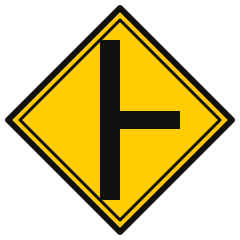
A side road joins from the right
This sign warns of a hidden or side road on the right. Watch for vehicles entering.
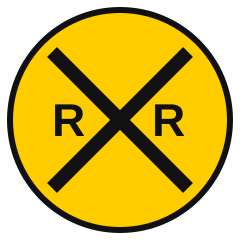
A railway crossing ahead
The round yellow RR sign warns of a railway crossing ahead. Look, listen and slow down.

Yield to trains
The railway crossing sign means you must yield to trains. Stop if a train is visible or signalling within 500 m.
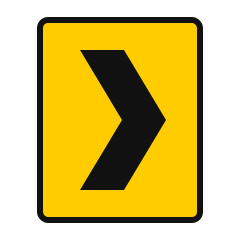
A sharp bend in the road
Chevron signs mark a sharp bend. Slow down and follow the direction they point.

The road narrows ahead
This sign warns that the road narrows. Adjust your speed and position.

People are working on the road ahead
Orange signs mark construction. Slow down, obey the posted limit, and note that fines double when workers are present.

A flag person ahead will direct traffic
A flag person ahead will direct traffic. Obey their signals and be prepared to stop.

Follow a temporary route around a closed road
Orange construction signs give temporary directions. A detour sign shows a temporary route around a closed road.

The vehicle travels under 40 km/h; be ready to slow down
The slow-moving vehicle sign is used on vehicles that travel less than 40 km/h. Be prepared to reduce speed.
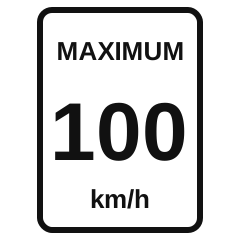
100 km/h is the highest speed allowed in ideal conditions
Speed limits are maximums for ideal conditions. Any speed that is unsafe for conditions is illegal.
FAQ
Alberta road signs chart: common questions
Does the Alberta knowledge test have a separate signs section?
Alberta.ca describes a 30-question multiple-choice test without a separate signs part. Sign, signal and marking questions are mixed in with the rules questions.
What do sign shapes mean in Alberta?
An octagon is always stop, a downward triangle is yield, a pentagon marks school zones, a diamond warns of a hazard, a rectangle gives a regulation or information, and a crossbuck marks a railway crossing.
Where can I see the official signs?
The Driver's Guide from Open Government Alberta shows every sign. Each of our questions cites the guide page it comes from.
Keep practising
- Alberta Class 7 practice test – 125 questionsOne long 125-question Alberta Class 7 practice test across every chapter of the Driver's Guide, with instant feedback and explanations.
- Alberta Class 7 practice test (printable PDF)100 Alberta Class 7 practice questions with an answer key and explanations. Print it or save it as a PDF from your browser. Free, no sign-up.
- Alberta Class 7 study guide
- How to get an Alberta learner's licence
- Alberta Class 5 road test guide
- Alberta Class 7 Mock Exam 1 – 30 QuestionsTimed practice · 30 minutes · answers explained
- Alberta Class 7 Mock Exam 2 – 30 QuestionsTimed practice · 30 minutes · answers explained
- Alberta Class 7 Practice Test 130 questions with explanations
- Alberta Class 7 Practice Test 230 questions with explanations
- Alberta Class 7 Practice Test 330 questions with explanations
Practice by topic
- Licensing and the GDL programClass 7 learner rules, the knowledge test, Class 5-GDL probation, licence classes, new residents and documents you must carry.
- Traffic lights and signalsSolid, flashing and arrow lights, right and left turns on red, pedestrian signals and lane reversal signals.
- Road signsSign shapes and colours, regulatory, permissive and prohibitive signs, warning, guide and construction signs.
- Speed limits, school and playground zonesDefault speed limits, school zone and playground zone times and speeds, and when you may not pass.
- Pavement markings and lanesYellow and white lines, passing zones, arrows, diamonds, painted islands, bicycle lanes and stop lines.
- Driving basics and parkingPre-drive checks, seat and mirrors, steering, signalling, stopping distance, reversing, parallel and hill parking, where not to park.
- Right-of-way and intersectionsStop and yield signs, four-way stops, uncontrolled and T intersections, keeping intersections clear, roundabouts.
- Turning, turn lanes and U-turnsRight and left turns, turning onto one-way streets, dual turn lanes, two-way left turn lanes and where U-turns are illegal.
- Highways, passing and mergingLane position, blind spots, lane changes, passing rules, emergency stopping lanes, merging, weave zones, curves and hills.
- Emergencies and difficult conditionsEmergency braking with and without ABS, skids, breakdowns, night driving, fog, black ice, collisions and emergency vehicles.
- Responsible and proactive drivingScanning, following distance, space cushion, distracted driving, seat belts and child seats, fuel efficiency and general traffic laws.
- Sharing the roadPedestrians, cyclists, motorcycles, large trucks, school buses, snowplows, railway crossings, LRT and funeral processions.
- Demerits, suspensions and impaired drivingDemerit point thresholds and offences, suspensions, fatigue and medication, and Alberta's Immediate Roadside Sanctions.