Turning left from a two-way road onto a one-way road, which lane should you enter?
Alberta Class 7 overview
Alberta Class 7 Practice Test: 125 Questions
One long 125-question Alberta Class 7 practice test across every chapter of the Driver's Guide, with instant feedback and explanations.
- No sign-up
- Every answer explained
- Independent · not a government site
- 125 questions
- Instant feedback
- Free, no sign-up
This page gives you 125 Alberta learner's questions in one test, spread evenly across all 13 topics in our bank: licensing and GDL rules, signs and signals, school and playground zones, right-of-way, turning, highways, emergencies, sharing the road and demerits. Your answers save on your device so you can take breaks.
One hundred and twenty-five questions is about four full knowledge tests. Review every explanation you get wrong and reread that page of the Driver's Guide. When you finish, our 13 shorter practice tests and timed 30-question mock exams still have new questions for you.
0/125
All 125 questions in this test
Every question and its answer choices. The correct answers and explanations appear when you take the test above.
Turning left from a two-way road onto a one-way road, which lane should you enter?
- Any lane, as long as you signal first
- The centre lane of the one-way road
- The first available lane on the left side
- The right-hand lane of the one-way road
When must a collision be reported to police?
- Only when a vehicle must be towed or a driver has no insurance
- When anyone is injured or killed, or damage exceeds $5,000
- Only when the other driver asks
- Only on provincial highways
How do you measure a two-second following distance?
- Count the painted dashes between you and the car
- Count two seconds after the car ahead passes a fixed point
- Keep exactly two car lengths behind the car
- Watch your speedometer and stay under the limit
White arrows painted in a lane show:
- Where to park
- The direction of the wind
- The way to the nearest highway or freeway exit
- The movements permitted from that lane
Unless a different limit is posted, what is the speed limit in a school zone when it is in effect?
- 50 km/h
- 20 km/h
- 30 km/h
- 40 km/h
What does this sign warn of?

- A winding road ahead
- Detour ahead
- Lane changes allowed
- Slippery road
What is threshold braking?
- Braking only with the park brake
- Pumping the brake pedal rapidly
- Braking firmly just short of locking the wheels
- Braking hard enough to lock the wheels for a short time
Within how long must you register your vehicle after moving to Alberta?
- One year
- Three months
- Six months
- 30 days
On a multi-lane highway, which lane should slower traffic use?
- Any lane
- The centre lane, away from merging cars
- The lane furthest to the right
- The left lane
You have the right-of-way, but another driver is clearly not going to stop. What should you do?
- Speed up to get through first
- Sound your horn and continue
- Proceed, because you have the right-of-way and they must stop
- Yield and do everything you can to avoid a collision
A pedestrian is facing a 'DON'T WALK' signal. What may they do?
- Finish crossing only if they had already started
- Start crossing if no cars are coming from either direction
- Cross only at the stop line
- Cross diagonally
A first IRS: FAIL begins with how long a period of no driving at all?
- One year
- 30 days
- 24 hours
- 90 days
How should you pass a cyclist on the road?
- Change lanes as you would to pass another vehicle
- Pass closely in the same lane
- Sound your horn so they move over to the edge of the road
- Pass on the right
How far before an intersection should you be in the proper lane to turn?
- At least 5 metres
- At least 50 metres
- Just before the stop line
- At least 15 metres
A vehicle with flashing green lights approaches. How should you treat it?
- Like any other emergency vehicle
- As a funeral procession
- Ignore it — green lights have no meaning
- As a slow-moving farm vehicle
Why should you stay by the nozzle while fuelling?
- So you can keep an eye on the price
- To stop other drivers using your pump
- Because the pump will shut off if you leave
- Static electricity could ignite the fuel vapours
The centre markings are a solid yellow line beside a broken yellow line. The broken line is on your side. What may you do?
- Not pass under any circumstances
- Pass when it is safe
- Drive on the solid line
- Pass only if the other driver signals
Unless otherwise posted, what is the speed limit on a rural road that is not a provincial highway?
- 60 km/h
- 80 km/h
- 50 km/h
- 100 km/h
What does this sign mean?

- Two-way traffic ahead
- U-turns are not allowed
- Turn around at the next exit
- Winding road ahead
How close to a driveway, garage entrance or private road may you park?
- No closer than 50 centimetres
- No closer than 1.5 metres
- There is no rule
- No closer than 5 metres
How many passengers may a Class 7 learner carry?
- No passengers except the supervisor
- Up to three passengers
- One passenger besides the supervisor
- No more passengers than there are seat belts
You missed your highway exit. What should you do?
- Make a U-turn across the median
- Stop in the lane and wait for a gap to back up to it
- Stop and reverse on the shoulder
- Continue to the next exit and plan a route back
At a four-way stop, two vehicles arrive at the same time. Which goes first?
- The vehicle turning left
- The vehicle on the left
- The vehicle that signals first
- The vehicle on the right
At a traffic light with no pedestrian signals, the light facing a pedestrian is yellow. What should the pedestrian do?
- Wait in the middle of the road
- Cross only if no cars are turning into the pedestrian's path
- Start crossing quickly
- Not enter the intersection, or clear it if already crossing
What credit do you get for completing an approved defensive driving course before reaching 15 points?
- All points are removed from your record
- A 1-point credit
- A 3-point credit for two years
- Nothing
Why should you leave extra space when following a motorcycle?
- It is required by law to leave 10 m
- Motorcycles cannot see behind them
- Motorcycles can stop very quickly
- Motorcycles are always slower
When turning right from a two-way road onto another two-way road, how close to the curb should you stay?
- In the centre of the road
- Within about 1 metre of the curb or edge
- Any distance, as long as you signal
- At least 3 metres from the curb
Your vehicle breaks down on a highway. Where should you place reflective triangles?
- On the roof so they are easy to see
- Behind your vehicle, about 10–20 m apart
- In front of your vehicle, close together
- Beside the driver's door on the road
When stopped behind another vehicle in traffic, how much space should you leave?
- No space, to stop others cutting in
- Enough to pull around it without reversing
- About 30 centimetres
- Exactly one car length
Within an urban area, is passing across a single solid yellow line ever permitted?
- Yes, it is permitted if it can be done safely
- Only at night
- No, never
- Only for emergency vehicles responding to a call
How can you identify a provincial highway?
- By its yellow centre line
- By the absence of speed signs
- By a one-, two- or three-digit highway route marker
- By a road name such as 'Range Road' or 'Township Road'
What does this sign warn of?

- Railway signals ahead
- Traffic control signals ahead
- Pedestrian-activated light only
- Flashing light at a school
How close to a stop sign or yield sign may you park?
- No closer than 10 metres
- Right beside it is allowed
- No closer than 5 metres
- No closer than 1.5 metres
What happens if a parent withdraws consent in writing for their 17-year-old's licence?
- The licence becomes a Class 7 again
- The licence is suspended
- The teen must retake the knowledge test
- Nothing until the next renewal
What is a weave zone?
- A zone where drivers may change lanes freely without signalling
- A section where lane markings are missing
- A construction detour
- A lane shared by vehicles entering and exiting a highway at an interchange
You are in a roundabout and cannot exit safely at your exit. What should you do?
- Stay in your lane and go around the circle again
- Reverse to the exit
- Stop in the circle and wait until the exit lane is clear
- Cut across the lane quickly
A pedestrian crossing sign has flashing yellow lights. What must you do?
- Slow to 50 km/h
- Slow to a maximum of 30 km/h and yield or stop for pedestrians
- Stop and wait until the lights stop flashing, then proceed slowly
- Sound your horn and continue
A fully licensed driver gets a first IRS: WARN. What is the licence suspension?
- 90 days
- Three days
- 24 hours
- 30 days
About how often do snowplow operators pull over to let traffic pass?
- Every 50 kilometres, at the next rest area
- Never
- Every 5 to 8 kilometres, where safe
- Every 500 metres
Outside urban areas, where else are U-turns not permitted?
- On a curve
- On a gravel road
- On a straight, flat road
- At a rural intersection with clear sightlines
An ambulance with its siren on is approaching from behind on a two-way road. What should you do?
- Pull over to the left side of the road
- Pull close to the right curb or edge and stop
- Speed up so you stay ahead of it
- Stop right where you are in your lane
In an urban area, how far ahead should you look while driving?
- 12 to 15 seconds, about a block or more
- Just past the end of your hood
- 40 to 60 seconds ahead of your car
- 2 to 3 seconds ahead of your car
Outside an urban area, what does a single solid yellow centre line mean?
- Only trucks may pass
- The road is one-way
- Passing is permitted with care
- Passing is not permitted
What is the speed limit in a playground zone during its hours, unless otherwise posted?
- 20 km/h
- 30 km/h
- 40 km/h
- 50 km/h
A chevron sign (a series of arrow shapes) on the side of the road indicates:
- A passing lane ahead
- A sharp bend in the road
- A detour
- A one-way street
You park facing downhill on the right side of the road. Which way do you turn your front wheels?
- Left, toward the centre of the road
- Straight ahead
- Right, toward the curb or edge of the road
- Left only if there is no curb
In how many languages is the Class 7 knowledge test offered?
- 25
- 2
- 40
- 10
When should you reduce speed for a curve?
- Only if the road is wet
- In the middle of the curve
- Before entering the curve
- At the end of the curve
May you change lanes inside a two-lane roundabout?
- Only in the right lane
- Yes, after signalling
- No, stay in the lane you entered
- Yes, to reach the lane for your exit
A red X is lit above your lane. What does it mean?
- Do not drive in that lane; oncoming traffic is using it
- The lane is reserved for buses
- You may use the lane to pass
- The lane is closed for construction only at night
Can you appeal a demerit point suspension?
- No, but you can ask for a review of errors
- Yes, by paying a reinstatement fee
- Yes, at any registry agent office
- Yes, through your insurance company
Why are LRT trains in Calgary and Edmonton especially hazardous at crossings?
- They do not use signals
- They are very quiet and may need up to 100 metres to stop
- They never stop at stations
- They have the right-of-way at crossings only at night and on weekends
There is room for only one vehicle ahead of you to wait in the intersection to turn left. Where should you wait?
- Beside the car that is already waiting
- Partly in the oncoming traffic lane
- Inside the crosswalk, ready to go
- Behind the crosswalk until it clears
How far behind an emergency vehicle with its siren or lights on should you follow?
- At least 150 metres
- At least 50 metres
- At least 2 seconds
- At least 500 metres
Which of these is a variable hazard?
- A hidden driveway behind trees
- A child playing near the road
- A merging roadway
- A sharp curve
Are there crosswalks at intersections that have no painted lines?
- Only near schools and playgrounds
- Only at intersections with traffic lights
- Yes, unless a sign says crossing is not allowed
- No, a crosswalk exists only where lines are painted
What happens to speeding fines when you pass stopped emergency vehicles or tow trucks with lights flashing?
- They are tripled
- Demerits are doubled, fines are not
- They stay the same
- They are doubled
What does this sign mean?

- Turn right only
- Keep to the right of the divider ahead
- Merge to the right lane before the bridge
- Right lane ends ahead
Your vehicle has air bags. Must you still wear a seat belt?
- Only on highways
- Yes, seat belts are required by law
- No, air bags replace seat belts
- Only in the front seat
Which of these is required to exit the GDL program and receive a full Class 5 licence?
- No suspensions or traffic violations in the last 12 months of probation
- Holding a probationary licence for five years with no at-fault collisions
- A medical report from a doctor
- Completing a second road test after three years
Your vehicle has no rear side windows or back window. How do you check blind spots?
- Rely on the inside mirror
- You cannot change lanes
- Use outside mirrors with attached convex mirrors
- Sound the horn before changing lanes to warn other drivers
Two vehicles arrive at an uncontrolled intersection at the same time from different roads. Who has the right-of-way?
- The vehicle on the right
- The vehicle on the left
- The vehicle going faster
- The larger vehicle
You are turning left on a solid green light. Who must you yield to?
- Oncoming traffic and pedestrians in the crosswalk
- Only pedestrians
- Only oncoming traffic going faster than you
- Nobody, because the light is green
Who reviews challenges to Alberta's immediate roadside impaired-driving penalties?
- Your insurance company
- SafeRoads Alberta
- The driving school
- The registry agent
Why might a cyclist ride away from the right curb?
- To prepare to stop
- To block cars from passing
- To avoid grates, potholes, debris or slippery surfaces
- Because cyclists must ride in the centre of the lane by law
Turning left from a two-way road onto another two-way road, which lane do you end up in?
- The curb lane
- The lane just left of the yellow line, then move right
- The lane nearest to and right of the yellow line
- Any lane that is open
Your car breaks down on a busy highway in a dangerous spot. Where should passengers wait?
- Out of the vehicle, in a safe spot behind and away from it
- In front of the vehicle
- Standing in the next lane behind the car to wave traffic around it
- Inside the vehicle with seat belts on
Is using a hands-free phone while driving a safe practice according to the guide?
- Yes, on highways
- No, stop in a safe, legal place to make or take calls
- Yes, hands-free is safe if both hands stay on the wheel
- Yes, if the call is short
What does a stop line painted across your lane show?
- Where passing is allowed on a two-lane road
- Where a school or playground zone ends
- Where to stop at an intersection or railway crossing
- Where on-street parking begins on that block
Unless otherwise posted, what is the speed limit on a provincial highway outside an urban area?
- 110 km/h
- 80 km/h
- 90 km/h
- 100 km/h
What does this sign warn of?
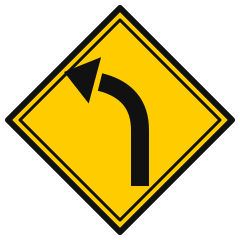
- Left lane ends
- Detour to the left
- A curve to the left ahead
- Left turn only
After parallel parking, how far from the curb may your wheels be?
- No more than 2 metres
- No more than 1 metre
- No more than 50 cm
- No more than 25 cm
What is the minimum time a driver must stay in the Class 5-GDL probationary stage?
- Two years
- Three years
- One year
- Six months
Another vehicle is passing you on a two-lane highway. What should you do?
- Move onto the shoulder and stop until the vehicle has passed
- Speed up
- Stay in your lane and move to the right side of it
- Brake hard
Why are pedestrian crossings at roundabouts set back from the circle?
- For safety and better sightlines for everyone
- To slow down traffic already inside the circle
- To leave space for buses to stop and load
- So drivers in the circle never have to yield
A double red light has the same meaning as:
- A flashing red light
- A yield sign
- A railway signal
- A single solid red light
A second demerit suspension occurs within one year of the first. How long is it?
- Three months
- Six months
- One year
- One month
What does a vehicle with flashing amber and red lights on a winter highway usually mean?
- A snowplow ahead
- A police checkstop
- A school bus
- A tow truck
Turning left from a one-way road onto a two-way road, which lane do you turn from?
- The right-hand lane
- Any lane, as long as you signal and shoulder check first
- The centre lane
- The lane nearest the left side of the one-way road
Why is carbon monoxide especially dangerous?
- It is colourless, odourless and tasteless
- It only builds up in new cars with sealed cabins
- It causes the engine to stall
- It smells strongly of gas
Is it legal to tow a person on skis or a toboggan behind your vehicle?
- No
- Yes, under 20 km/h
- Yes, in winter
- Yes, on private roads only
Diamond markings painted in a lane mean:
- The lane is reserved for specific vehicles
- The lane is ending
- The lane is for passing slower vehicles only
- A railway crossing is ahead
You pass a stopped police car with lights flashing on a street posted at 50 km/h, in the next lane. What is your maximum speed?
- 40 km/h
- 60 km/h
- 30 km/h
- 50 km/h
What does this sign warn of?
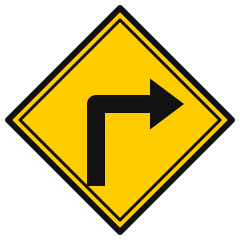
- Side road on the right
- Right turn on red allowed
- Right lane must turn
- A sharp turn to the right
You park on a two-way street and need to get out. What should you do first?
- Sound the horn
- Open the door quickly and all the way so you are not in traffic for long
- Signal right
- Check your mirrors and do a shoulder check for traffic and cyclists
You move to Alberta from another province. How long can you drive on your old licence?
- 1 year
- 30 days
- 90 days
- 6 months
Driving a manual transmission down a steep hill, how can you reduce the risk of brake overheating?
- Shift to a lower gear
- Ride the brake pedal all the way down
- Shift to neutral and coast
- Turn off the engine
A vehicle ahead of you has stopped at a crosswalk. What should you do?
- Sound your horn so the driver moves on
- Stop as well; never pass a car stopped for a pedestrian
- Pass it slowly on the right side
- Pass it carefully on the left if the lane is clear
What must you do at a flashing red light?
- Treat it as a yield sign
- Stop and wait for a green light
- Stop completely, then proceed when safe
- Slow down and proceed with caution without stopping
What happens if you drive while your licence is suspended?
- Only a $100 fine with no other penalty
- Jail or fines, a new suspension and a 30-day seizure
- Your current suspension is shortened
- Only a warning letter mailed by the Registrar of Motor Vehicles
A motorcyclist is riding in the left part of their lane. What does this usually mean?
- They are about to turn left at the corner
- Staying visible; it does not mean a left turn
- They want you to pass them on the right
- Their motorcycle has a mechanical problem
Outside urban areas, U-turns are not permitted near the crest of a hill if a driver approaching within what distance cannot see you?
- 300 metres
- 500 metres
- 50 metres
- 150 metres
What does 'overdriving your headlights' mean?
- Driving too fast to stop within your headlight range
- Leaving your headlights on during the day, draining the battery
- Using high beams on city streets
- Driving with only one working headlight
You are filling a portable gas can. Where should it be?
- On the ground, out of the vehicle
- In the trunk
- In the pickup box, on a rubber bed liner
- On the back seat
Why is a bicycle lane line usually dashed near a corner?
- To mark a crosswalk
- Because the bike lane ends there for cyclists
- To show drivers may enter it to turn right
- To show cyclists must stop
Which of these is NOT one of the standard school zone time periods?
- 6:00 p.m. to 7:00 p.m.
- 11:30 a.m. to 1:30 p.m.
- 3:00 p.m. to 4:30 p.m.
- 8:00 a.m. to 9:30 a.m.
What does this sign mean?

- Follow a temporary route around a closed road
- The speed limit is reduced for the next 1 km
- The road ahead is closed with no way through
- Construction work on this road has finished
How should an adjustable head restraint be positioned?
- Centre level with the top of your ears
- As low as it will go, for comfort
- Touching the roof lining
- Level with the base of your neck
A GDL driver's licence is automatically suspended when they reach how many demerit points?
- 8
- 6
- 10
- 15
Before changing lanes, what must you do in addition to checking your mirrors?
- Sound your horn
- Slow down sharply
- Flash your headlights
- Do a shoulder check
Do right-of-way rules apply in parking lots?
- No, parking lots are private property with their own rules
- Only if there are painted lines
- Yes, the same right-of-way rules apply
- Only to pedestrians
A police officer is directing traffic at an intersection with a green light. Whose direction do you follow?
- The vehicle in front of you
- Whichever is safer in your opinion
- The traffic light
- The officer's
Under IRS ZERO: Novice, how long is the vehicle seized?
- 24 hours
- 30 days
- 7 days
- 3 days
A yellow flashing pedestrian-activated light is ahead. What must you do?
- Slow to 30 km/h and yield to pedestrians wanting to cross
- Stop fully and wait for the flashing light to turn solid green
- Maintain speed
- Treat it as a four-way stop
You are waiting in the intersection to turn left. How should your front wheels be pointed?
- It does not matter
- Turned left, ready to go when the gap opens
- Straight ahead, until you begin the turn
- Turned right
How can you recognize black ice?
- It always looks white and frosty
- It forms only on sunny stretches of road
- It makes a crunching sound under the tires
- The road looks shiny and black, not grey-white
Forward-facing child seats are designed for children weighing about:
- Under 5 kg
- 10 to 18 kg (22 to 40 lb)
- 18 to 36 kg (40 to 80 lb)
- Any weight
A large X painted on a rural highway indicates:
- A no-parking area
- A school crossing
- An approaching railway crossing
- An intersection where U-turns are prohibited
It is Saturday at 8:30 a.m. You drive past a school zone sign with no special times posted. What speed applies?
- The normal posted speed; school zones apply on school days only
- 20 km/h
- 30 km/h, because the zone applies between 8:00 and 9:30 a.m. every day
- 30 km/h at all times
Green rectangular signs with white lettering provide:
- Information such as distance to a destination
- Construction information
- Regulations you must obey, such as speed limits
- Warnings about hazards
There is no curb and your car faces uphill. To keep it from rolling into traffic, which way should the front wheels point?
- Toward any nearby driveway
- Straight ahead
- Left, toward the centre of the road
- Right, toward the edge of the road
Who is responsible for renewing your Alberta driver's licence on time?
- You are; Alberta no longer mails renewal reminders
- Your insurance company
- The registry agent
- The government renews it automatically and mails it to you
Which is the correct order for changing lanes?
- Signal, change lanes, then check your mirrors
- Change lanes, then signal and shoulder check
- Shoulder check, change lanes, then signal
- Mirrors, shoulder check, signal, move, cancel signal
What is the main reason to slow down at an uncontrolled intersection?
- Uncontrolled intersections are always icy
- You must stop at every uncontrolled intersection before entering
- Speed limits are always 30 km/h there
- Your view may be blocked and you must be able to stop easily
The traffic lights in all directions are flashing red. How should you treat the intersection?
- As a yield intersection for side streets only
- As a closed intersection
- As a four-way stop
- As an uncontrolled intersection
A fully licensed driver's licence is automatically suspended at how many demerit points within two years?
- 15
- 12
- 8
- 10
A large truck ahead is turning right. What should you avoid?
- Waiting until it finishes the turn
- Driving into the space on its right side
- Stopping behind it
- Staying well back
In an urban area, where is a U-turn not permitted?
- At a four-way stop
- On a roadway between intersections (mid-block)
- On a one-lane street
- At a quiet residential intersection with no signs
Your vehicle has anti-lock brakes (ABS) and you must stop suddenly. What should you do?
- Pump the brake pedal rapidly
- Release the brake when you feel vibration, then press again
- Apply steady, firm pressure and steer where you want to go
- Brake gently and wait
May someone ride in the open box of a pickup truck?
- Yes, if you drive under 30 km/h
- Yes, if the rider stays seated
- Yes, but only on rural roads
- No, and both of you can be charged
Yellow lines separate traffic travelling in:
- Opposite directions
- Bus lanes
- The same direction
- Turning lanes only
What is the difference between a school zone and a school area?
- A school zone is near high schools; a school area, near elementary ones
- There is no difference
- A school zone has a speed sign attached; a school area does not
- A school area has a lower speed limit
What does this sign mean?

- Traffic flows only in the direction of the arrow
- Right lane ends ahead
- Turn right at the next intersection to stay on route
- Detour to the right
In an automatic, when would you choose a low gear such as 1 or 2?
- On the highway at high speed to save fuel and reduce wear
- When you need more power and less speed, like on hills
- Whenever you are reversing out of a stall
- Only when the vehicle is being towed
Drivers of what age must provide a Driver Medical Intake Form when applying for or renewing a Class 5 licence?
- 70 or older
- 75 or older
- 80 or older
- 65 or older
FAQ
Alberta Class 7 practice test – 125 questions: common questions
Is 125 questions enough to pass the Class 7 test?
It touches every chapter the test draws from. Passing depends more on reviewing what you miss than on raw volume.
How long does a 125-question test take?
Most people need 40 to 60 minutes. You can stop and come back; progress is saved on your device.
Can I print these questions?
Yes. Our printable Alberta practice test page has 100 questions with a separate answer key you can print or save as a PDF.
Keep practising
- Alberta Class 7 practice test (printable PDF)100 Alberta Class 7 practice questions with an answer key and explanations. Print it or save it as a PDF from your browser. Free, no sign-up.
- Alberta road signs chartEvery road sign in our Alberta Class 7 question bank on one page, with what each one means and what to do, grouped like the Driver's Guide.
- Alberta Class 7 study guide
- How to get an Alberta learner's licence
- Alberta Class 5 road test guide
- Alberta Class 7 Mock Exam 1 – 30 QuestionsTimed practice · 30 minutes · answers explained
- Alberta Class 7 Mock Exam 2 – 30 QuestionsTimed practice · 30 minutes · answers explained
- Alberta Class 7 Practice Test 130 questions with explanations
- Alberta Class 7 Practice Test 230 questions with explanations
- Alberta Class 7 Practice Test 330 questions with explanations
Practice by topic
- Licensing and the GDL programClass 7 learner rules, the knowledge test, Class 5-GDL probation, licence classes, new residents and documents you must carry.
- Traffic lights and signalsSolid, flashing and arrow lights, right and left turns on red, pedestrian signals and lane reversal signals.
- Road signsSign shapes and colours, regulatory, permissive and prohibitive signs, warning, guide and construction signs.
- Speed limits, school and playground zonesDefault speed limits, school zone and playground zone times and speeds, and when you may not pass.
- Pavement markings and lanesYellow and white lines, passing zones, arrows, diamonds, painted islands, bicycle lanes and stop lines.
- Driving basics and parkingPre-drive checks, seat and mirrors, steering, signalling, stopping distance, reversing, parallel and hill parking, where not to park.
- Right-of-way and intersectionsStop and yield signs, four-way stops, uncontrolled and T intersections, keeping intersections clear, roundabouts.
- Turning, turn lanes and U-turnsRight and left turns, turning onto one-way streets, dual turn lanes, two-way left turn lanes and where U-turns are illegal.
- Highways, passing and mergingLane position, blind spots, lane changes, passing rules, emergency stopping lanes, merging, weave zones, curves and hills.
- Emergencies and difficult conditionsEmergency braking with and without ABS, skids, breakdowns, night driving, fog, black ice, collisions and emergency vehicles.
- Responsible and proactive drivingScanning, following distance, space cushion, distracted driving, seat belts and child seats, fuel efficiency and general traffic laws.
- Sharing the roadPedestrians, cyclists, motorcycles, large trucks, school buses, snowplows, railway crossings, LRT and funeral processions.
- Demerits, suspensions and impaired drivingDemerit point thresholds and offences, suspensions, fatigue and medication, and Alberta's Immediate Roadside Sanctions.