Alberta Class 7 Practice Test – Printable PDF
100 Alberta Class 7 practice questions with an answer key and explanations. Print it or save it as a PDF from your browser. Free, no sign-up.
- No sign-up
- Every answer explained
- Independent · not a government site
- 100 questions
- Answer key included
- Free, no sign-up
Prefer paper? This page lays out 100 Alberta learner's practice questions with the answer key and explanations on separate pages at the end, so you can test yourself first and check after. Press the print button and choose Save as PDF to keep a copy.
The questions are original and written from the Spring 2026 Driver's Guide, which is free from Open Government Alberta. Each answer cites the guide page it comes from. For instant feedback and timed mock exams, use the interactive tests linked below.
Alberta Class 7 Practice Test – Printable PDF
1.When is a left turn on a red light allowed?
- Only when there are no pedestrians or oncoming vehicles in sight
- Never in Alberta
- From any street, after a complete stop
- From a one-way street onto a one-way street, after a full stop
2.What does a stop line painted across your lane show?
- Where passing is allowed on a two-lane road
- Where a school or playground zone ends
- Where to stop at an intersection or railway crossing
- Where on-street parking begins on that block
3.After you pass the Class 5 road test, what must you do to update your licence?
- Nothing — the permit is your new licence
- Take the road test permit to a registry agent
- Book a second test with the examiner
- Wait for a new licence to arrive in the mail
4.On a multi-lane highway, which lane should slower traffic use?
- Any lane
- The centre lane, away from merging cars
- The lane furthest to the right
- The left lane
5.Why are LRT trains in Calgary and Edmonton especially hazardous at crossings?
- They do not use signals
- They are very quiet and may need up to 100 metres to stop
- They never stop at stations
- They have the right-of-way at crossings only at night and on weekends
6.When are animals most active near roads?
- At midday
- Only in winter
- Only at midnight
- At dusk and dawn
7.A second demerit suspension occurs within one year of the first. How long is it?
- Three months
- Six months
- One year
- One month
8.How far should you sit from the steering wheel?
- As close as possible
- At least 25 cm (10 inches)
- At least 10 cm (4 inches)
- At least 50 cm (20 inches)
9.Turning left from a one-way road onto a two-way road, which lane do you turn from?
- The right-hand lane
- Any lane, as long as you signal and shoulder check first
- The centre lane
- The lane nearest the left side of the one-way road
10.What does this sign warn of?
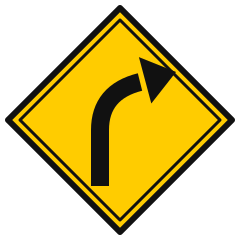
- Right turn only
- Keep to the right of the island
- A curve to the right ahead
- Right lane ends
11.What following distance is recommended for large vehicles such as motor homes?
- Three seconds
- At least four seconds
- Two seconds
- Ten seconds
12.May you change lanes inside a two-lane roundabout?
- Only in the right lane
- Yes, after signalling
- No, stay in the lane you entered
- Yes, to reach the lane for your exit
13.How do you know a school or playground zone has ended?
- One block after the first school or playground sign
- As soon as you can no longer see any children
- At a sign showing a higher speed or the end of the zone
- At the next intersection with traffic lights
14.May you turn right on a red light in Alberta?
- Yes, after a complete stop and yielding, unless a sign prohibits it
- Only between midnight and 6 a.m.
- No, never
- Yes, without a full stop, as long as no traffic or pedestrians are near
15.While driving, on which side of your vehicle should the yellow line be?
- Directly under your vehicle
- It depends on the road
- On your right
- On your left
16.When you are driving, what documents must you produce if a peace officer asks?
- Your licence, registration and proof of insurance
- Your licence and your vehicle bill of sale
- Your licence and your birth certificate
- Your licence only; nothing else is needed
17.What should a slower vehicle do on a highway with a passing lane?
- Pull onto the shoulder and stop
- Move to the right lane so others can pass
- Speed up to match the faster traffic
- Stay in the left lane at a steady speed
18.Your vehicle stalls on a railway crossing and a train is coming. Which way should you move?
- Away from the tracks toward the direction the train is coming from
- Stay inside the vehicle
- Try to restart the engine repeatedly
- Away from the tracks in the direction the train is heading
19.Your right wheels drop off the pavement onto the gravel shoulder. What should you do first?
- Grip firmly, ease off the gas and don't steer back right away
- Brake hard and steer sharply back onto the pavement right away
- Stop in the lane
- Accelerate back onto the road
20.How many demerit points for careless driving?
- 7
- 3
- 6
- 4
21.Your vehicle has air bags. Must you still wear a seat belt?
- Only on highways
- Yes, seat belts are required by law
- No, air bags replace seat belts
- Only in the front seat
22.At a dual right turn intersection with a red light and no sign prohibiting it, may you turn right?
- No, dual turns need a green light
- Only with a green arrow
- Only from the right-most lane, and only after a complete stop
- Yes, after a complete stop when the turn can be made safely
23.What does a speed limit sign tell you?
- The maximum speed allowed in ideal conditions
- The minimum speed allowed
- The average speed of traffic
- The speed you should always drive at on that road
24.About how much more fuel do you use for every 10 km/h you drive above 90 km/h?
- About 10 per cent
- About 1 per cent
- It makes no difference
- About 25 per cent
25.In a two-lane roundabout you plan to go past the first exit. Which lane should you use to enter?
- The right lane
- The right lane, then move left inside
- Either lane
- The left lane
26.A playground sign has no speed limit sign attached. What does it mean?
- Stop before passing the playground, then continue at 30 km/h
- The 30 km/h limit applies all day
- The playground is closed
- A playground area: children may be near, so use caution
27.You are approaching a green light and the pedestrian signal shows the 'WALK' symbol. What does this tell you?
- You must yield to every pedestrian on the corner
- The light is about to turn red
- The light is malfunctioning
- The light will probably stay green as you go through
28.Are there crosswalks at intersections that have no painted lines?
- Only near schools and playgrounds
- Only at intersections with traffic lights
- Yes, unless a sign says crossing is not allowed
- No, a crosswalk exists only where lines are painted
29.Which of the following can a Class 5-GDL driver NOT do?
- Drive at night
- Drive on a highway
- Carry passengers wearing seat belts
- Supervise a Class 7 learner
30.When merging onto a highway, who has the right-of-way?
- Neither; merging is a shared responsibility
- The merging vehicle
- The faster vehicle
- Vehicles already travelling in the right-hand lane
31.Who must wear an approved bicycle helmet in Alberta?
- All cyclists of every age
- Nobody — helmets are optional
- Cyclists and passengers under 18
- Only children under 12
32.Your car breaks down on a busy highway in a dangerous spot. Where should passengers wait?
- Out of the vehicle, in a safe spot behind and away from it
- In front of the vehicle
- Standing in the next lane behind the car to wave traffic around it
- Inside the vehicle with seat belts on
33.A fully licensed driver gets a first IRS: WARN. What is the licence suspension?
- 90 days
- Three days
- 24 hours
- 30 days
34.You park facing uphill on a street with a curb. Which way do you turn your front wheels?
- It does not matter if the park brake is set
- Straight ahead
- Right, toward the curb
- Left, toward the centre of the road
35.You are turning right and a car is parked close to the corner in the curb lane of the street you're entering. Where should you turn?
- Wait until the parked car leaves
- Into the first available lane to the left of the parked car
- Wide into the far lane
- Into the curb lane, then stop behind the parked car
36.What does this sign warn of?

- A steep hill ahead
- Runaway lane
- Truck route
- Falling rock
37.Is it legal to let someone ride in a trailer while it is being towed?
- No
- Yes, on rural roads
- Yes, if they wear a seat belt
- Yes, under 50 km/h
38.You plan to take the first exit of a roundabout. When do you signal?
- Signal right as you approach, and keep it on
- Signal left as you approach the circle
- Do not signal at all for the first exit
- Signal only after you are inside the circle
39.A municipality sets different school zone times. How will you know?
- They are listed only in the city bylaw, not on signs
- School zone times can't be changed
- The times will be posted beneath the school sign
- They are announced on the radio
40.You are turning left on a solid green light. Who must you yield to?
- Oncoming traffic and pedestrians in the crosswalk
- Only pedestrians
- Only oncoming traffic going faster than you
- Nobody, because the light is green
41.Within an urban area, is passing across a single solid yellow line ever permitted?
- Yes, it is permitted if it can be done safely
- Only at night
- No, never
- Only for emergency vehicles responding to a call
42.How much can an approved driver training course shorten the probationary stage?
- Up to six months
- It does not shorten probation
- Up to three months
- Up to one year
43.When should you reduce speed for a curve?
- Only if the road is wet
- In the middle of the curve
- Before entering the curve
- At the end of the curve
44.What does a vehicle with flashing amber and red lights on a winter highway usually mean?
- A snowplow ahead
- A police checkstop
- A school bus
- A tow truck
45.In a vehicle without ABS, the wheels lock during hard braking. What should you do?
- Ease off the brake slightly, then brake again
- Pump the brake pedal as fast as you can
- Press the brake pedal even harder
- Turn the steering wheel sharply
46.What happens if you drive while your licence is suspended?
- Only a $100 fine with no other penalty
- Jail or fines, a new suspension and a 30-day seizure
- Your current suspension is shortened
- Only a warning letter mailed by the Registrar of Motor Vehicles
47.Which of these can you control to shorten your stopping distance?
- Your speed and your alertness
- The weather
- Other drivers' speed around you
- The road surface
48.Before turning left off a two-lane highway, why should you shoulder check to the left?
- To check your blind spot for parked cars
- To check for cyclists on the right
- To make sure no one is passing you on the left
- To look for pedestrians behind you
49.A sign with a red circle and a red diagonal slash over a symbol means:
- The action shown is permitted
- The road ahead is closed
- The action shown is not permitted
- The action shown is recommended
50.Which of these is a distracted-driving offence in Alberta?
- Adjusting your mirrors before driving
- Talking to a passenger
- Listening to the radio
- Entering information into a GPS while driving
51.When entering a roundabout, who must you yield to?
- Nobody, if you signal
- Only buses
- Traffic already in the circle
- Traffic waiting to enter
52.Unless otherwise posted, what is the speed limit on a provincial highway inside a city's limits?
- 100 km/h
- 80 km/h
- 70 km/h
- 50 km/h
53.A pedestrian crossing sign has flashing yellow lights. What must you do?
- Slow to 50 km/h
- Slow to a maximum of 30 km/h and yield or stop for pedestrians
- Stop and wait until the lights stop flashing, then proceed slowly
- Sound your horn and continue
54.Diamond markings painted in a lane mean:
- The lane is reserved for specific vehicles
- The lane is ending
- The lane is for passing slower vehicles only
- A railway crossing is ahead
55.A GDL driver's licence is automatically suspended when they reach how many demerit points?
- 8
- 6
- 10
- 15
56.Is it legal to exceed the speed limit to complete a pass?
- Yes, on two-lane highways
- Yes, by up to 10 km/h
- No, it is illegal
- Yes, if the pass is short
57.When is passing a snowplow strictly prohibited?
- When it is unsafe, blocked from view, or hinders the plow
- Never; snowplows must always let you pass
- Only at night or in blowing snow, when visibility is much lower
- Only inside towns and cities
58.When must you turn on your headlights?
- Only between midnight and 5 a.m.
- Only when it is snowing, raining or foggy outside
- At night, or when you can't see 150 m ahead
- Only on provincial highways
59.A fully licensed driver's licence is automatically suspended at how many demerit points within two years?
- 15
- 12
- 8
- 10
60.What is threshold braking?
- Braking only with the park brake
- Pumping the brake pedal rapidly
- Braking firmly just short of locking the wheels
- Braking hard enough to lock the wheels for a short time
61.Outside urban areas, where else are U-turns not permitted?
- On a curve
- On a gravel road
- On a straight, flat road
- At a rural intersection with clear sightlines
62.What must you do at this sign?

- Yield to trains
- Nothing; it is only information
- Stop every time
- Speed up to cross quickly
63.When stopped behind another vehicle in traffic, how much space should you leave?
- No space, to stop others cutting in
- Enough to pull around it without reversing
- About 30 centimetres
- Exactly one car length
64.Two vehicles arrive at an uncontrolled intersection at the same time from different roads. Who has the right-of-way?
- The vehicle on the right
- The vehicle on the left
- The vehicle going faster
- The larger vehicle
65.It is Saturday at 7:00 p.m. in July. You drive past a playground zone sign. What applies?
- The 30 km/h limit, since it is before one hour after sunset
- No limit applies to playground zones in summer
- The normal speed limit, because it is a weekend
- The normal speed limit, because it is after 4:30 p.m. on a weekend
66.A pedestrian is facing a 'DON'T WALK' signal. What may they do?
- Finish crossing only if they had already started
- Start crossing if no cars are coming from either direction
- Cross only at the stop line
- Cross diagonally
67.White lines separate traffic travelling in:
- Parking lanes
- Opposite directions
- Bicycle lanes only
- The same direction
68.What is the minimum age to apply for a Class 7 learner's licence in Alberta?
- 18
- 15
- 16
- 14
69.What is a blind spot?
- The part of the windshield behind your sun visor
- The road hidden beyond the crest of a hill
- The area beside and behind you that mirrors don't show
- The area directly in front of your hood
70.A pedestrian carrying a white cane is waiting to cross. What does the cane indicate?
- Nothing in particular
- The person is a crossing guard
- The person may be visually impaired
- The person is directing traffic
71.You are on a one-way street and a fire truck with its siren on approaches. Which way do you pull over?
- To the nearest curb, left or right
- Always to the right
- Do not move; stop where you are in your lane
- Always to the left
72.A Class 7 driver is found with any amount of alcohol. Under IRS ZERO: Novice, what is the licence suspension?
- A warning only
- A 90-day suspension after court
- An immediate 30-day suspension
- A 24-hour suspension
73.What is the recommended order of pre-drive habits once you are in the driver's seat?
- Fasten seat belt, start engine, adjust mirrors, lock doors, adjust seat
- Lock doors, adjust seat, adjust head restraint, adjust mirrors, fasten seat belt
- Adjust mirrors, start engine, fasten seat belt, adjust seat, lock doors
- Start engine, adjust seat, fasten seat belt, adjust mirrors, lock doors
74.After a dual turn, the two lanes merge into one. Who must change lanes?
- The driver in the lane that ends
- Whichever driver is going slower
- Neither; both cars may share the lane
- The driver in the lane that continues
75.In a construction zone, speeding fines are doubled when:
- It is after dark
- It is raining
- Workers are present
- Always, at all times
76.Driving without due care and attention or reasonable consideration for others is called:
- Careless driving
- Stunting
- Improper passing
- Impeding traffic
77.Do right-of-way rules apply in parking lots?
- No, parking lots are private property with their own rules
- Only if there are painted lines
- Yes, the same right-of-way rules apply
- Only to pedestrians
78.How can you identify a provincial highway?
- By its yellow centre line
- By the absence of speed signs
- By a one-, two- or three-digit highway route marker
- By a road name such as 'Range Road' or 'Township Road'
79.On a vertical traffic light, what is the order of the lights from top to bottom?
- Yellow, red, green
- Green, yellow, red
- Red, yellow, green
- Red, green, yellow
80.Why should you not stop in a marked 'no stopping zone' near an intersection?
- It is a waiting area for pedestrians at the crossing
- Large vehicles may need that space to turn
- It is reserved for taxis
- It is a bus lane
81.How many passengers may a Class 7 learner carry?
- No passengers except the supervisor
- Up to three passengers
- One passenger besides the supervisor
- No more passengers than there are seat belts
82.When leaving a highway, where should you slow down?
- At the last moment while turning
- On the shoulder
- After you move into the deceleration (exit) lane
- In the highway lane well before the exit ramp begins
83.A train is visible and approaching a crossing. Within what distance must you stop?
- Only if the bells ring
- Only if the gates are down
- When it is within about 500 metres of the crossing
- Only when it is within 50 metres, or about half a block
84.What causes most skids?
- Driver error, such as speed too high for conditions
- Other drivers who follow too closely
- Sudden mechanical failure of the vehicle's brakes or steering
- Worn or faded paint on the road surface
85.If an impaired driving offence causes death or injury, what is the minimum licence suspension, even for a first offence?
- One year
- Six months
- Five years
- Three years
86.At what speed should you reverse?
- As fast as needed to clear traffic
- The posted speed limit
- About 20 km/h
- At a crawl or slow walking speed
87.Where are U-turns not allowed?
- On any residential street with parked cars on both sides
- Anywhere that is not inside a parking lot
- At intersections with traffic lights, unless permitted
- On any road that has a painted centre line
88.What does this sign mean?
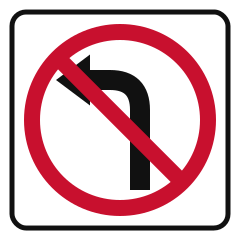
- Sharp curve to the left
- Left lane ends ahead
- Left turn only
- Left turns are not allowed
89.A driver is following you too closely. What should you do?
- Speed up to put more space behind you
- Brake suddenly to warn them off
- If safe, slow slightly so they can pass
- Stop on the shoulder right away
90.You are driving out of a parking lot onto a street across a sidewalk. What must you do?
- Sound your horn and then cross the sidewalk
- Stop before the sidewalk and again before the street
- Drive slowly across without stopping at all
- Stop once, at the edge of the street only
91.What is the difference between a school zone and a school area?
- A school zone is near high schools; a school area, near elementary ones
- There is no difference
- A school zone has a speed sign attached; a school area does not
- A school area has a lower speed limit
92.You face a green arrow together with a solid red light. What may you do?
- Proceed straight only
- Proceed only in the direction of the arrow
- Proceed in any direction
- Stop and wait for the red to change
93.When may you drive across a painted island?
- To pass a slow vehicle when the road is clear
- Whenever traffic in your lane is very heavy
- To stop briefly to pick up a passenger
- Only to get into or out of a driveway or alley
94.Which of these is required to exit the GDL program and receive a full Class 5 licence?
- No suspensions or traffic violations in the last 12 months of probation
- Holding a probationary licence for five years with no at-fault collisions
- A medical report from a doctor
- Completing a second road test after three years
95.Which is the correct order for changing lanes?
- Signal, change lanes, then check your mirrors
- Change lanes, then signal and shoulder check
- Shoulder check, change lanes, then signal
- Mirrors, shoulder check, signal, move, cancel signal
96.You are driving behind a large truck and cannot see either of its side mirrors. What does this mean?
- You are too close; the driver can't see you
- You are following at a safe distance
- The truck is not fitted with side mirrors
- The truck is about to turn right
97.Where should you avoid stopping if your vehicle has mechanical trouble?
- In a parking lot
- On a wide paved shoulder
- On a bridge or in a tunnel
- On a quiet side street
98.A first IRS: FAIL begins with how long a period of no driving at all?
- One year
- 30 days
- 24 hours
- 90 days
99.Outside an urban area your vehicle breaks down and you must stop. What must be true?
- Nothing; any stop is legal during a breakdown
- Others must be able to pass and see you from 60 m away
- You must move your vehicle onto the centre line
- You must be at least 200 m from the nearest curve
100.In an urban area, where is a U-turn not permitted?
- At a four-way stop
- On a roadway between intersections (mid-block)
- On a one-lane street
- At a quiet residential intersection with no signs
Answer key with explanations
1. D — From a one-way street onto a one-way street, after a full stop
Unless a sign prohibits it, the only left turn permitted on red is from a one-way street onto a one-way street, after a full stop and yielding.
Traffic lights and signals · Based on: Driver's Guide (Spring 2026), Ch. 2 Traffic Control, p. 22
2. C — Where to stop at an intersection or railway crossing
Stop lines show where vehicles must stop at intersections or railway crossings.
Pavement markings and lanes · Based on: Driver's Guide (Spring 2026), Ch. 2 Traffic Control, p. 41
3. B — Take the road test permit to a registry agent
You must take the road test permit to a registry agent so your licence can be updated. The road test permit is not a driver's licence.
Licensing and the GDL program · Based on: Driver's Guide (Spring 2026), Ch. 1 Licensing Information, p. 12
4. C — The lane furthest to the right
Slower traffic should use the right-most lane, leaving the left lane free for passing (unless you need it to turn left).
Highways, passing and merging · Based on: Driver's Guide (Spring 2026), Ch. 5 Highways and Freeways, p. 71
5. B — They are very quiet and may need up to 100 metres to stop
LRT trains are electric and quiet. Due to their weight and speed they may need up to 100 metres to stop in an emergency.
Sharing the road · Based on: Driver's Guide (Spring 2026), Ch. 8 Sharing the Road, p. 105
6. D — At dusk and dawn
Be careful at dusk and dawn, scan the roadsides, and remember that if you see one animal there may be more.
Emergencies and difficult conditions · Based on: Driver's Guide (Spring 2026), Ch. 6 Emergency Situations and Challenging Conditions, p. 84
7. A — Three months
A second demerit suspension within one year is an automatic three-month suspension.
Demerits, suspensions and impaired driving · Based on: Driver's Guide (Spring 2026), Ch. 9 Driving within the Law, p. 110
8. B — At least 25 cm (10 inches)
Transport Canada recommends sitting at least 25 centimetres (10 inches) from the steering wheel, with elbows slightly bent.
Driving basics and parking · Based on: Driver's Guide (Spring 2026), Ch. 3 The Basics of Driving, p. 44
9. D — The lane nearest the left side of the one-way road
Turn from the lane nearest the left side of the road into the nearest lane to the right of the yellow line.
Turning, turn lanes and U-turns · Based on: Driver's Guide (Spring 2026), Ch. 4 Intersections and Turns, p. 66
10. C — A curve to the right ahead
Yellow diamonds warn of road conditions. This one shows the road curves right ahead.
Road signs · Based on: Driver's Guide (Spring 2026), Ch. 2 Traffic Control, p. 33
11. B — At least four seconds
Drivers of large vehicles such as motor homes should use a minimum four-second following distance.
Responsible and proactive driving · Based on: Driver's Guide (Spring 2026), Ch. 7 Responsible Driving, p. 90
12. C — No, stay in the lane you entered
Do not change lanes in the circle. Enter, stay in and exit from the same lane.
Right-of-way and intersections · Based on: Driver's Guide (Spring 2026), Ch. 4 Intersections and Turns, p. 62
13. C — At a sign showing a higher speed or the end of the zone
A zone ends where a sign shows a higher maximum speed or the end of the zone.
Speed limits, school and playground zones · Based on: Driver's Guide (Spring 2026), Ch. 2 Traffic Control, p. 31–32
14. A — Yes, after a complete stop and yielding, unless a sign prohibits it
A right turn on red is allowed unless a sign prohibits it. You must first stop completely at the stop line or crosswalk and yield to traffic and pedestrians.
Traffic lights and signals · Based on: Driver's Guide (Spring 2026), Ch. 2 Traffic Control, p. 22
15. D — On your left
A yellow line separates opposing traffic and should always be on the driver's left side.
Pavement markings and lanes · Based on: Driver's Guide (Spring 2026), Ch. 2 Traffic Control, p. 38
16. A — Your licence, registration and proof of insurance
You must carry your licence when driving and, on request, produce your licence, registration and insurance.
Licensing and the GDL program · Based on: Driver's Guide (Spring 2026), Ch. 1 Licensing Information, p. 15
17. B — Move to the right lane so others can pass
On a passing lane, slower vehicles move into the right lane so other vehicles can pass safely in the left lane.
Highways, passing and merging · Based on: Driver's Guide (Spring 2026), Ch. 5 Highways and Freeways, p. 71
18. A — Away from the tracks toward the direction the train is coming from
Get everyone out and away from the track. Move toward the approaching train's direction so you are not hit by flying debris.
Sharing the road · Based on: Driver's Guide (Spring 2026), Ch. 8 Sharing the Road, p. 104
19. A — Grip firmly, ease off the gas and don't steer back right away
Keep a firm grip, don't steer back immediately, ease off the gas and avoid braking. Check traffic, then return gradually at a controlled speed.
Emergencies and difficult conditions · Based on: Driver's Guide (Spring 2026), Ch. 6 Emergency Situations and Challenging Conditions, p. 79
20. C — 6
Careless driving carries 6 demerit points.
Demerits, suspensions and impaired driving · Based on: Driver's Guide (Spring 2026), Ch. 9 Driving within the Law, p. 109
21. B — Yes, seat belts are required by law
You are still required to wear your seat belt in a vehicle with air bags. Seat belts give the greatest protection when worn properly.
Driving basics and parking · Based on: Driver's Guide (Spring 2026), Ch. 3 The Basics of Driving, p. 45
22. D — Yes, after a complete stop when the turn can be made safely
Unless a sign prohibits it, you may turn right on red at a dual right turn intersection after a complete stop, if it's safe.
Turning, turn lanes and U-turns · Based on: Driver's Guide (Spring 2026), Ch. 4 Intersections and Turns, p. 66
23. A — The maximum speed allowed in ideal conditions
Speed limits are maximums for ideal conditions. Any speed that is unsafe for the current conditions is illegal, even if it is under the limit.
Road signs · Based on: Driver's Guide (Spring 2026), Ch. 2 Traffic Control, p. 27
24. A — About 10 per cent
Every 10 km/h above 90 km/h burns about 10 per cent more fuel.
Responsible and proactive driving · Based on: Driver's Guide (Spring 2026), Ch. 7 Responsible Driving, p. 93
25. D — The left lane
Drivers planning to travel past the first exit should enter in the left lane, stay in it, and exit from it. Do not change lanes in the circle.
Right-of-way and intersections · Based on: Driver's Guide (Spring 2026), Ch. 4 Intersections and Turns, p. 62
26. D — A playground area: children may be near, so use caution
A playground sign without a speed tab marks a playground area. No special limit applies, but you must use caution.
Speed limits, school and playground zones · Based on: Driver's Guide (Spring 2026), Ch. 2 Traffic Control, p. 31
27. D — The light will probably stay green as you go through
If the pedestrian signal shows WALK, the green should stay on. If it shows DON'T WALK, the green is stale and you should be ready to stop.
Traffic lights and signals · Based on: Driver's Guide (Spring 2026), Ch. 2 Traffic Control, p. 23
28. C — Yes, unless a sign says crossing is not allowed
Crosswalks exist at intersections even when they are unmarked, unless a sign indicates no crossing.
Pavement markings and lanes · Based on: Driver's Guide (Spring 2026), Ch. 2 Traffic Control, p. 41
29. D — Supervise a Class 7 learner
Probationary drivers cannot act as the supervising driver for a learner and cannot re-class to a commercial licence until they leave the GDL program.
Licensing and the GDL program · Based on: Driver's Guide (Spring 2026), Ch. 1 Licensing Information, p. 10
30. A — Neither; merging is a shared responsibility
Neither the merging vehicle nor the vehicles on the highway have the right-of-way. Both must cooperate to allow a safe merge.
Highways, passing and merging · Based on: Driver's Guide (Spring 2026), Ch. 5 Highways and Freeways, p. 73
31. C — Cyclists and passengers under 18
The law requires cyclists or passengers on a bicycle who are under 18 to wear an approved bicycle safety helmet.
Sharing the road · Based on: Driver's Guide (Spring 2026), Ch. 8 Sharing the Road, p. 97
32. A — Out of the vehicle, in a safe spot behind and away from it
In a potentially dangerous situation, have everyone leave the vehicle and wait at a safe location behind and away from it.
Emergencies and difficult conditions · Based on: Driver's Guide (Spring 2026), Ch. 6 Emergency Situations and Challenging Conditions, p. 80
33. B — Three days
First IRS: WARN: three-day licence suspension, three-day vehicle seizure and a $300 fine plus surcharge.
Demerits, suspensions and impaired driving · Based on: Driver's Guide (Spring 2026), Ch. 9 Driving within the Law, p. 112
34. D — Left, toward the centre of the road
Uphill with a curb, turn the wheels to the left and let the car roll back until the right front tire touches the curb.
Driving basics and parking · Based on: Driver's Guide (Spring 2026), Ch. 3 The Basics of Driving, p. 55
35. B — Into the first available lane to the left of the parked car
If the first lane has a parked car close to the corner, turn into the first available lane to its left, yielding to traffic approaching from your left in that lane.
Turning, turn lanes and U-turns · Based on: Driver's Guide (Spring 2026), Ch. 4 Intersections and Turns, p. 64
36. A — A steep hill ahead
The truck on a slope warns of a steep hill. Check your speed and use a lower gear if needed.
Road signs · Based on: Driver's Guide (Spring 2026), Ch. 2 Traffic Control, p. 35
37. A — No
It is against the law to let a person ride in a trailer while it is being towed.
Responsible and proactive driving · Based on: Driver's Guide (Spring 2026), Ch. 7 Responsible Driving, p. 94
38. A — Signal right as you approach, and keep it on
For the first exit, use your right signal as you approach and leave it on until you have exited.
Right-of-way and intersections · Based on: Driver's Guide (Spring 2026), Ch. 4 Intersections and Turns, p. 61
39. C — The times will be posted beneath the school sign
If a municipality sets times different from the standard ones, the times are posted beneath the school sign.
Speed limits, school and playground zones · Based on: Driver's Guide (Spring 2026), Ch. 2 Traffic Control, p. 31
40. A — Oncoming traffic and pedestrians in the crosswalk
A solid green lets you proceed, but you must yield to oncoming traffic when turning left and to pedestrians in the crosswalk.
Traffic lights and signals · Based on: Driver's Guide (Spring 2026), Ch. 2 Traffic Control, p. 23
41. A — Yes, it is permitted if it can be done safely
Passing safely across a single solid yellow line is permitted within an urban area. In all other cases single or double solid yellow lines mean no passing.
Pavement markings and lanes · Based on: Driver's Guide (Spring 2026), Ch. 2 Traffic Control, p. 38
42. A — Up to six months
Completing an approved driver training course adds condition code U and can reduce probation by up to six months if all other requirements are met.
Licensing and the GDL program · Based on: Driver's Guide (Spring 2026), Ch. 1 Licensing Information, p. 11
43. C — Before entering the curve
If you need to slow down, do it before entering the curve. Look well ahead and keep a safe, steady speed through it.
Highways, passing and merging · Based on: Driver's Guide (Spring 2026), Ch. 5 Highways and Freeways, p. 75
44. A — A snowplow ahead
Remember: flashing amber and red means snowplow ahead.
Sharing the road · Based on: Driver's Guide (Spring 2026), Ch. 8 Sharing the Road, p. 102
45. A — Ease off the brake slightly, then brake again
Locked wheels mean lost steering. Release the brake pedal slightly to regain control, then brake firmly again without locking.
Emergencies and difficult conditions · Based on: Driver's Guide (Spring 2026), Ch. 6 Emergency Situations and Challenging Conditions, p. 78
46. B — Jail or fines, a new suspension and a 30-day seizure
Driving while suspended or disqualified can bring jail, fines, another suspension, and the vehicle is seized for 30 days regardless of owner.
Demerits, suspensions and impaired driving · Based on: Driver's Guide (Spring 2026), Ch. 9 Driving within the Law, p. 111
47. A — Your speed and your alertness
Factors you can control include your scanning, decisions, alertness and fatigue, alcohol or drug use, speed, and the condition of your brakes and tires.
Driving basics and parking · Based on: Driver's Guide (Spring 2026), Ch. 3 The Basics of Driving, p. 50
48. C — To make sure no one is passing you on the left
Before turning left off a two-lane highway, shoulder check left to be sure you are not being passed.
Turning, turn lanes and U-turns · Based on: Driver's Guide (Spring 2026), Ch. 4 Intersections and Turns, p. 65
49. C — The action shown is not permitted
Prohibitive signs show a red circle and slash on a white square. The action inside the circle is not allowed.
Road signs · Based on: Driver's Guide (Spring 2026), Ch. 2 Traffic Control, p. 25
50. D — Entering information into a GPS while driving
Offences include hand-held phone use, texting, using electronic devices, programming audio players or GPS, reading, writing and personal grooming.
Responsible and proactive driving · Based on: Driver's Guide (Spring 2026), Ch. 7 Responsible Driving, p. 91
51. C — Traffic already in the circle
Vehicles entering a traffic circle or roundabout must yield to traffic already in the circle.
Right-of-way and intersections · Based on: Driver's Guide (Spring 2026), Ch. 4 Intersections and Turns, p. 61
52. B — 80 km/h
80 km/h is the maximum on a provincial highway located inside the corporate limits of a city.
Speed limits, school and playground zones · Based on: Driver's Guide (Spring 2026), Ch. 2 Traffic Control, p. 27
53. B — Slow to a maximum of 30 km/h and yield or stop for pedestrians
Flashing yellow lights on school, playground, school crossing or pedestrian crossing signs mean slow to 30 km/h at most and yield or stop for pedestrians.
Traffic lights and signals · Based on: Driver's Guide (Spring 2026), Ch. 2 Traffic Control, p. 24
54. A — The lane is reserved for specific vehicles
Diamond markings show a lane is reserved for specific vehicles. Signs may show times or vehicle types.
Pavement markings and lanes · Based on: Driver's Guide (Spring 2026), Ch. 2 Traffic Control, p. 39
55. A — 8
GDL drivers are suspended at 8 or more demerit points within two years. Fully licensed drivers are suspended at 15.
Licensing and the GDL program · Based on: Driver's Guide (Spring 2026), Ch. 1 Licensing Information, p. 10, 108
56. C — No, it is illegal
It is illegal to exceed the speed limit when passing another vehicle. If you can't pass safely within the limit, don't pass.
Highways, passing and merging · Based on: Driver's Guide (Spring 2026), Ch. 5 Highways and Freeways, p. 72
57. A — When it is unsafe, blocked from view, or hinders the plow
Passing is prohibited when the view along the side is obstructed, passing impedes the plow, or it cannot be done safely.
Sharing the road · Based on: Driver's Guide (Spring 2026), Ch. 8 Sharing the Road, p. 102
58. C — At night, or when you can't see 150 m ahead
Headlights are required at night or any time you can't see clearly 150 metres (500 feet) in front. Daytime running lights are not enough at night.
Emergencies and difficult conditions · Based on: Driver's Guide (Spring 2026), Ch. 6 Emergency Situations and Challenging Conditions, p. 81
59. A — 15
Fully licensed drivers get a warning letter at 8–14 points and are automatically suspended at 15 or more within two years.
Demerits, suspensions and impaired driving · Based on: Driver's Guide (Spring 2026), Ch. 9 Driving within the Law, p. 108
60. C — Braking firmly just short of locking the wheels
Threshold braking applies the brakes without locking the wheels, giving maximum braking while you can still steer.
Driving basics and parking · Based on: Driver's Guide (Spring 2026), Ch. 3 The Basics of Driving, p. 50
61. A — On a curve
Outside urban areas you may not make a U-turn on a curve or near the crest of a hill where you can't be seen within 150 m.
Turning, turn lanes and U-turns · Based on: Driver's Guide (Spring 2026), Ch. 4 Intersections and Turns, p. 67
62. A — Yield to trains
The railway crossing sign means you must yield to trains. Stop if a train is visible or signalling within 500 m.
Road signs · Based on: Driver's Guide (Spring 2026), Ch. 2 Traffic Control, p. 103
63. B — Enough to pull around it without reversing
Leave enough room to move into another lane without reversing. This reduces the risk of being pushed into the vehicle ahead and lets you escape a skidding car.
Responsible and proactive driving · Based on: Driver's Guide (Spring 2026), Ch. 7 Responsible Driving, p. 90
64. A — The vehicle on the right
At an intersection with no signs or signals, you must yield the right-of-way to a vehicle on your right.
Right-of-way and intersections · Based on: Driver's Guide (Spring 2026), Ch. 4 Intersections and Turns, p. 59
65. A — The 30 km/h limit, since it is before one hour after sunset
Playground zones run every day from 8:30 a.m. to one hour after sunset. On a July evening the sun sets late, so the zone is still in effect.
Speed limits, school and playground zones · Based on: Driver's Guide (Spring 2026), Ch. 2 Traffic Control, p. 31
66. A — Finish crossing only if they had already started
Pedestrians must not enter the crosswalk on DON'T WALK. Those who already started crossing may continue and clear the crosswalk.
Traffic lights and signals · Based on: Driver's Guide (Spring 2026), Ch. 2 Traffic Control, p. 23
67. D — The same direction
White lines mean vehicles on each side of the line travel in the same direction.
Pavement markings and lanes · Based on: Driver's Guide (Spring 2026), Ch. 2 Traffic Control, p. 39
68. D — 14
You can apply for a Class 7 learner's licence at 14 or older. You also need a vision screening, a passed knowledge test, valid ID and, if under 18, parental consent.
Licensing and the GDL program · Based on: Driver's Guide (Spring 2026), Ch. 1 Licensing Information, p. 10
69. C — The area beside and behind you that mirrors don't show
Mirrors don't show what is right beside and slightly behind you in the next lanes. These are blind spots; check them with a shoulder check.
Highways, passing and merging · Based on: Driver's Guide (Spring 2026), Ch. 5 Highways and Freeways, p. 70
70. C — The person may be visually impaired
Be considerate of visually impaired pedestrians; some use a white cane or a guide dog.
Sharing the road · Based on: Driver's Guide (Spring 2026), Ch. 8 Sharing the Road, p. 97
71. A — To the nearest curb, left or right
On one-way streets, move right or left to the nearest curb and stop until the emergency vehicle has passed.
Emergencies and difficult conditions · Based on: Driver's Guide (Spring 2026), Ch. 6 Emergency Situations and Challenging Conditions, p. 85
72. C — An immediate 30-day suspension
IRS ZERO: Novice brings an immediate 30-day licence suspension, a seven-day vehicle seizure and a $200 fine plus a 20% victim surcharge.
Demerits, suspensions and impaired driving · Based on: Driver's Guide (Spring 2026), Ch. 9 Driving within the Law, p. 112
73. B — Lock doors, adjust seat, adjust head restraint, adjust mirrors, fasten seat belt
The guide's order is: lock doors, adjust seat and seat back, adjust head restraint, adjust mirrors, then fasten your seat belt.
Driving basics and parking · Based on: Driver's Guide (Spring 2026), Ch. 3 The Basics of Driving, p. 44
74. A — The driver in the lane that ends
The driver in the lane that ends must change to the available lane by following the proper steps for a lane change.
Turning, turn lanes and U-turns · Based on: Driver's Guide (Spring 2026), Ch. 4 Intersections and Turns, p. 66
75. C — Workers are present
The construction speed limit always applies, and when workers are present the fines are doubled.
Road signs · Based on: Driver's Guide (Spring 2026), Ch. 2 Traffic Control, p. 37
76. A — Careless driving
Driving without care and attention, or without reasonable consideration for others, can lead to a careless driving conviction — 6 demerit points.
Responsible and proactive driving · Based on: Driver's Guide (Spring 2026), Ch. 7 Responsible Driving, p. 95
77. C — Yes, the same right-of-way rules apply
Parking lots have intersections without signs or signals, and the right-of-way rules apply.
Right-of-way and intersections · Based on: Driver's Guide (Spring 2026), Ch. 4 Intersections and Turns, p. 60
78. C — By a one-, two- or three-digit highway route marker
Provincial highways have single-, two- or three-digit route markers. Local roads usually have names such as TWP RD or RGE RD.
Speed limits, school and playground zones · Based on: Driver's Guide (Spring 2026), Ch. 2 Traffic Control, p. 27
79. C — Red, yellow, green
Vertical signals show red at the top, yellow in the centre and green at the bottom. Horizontal signals show red on the left and green on the right.
Traffic lights and signals · Based on: Driver's Guide (Spring 2026), Ch. 2 Traffic Control, p. 22
80. B — Large vehicles may need that space to turn
No stopping zones are usually where large vehicles need extra room to turn from one roadway to another.
Pavement markings and lanes · Based on: Driver's Guide (Spring 2026), Ch. 2 Traffic Control, p. 41
81. D — No more passengers than there are seat belts
GDL drivers may not have more passengers than seat belts in the vehicle. Having extra passengers is a 2-point demerit offence for GDL drivers.
Licensing and the GDL program · Based on: Driver's Guide (Spring 2026), Ch. 1 Licensing Information, p. 10
82. C — After you move into the deceleration (exit) lane
Keep your speed on the highway, move into the deceleration lane, then slow down. Don't make last-minute turn-offs.
Highways, passing and merging · Based on: Driver's Guide (Spring 2026), Ch. 5 Highways and Freeways, p. 74
83. C — When it is within about 500 metres of the crossing
Stop when a train is visible or sounding a signal and approaching within 500 metres (about five city blocks) of the crossing.
Sharing the road · Based on: Driver's Guide (Spring 2026), Ch. 8 Sharing the Road, p. 103
84. A — Driver error, such as speed too high for conditions
Most skids result from driver error: too fast for conditions, steering too sharply, braking too firmly or accelerating too quickly.
Emergencies and difficult conditions · Based on: Driver's Guide (Spring 2026), Ch. 6 Emergency Situations and Challenging Conditions, p. 78
85. C — Five years
If a death or injury occurs as a result of an impaired offence, the minimum licence suspension is five years, even for a first offender.
Demerits, suspensions and impaired driving · Based on: Driver's Guide (Spring 2026), Ch. 9 Driving within the Law, p. 111
86. D — At a crawl or slow walking speed
All reversing must be done at a crawl or slow walking speed, only when your path is clear.
Driving basics and parking · Based on: Driver's Guide (Spring 2026), Ch. 3 The Basics of Driving, p. 51
87. C — At intersections with traffic lights, unless permitted
U-turns are not permitted at intersections with traffic lights unless a traffic control device permits them, or where a sign prohibits them.
Turning, turn lanes and U-turns · Based on: Driver's Guide (Spring 2026), Ch. 4 Intersections and Turns, p. 67
88. D — Left turns are not allowed
A red circle and slash over an action means it is prohibited. Here, no left turn.
Road signs · Based on: Driver's Guide (Spring 2026), Ch. 2 Traffic Control, p. 29
89. C — If safe, slow slightly so they can pass
Reduce speed just enough to encourage them to pass. If they don't, create a wider space cushion between you and the vehicle ahead.
Responsible and proactive driving · Based on: Driver's Guide (Spring 2026), Ch. 7 Responsible Driving, p. 89
90. B — Stop before the sidewalk and again before the street
When exiting service roads, alleys, parking lots and driveways, stop before any sidewalk crossing and before entering the main street, and yield to pedestrians.
Right-of-way and intersections · Based on: Driver's Guide (Spring 2026), Ch. 4 Intersections and Turns, p. 60
91. C — A school zone has a speed sign attached; a school area does not
A school sign with a maximum speed attached marks a school zone. Without a speed sign it is a school area, where you must use caution.
Speed limits, school and playground zones · Based on: Driver's Guide (Spring 2026), Ch. 2 Traffic Control, p. 30–31
92. B — Proceed only in the direction of the arrow
With a green arrow and a red light, you may proceed without stopping only in the direction the arrow shows.
Traffic lights and signals · Based on: Driver's Guide (Spring 2026), Ch. 2 Traffic Control, p. 23
93. D — Only to get into or out of a driveway or alley
Painted islands are not for travel. You may cross one only to enter or leave a driveway, alleyway or private drive, and you must not stop or park on it.
Pavement markings and lanes · Based on: Driver's Guide (Spring 2026), Ch. 2 Traffic Control, p. 40
94. A — No suspensions or traffic violations in the last 12 months of probation
To exit GDL you must be at least 18, have at least two years of probation, and have no suspensions or violations in the last 12 months of it, including zero alcohol and drugs.
Licensing and the GDL program · Based on: Driver's Guide (Spring 2026), Ch. 1 Licensing Information, p. 11
95. D — Mirrors, shoulder check, signal, move, cancel signal
Make sure the change is permitted, check mirrors, shoulder check, signal, change lanes while maintaining speed, then ensure the signal is off.
Highways, passing and merging · Based on: Driver's Guide (Spring 2026), Ch. 5 Highways and Freeways, p. 71
96. A — You are too close; the driver can't see you
If you can't see both of its side mirrors you are too close. If you can see the driver in a side mirror, the driver can see you.
Sharing the road · Based on: Driver's Guide (Spring 2026), Ch. 8 Sharing the Road, p. 99
97. C — On a bridge or in a tunnel
Do not stop on a bridge or in a tunnel; it can be very dangerous. Move to a safe location if possible.
Emergencies and difficult conditions · Based on: Driver's Guide (Spring 2026), Ch. 6 Emergency Situations and Challenging Conditions, p. 80
98. D — 90 days
IRS: FAIL starts with 90 days of no driving, followed by a further 12-month suspension during which the driver may join the ignition interlock program.
Demerits, suspensions and impaired driving · Based on: Driver's Guide (Spring 2026), Ch. 9 Driving within the Law, p. 113
99. B — Others must be able to pass and see you from 60 m away
Outside urban areas, do not park unless there is a clear passage for other vehicles and your vehicle can be seen for 60 metres in both directions.
Driving basics and parking · Based on: Driver's Guide (Spring 2026), Ch. 3 The Basics of Driving, p. 56
100. B — On a roadway between intersections (mid-block)
In urban areas, U-turns are not permitted between intersections, at an alley intersection, or where one roadway is an access to a public parking lot.
Turning, turn lanes and U-turns · Based on: Driver's Guide (Spring 2026), Ch. 4 Intersections and Turns, p. 67
Original practice questions by Canada Exam Prep, written from the official handbook. Not official test questions. Free to print for personal study.
FAQ
Alberta Class 7 practice test (printable PDF): common questions
Is there an official Alberta knowledge test PDF?
Alberta does not publish the test questions. The official study material is the Driver's Guide PDF from open.alberta.ca. Practice question PDFs, including this one, are written by third parties.
How do I save this page as a PDF?
Press Print or save as PDF, then pick Save as PDF as the printer. The site header, buttons and ads do not print.
Are answers included?
Yes, on a separate answer key after question 100, with the correct letter, a short explanation and the Driver's Guide page.
Keep practising
- Alberta Class 7 practice test – 125 questionsOne long 125-question Alberta Class 7 practice test across every chapter of the Driver's Guide, with instant feedback and explanations.
- Alberta road signs chartEvery road sign in our Alberta Class 7 question bank on one page, with what each one means and what to do, grouped like the Driver's Guide.
- Alberta Class 7 study guide
- How to get an Alberta learner's licence
- Alberta Class 5 road test guide
- Alberta Class 7 Mock Exam 1 – 30 QuestionsTimed practice · 30 minutes · answers explained
- Alberta Class 7 Mock Exam 2 – 30 QuestionsTimed practice · 30 minutes · answers explained
- Alberta Class 7 Practice Test 130 questions with explanations
- Alberta Class 7 Practice Test 230 questions with explanations
- Alberta Class 7 Practice Test 330 questions with explanations
Practice by topic
- Licensing and the GDL programClass 7 learner rules, the knowledge test, Class 5-GDL probation, licence classes, new residents and documents you must carry.
- Traffic lights and signalsSolid, flashing and arrow lights, right and left turns on red, pedestrian signals and lane reversal signals.
- Road signsSign shapes and colours, regulatory, permissive and prohibitive signs, warning, guide and construction signs.
- Speed limits, school and playground zonesDefault speed limits, school zone and playground zone times and speeds, and when you may not pass.
- Pavement markings and lanesYellow and white lines, passing zones, arrows, diamonds, painted islands, bicycle lanes and stop lines.
- Driving basics and parkingPre-drive checks, seat and mirrors, steering, signalling, stopping distance, reversing, parallel and hill parking, where not to park.
- Right-of-way and intersectionsStop and yield signs, four-way stops, uncontrolled and T intersections, keeping intersections clear, roundabouts.
- Turning, turn lanes and U-turnsRight and left turns, turning onto one-way streets, dual turn lanes, two-way left turn lanes and where U-turns are illegal.
- Highways, passing and mergingLane position, blind spots, lane changes, passing rules, emergency stopping lanes, merging, weave zones, curves and hills.
- Emergencies and difficult conditionsEmergency braking with and without ABS, skids, breakdowns, night driving, fog, black ice, collisions and emergency vehicles.
- Responsible and proactive drivingScanning, following distance, space cushion, distracted driving, seat belts and child seats, fuel efficiency and general traffic laws.
- Sharing the roadPedestrians, cyclists, motorcycles, large trucks, school buses, snowplows, railway crossings, LRT and funeral processions.
- Demerits, suspensions and impaired drivingDemerit point thresholds and offences, suspensions, fatigue and medication, and Alberta's Immediate Roadside Sanctions.