In Alberta, what happens to your licence plate when you sell your vehicle?
Alberta Class 7 overview
Alberta Class 7 Practice Test 4
30 questions on licensing and the gdl program, turning, turn lanes and u-turns, highways, passing and merging, sharing the road, road signs and more.
- No sign-up
- Every answer explained
- Independent · not a government site
- Set 4 of 13
- 30 questions
- Instant feedback
0/30
All 30 questions in this test
Every question and its answer choices. The correct answers and explanations appear when you take the test above.
In Alberta, what happens to your licence plate when you sell your vehicle?
- The plate stays with the vehicle
- The plate must be returned to the police
- The plate stays with you, the owner
- The buyer keeps the plate
What is the 'curb lane'?
- The lane by the curb, used for driving and turning
- An emergency lane for breakdowns
- A lane reserved only for parked and stopped vehicles
- A lane reserved for bicycles only
When is it illegal to pass another vehicle?
- When there is a broken yellow line on your side
- On a multi-lane highway
- When the other vehicle is under the limit
- When another vehicle has stopped to let a pedestrian cross
When stopping for a pedestrian at a crosswalk, how far back should you stop?
- About two to three car lengths
- Half a car length
- Right at the edge of the crosswalk
- Ten car lengths
A 'free flow' or added-lane warning sign means:
- Traffic from the right must merge ahead
- The speed limit ends at the next sign
- The highway ahead is a toll-free route
- Roads ahead run side by side but do not join
The traffic lights in all directions are flashing red. How should you treat the intersection?
- As a yield intersection for side streets only
- As a closed intersection
- As a four-way stop
- As an uncontrolled intersection
It is Saturday at 7:00 p.m. in July. You drive past a playground zone sign. What applies?
- The 30 km/h limit, since it is before one hour after sunset
- No limit applies to playground zones in summer
- The normal speed limit, because it is a weekend
- The normal speed limit, because it is after 4:30 p.m. on a weekend
Your car breaks down on a busy highway in a dangerous spot. Where should passengers wait?
- Out of the vehicle, in a safe spot behind and away from it
- In front of the vehicle
- Standing in the next lane behind the car to wave traffic around it
- Inside the vehicle with seat belts on
What do yellow diamond-shaped signs do?
- Mark construction zones
- Give rules you must obey
- Warn of a hazard or change in the road ahead
- Show directions and distances to destinations
You are driving below the speed limit in heavy snow, but too fast to stop safely. Are you breaking the law?
- Only on a provincial highway
- Yes, any speed unsafe for conditions is illegal
- Only if you are in a school, playground or construction zone
- No, you are under the limit
Outside an urban area, what does a single solid yellow centre line mean?
- Only trucks may pass
- The road is one-way
- Passing is permitted with care
- Passing is not permitted
When turning right from a two-way road onto another two-way road, how close to the curb should you stay?
- In the centre of the road
- Within about 1 metre of the curb or edge
- Any distance, as long as you signal
- At least 3 metres from the curb
What does this sign warn of?
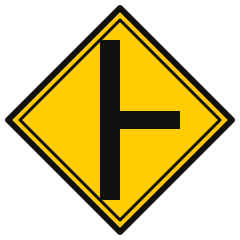
- Right turn only
- Detour right
- A side road joins from the right
- The right lane ends just past the sign
What does an ignition interlock device do?
- Locks the doors automatically when parked
- Tracks your speed and reports any speeding directly to police
- Stops the car starting if breath alcohol is too high
- Records any phone use while you drive
How do you measure a two-second following distance?
- Count the painted dashes between you and the car
- Count two seconds after the car ahead passes a fixed point
- Keep exactly two car lengths behind the car
- Watch your speedometer and stay under the limit
Which of these is required to exit the GDL program and receive a full Class 5 licence?
- No suspensions or traffic violations in the last 12 months of probation
- Holding a probationary licence for five years with no at-fault collisions
- A medical report from a doctor
- Completing a second road test after three years
At a stop sign with a painted stop line, where must you stop?
- Past the stop line, at the crosswalk
- Before the stop line
- At the edge of the intersecting road
- On the stop line
How can you recognize black ice?
- It always looks white and frosty
- It forms only on sunny stretches of road
- It makes a crunching sound under the tires
- The road looks shiny and black, not grey-white
When should you turn on your right signal to leave a single-lane roundabout at the third exit?
- You do not need to signal
- As soon as you enter the roundabout
- After you pass the exit just before yours
- Before you enter the roundabout
The light turns from green to yellow as you approach. What should you do?
- Stop immediately, even if you are in the intersection
- Continue at the same speed; yellow means caution only
- Speed up to get through before it turns red
- Stop before the stop line unless you are too close to stop safely
A GDL driver receives a warning letter about their demerit standing at how many points?
- 1 to 3
- 8 to 14
- 4 to 7
- 10 to 15
A child weighs more than 18 kg (40 lb). What should they use before using only the seat belt?
- A forward-facing seat without tether
- An approved booster seat
- Nothing extra
- A rear-facing seat
You are driving out of a parking lot onto a street across a sidewalk. What must you do?
- Sound your horn and then cross the sidewalk
- Stop before the sidewalk and again before the street
- Drive slowly across without stopping at all
- Stop once, at the edge of the street only
A tire goes flat while you are driving. What should you do first?
- Steer onto the shoulder at full speed before the tire comes apart
- Brake hard immediately
- Hold the wheel firmly and ease off the gas; don't brake hard
- Accelerate to keep control
Driving a manual transmission down a steep hill, how can you reduce the risk of brake overheating?
- Shift to a lower gear
- Ride the brake pedal all the way down
- Shift to neutral and coast
- Turn off the engine
When must you use your signal lights?
- When moving away from the curb, turning, or changing lanes
- Only when other vehicles or pedestrians are close enough to see it
- Only when turning left
- Only on highways
You are leaving a parking spot on the right side of a two-way road. Which signal should you use?
- Hazard lights
- Right signal
- Left signal
- No signal is needed
Driving through a residential area, how can you spot children who may run out?
- Sound your horn every block or so
- Watch for flashing lights on the houses
- Listen carefully for children's voices with your windows down
- Look under parked cars for feet, toys or bike wheels
While driving, on which side of your vehicle should the yellow line be?
- Directly under your vehicle
- It depends on the road
- On your right
- On your left
Within an urban area, is passing across a single solid yellow line ever permitted?
- Yes, it is permitted if it can be done safely
- Only at night
- No, never
- Only for emergency vehicles responding to a call
All Alberta Class 7 practice tests
- Alberta Class 7 Mock Exam 1 – 30 QuestionsTimed practice · 30 minutes · answers explained
- Alberta Class 7 Mock Exam 2 – 30 QuestionsTimed practice · 30 minutes · answers explained
- Alberta Class 7 Mock Exam 3 – 30 QuestionsTimed practice · 30 minutes · answers explained
- Alberta Class 7 Mock Exam 4 – 30 QuestionsTimed practice · 30 minutes · answers explained
- Alberta Class 7 Mock Exam 5 – 30 QuestionsTimed practice · 30 minutes · answers explained
- Licensing and the GDL programClass 7 learner rules, the knowledge test, Class 5-GDL probation, licence classes, new residents and documents you must carry.
- Traffic lights and signalsSolid, flashing and arrow lights, right and left turns on red, pedestrian signals and lane reversal signals.
- Road signsSign shapes and colours, regulatory, permissive and prohibitive signs, warning, guide and construction signs.
- Speed limits, school and playground zonesDefault speed limits, school zone and playground zone times and speeds, and when you may not pass.
- Pavement markings and lanesYellow and white lines, passing zones, arrows, diamonds, painted islands, bicycle lanes and stop lines.
About this practice test
How many questions are in Alberta Class 7 practice test 4?
30 original multiple-choice practice questions covering licensing and the gdl program, turning, turn lanes and u-turns, highways, passing and merging, sharing the road, road signs, traffic lights and signals, speed limits, school and playground zones, emergencies and difficult conditions, pavement markings and lanes, demerits, suspensions and impaired driving, responsible and proactive driving, right-of-way and intersections, driving basics and parking. Each answer includes an explanation. This mixed practice set does not reproduce the official exam format or predict an official score.
Are the questions the same every time?
Yes. Practice test 4 always has the same 30 questions, so you can repeat it until you get them all right. The other 12 sets use different questions.
Are these real test questions?
No. The official question bank is not published. These are original questions written from the official handbook, which is what the real Alberta Class 7 test is based on.