On a school day at 3:15 p.m. you enter a school zone with no other times posted. What is the speed limit?
Alberta Class 6 overview
Alberta Class 6: Road signs
Sign shapes and colours, regulatory, permissive and prohibitive signs, warning signs, school and playground zones, and construction signs.
- No sign-up
- Every answer explained
- Independent · not a government site
- 32 questions
- Topic drill
0/32
Study reference: Driver's Guide (Spring 2026), Ch. 2 Traffic Control — Sign shapes and colours to Construction zones, pp. 25–37
All 32 questions in this test
Every question and its answer choices. The correct answers and explanations appear when you take the test above.
On a school day at 3:15 p.m. you enter a school zone with no other times posted. What is the speed limit?
- 30 km/h
- 20 km/h
- 40 km/h
- 50 km/h
When does the posted speed in a construction zone apply?
- Only during daylight hours
- At all times, even when no one is working
- Only on weekdays
- Only when workers or equipment are present
You are behind a slow car in an active school zone. May you pass it?
- Only on the left side of the road
- Yes, if no children are visible near the road or sidewalk
- No, passing is not allowed while the zone is in effect
- Yes, if you stay under 30 km/h
What is the default speed limit on a provincial highway outside an urban area when no sign is posted?
- 100 km/h
- 110 km/h
- 80 km/h
- 90 km/h
A sign has a red circle with a slash across a symbol. What does that tell you?
- The action shown is permitted
- The action shown is not permitted
- The action is allowed at night only
- The action is only a suggestion
What does this sign warn you about?

- A car wash entrance
- The road is slippery when wet
- Sharp turns ahead
- Loose gravel for the next 2 km
You ride up to this sign at a quiet rural intersection with no traffic in sight. What must you do?

- Sound your horn and continue with caution
- Come to a full stop, then go when it is safe
- Slow down and roll through if the way is clear
- Stop only if another vehicle is approaching
What does this sign tell you?

- A road joins from the right
- The right lane ends ahead
- Right turns are prohibited
- The road narrows on both sides
A sign shows a green circle around a symbol. What does it mean?
- The action shown is permitted
- A detour begins here
- A hazard is ahead
- The action shown is prohibited
A lane sign shows that two lanes may turn left. You turn from the right of the two lanes. Where do you end up?
- In whichever lane is clearest
- In the far right lane of the new road
- In the far left lane of the new road
- In the matching lane, without drifting over
What does this round yellow sign warn of?
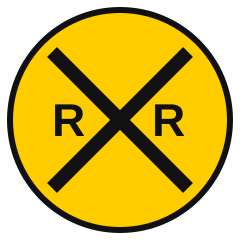
- A crossing for farm vehicles
- A road ahead with no exit
- A rest area ahead
- A railway crossing ahead
At a yield sign, who must you let go first?
- Traffic not facing the sign, and pedestrians
- Only traffic that is also facing a yield sign
- Only large trucks and buses
- Only vehicles coming from your left
What does this sign require you to do?

- Speed up to merge ahead of traffic
- Stop completely every time
- Slow down and give the right-of-way
- Give way only to pedestrians
You see this sign on the back of a farm tractor. What does it tell you?

- It is a wide load and an escort vehicle follows it
- It travels under 40 km/h; be ready to slow
- It is about to turn right
- It is carrying dangerous goods
No speed sign is posted on a road inside a town. What is the speed limit?
- 50 km/h
- 30 km/h
- 80 km/h
- 60 km/h
What does this sign warn you about?

- Your lane ends
- The road curves left
- A divided highway begins
- Traffic merging from the side
What do these striped boards placed at a sharp bend tell you?
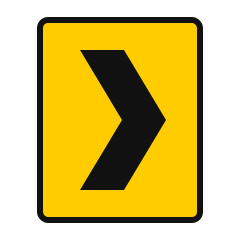
- The road ends at a gate
- The lane is closed to motorcycles
- There is a sharp bend or obstruction
- A parking lot entrance is ahead
What kind of sign is this?

- A playground zone sign
- A school zone or school area sign
- A construction zone sign
- A pedestrian crossover sign
A small tab under this curve sign shows 50 km/h. What does the tab mean?

- The legal minimum speed in the curve
- The distance to the curve in metres
- The recommended top speed for the curve in ideal conditions
- The posted speed limit that applies to trucks and buses only
What does this orange sign tell you?

- Workers are digging beside the road
- A parade is crossing
- A flag person ahead will direct traffic
- The road is closed ahead
What does this sign mean?
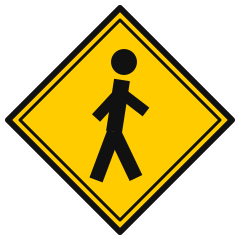
- A hiking trail entrance
- Pedestrians are not allowed
- A school zone begins
- A pedestrian crossing ahead
What does this black and white sign mean?

- Traffic may travel only in the arrow's direction
- Turn right at the next intersection to follow the route
- Detour to the right
- Two-way traffic begins ahead
You see this sign on a two-lane highway. What does it tell you?

- Do not pass
- Slow vehicles must keep right
- Two-way traffic ahead
- Passing is permitted with care
You see an orange diamond-shaped sign. What kind of information does it give?
- Tourist attractions
- Hospital or police services
- Construction information
- Distance to the next town
What does this sign mean?
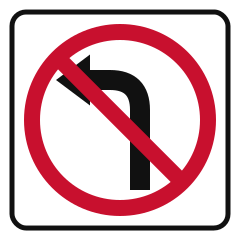
- Keep to the left lane
- Left turns are allowed only on green
- A curve to the left is ahead
- Left turns are not allowed
Which of these times is NOT one of Alberta's standard school zone periods?
- 3:00 to 4:30 p.m.
- 11:30 a.m. to 1:30 p.m.
- 1:30 to 3:00 p.m.
- 8:00 to 9:30 a.m.
What does this sign tell you about the speed limit?

- 50 km/h applies only to trucks and vehicles towing trailers
- You must ride at exactly 50 km/h
- 50 km/h is the most allowed in ideal conditions
- 50 km/h is the minimum speed
What does this sign tell you?

- Road closed to trucks only
- Stop and yield to traffic
- No parking at any time
- Do not enter
What does this yellow sign warn you about?
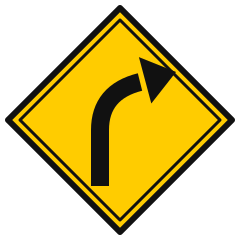
- The right lane ends
- Keep right of a divider
- A right turn is required
- A curve to the right ahead
What does this sign warn of?

- A school bus stop
- A fire hall entrance
- A railway crossing ahead
- Traffic signals ahead
When is a playground zone in effect if no times are posted?
- School days only, 8:00 a.m. to 4:30 p.m.
- Every day, 7:00 a.m. to 9:00 p.m.
- Every day, 8:30 a.m. to one hour after sunset
- Weekends only, sunrise to sunset
Which sign shape and colour warns you of a hazard or change in the road ahead?
- A green rectangle
- A blue square
- A yellow diamond
- A white rectangle
Road signs: key rules to remember
Our summary of what the official handbook says on this topic, in our own words. Read it before or after the practice questions above, then check the original chapter. Read the official chapter ↗
Driver's Guide (Spring 2026), Ch. 2 Traffic Control, pp. 25–37
- Red circle with slash: action not permitted. Green circle: action permitted.
- White rectangle with black message: regulatory.
- Five-sided fluorescent yellow-green: school zone/area.
- Black square with white message: lane control.
- Orange diamond: construction. Yellow diamond: warning.
- Green rectangle: guide information (destinations, distances). Blue: services.
- Red octagon STOP: full stop, go when safe. Yield triangle: yield to traffic not facing the sign and to pedestrians.
- Do not enter.
- Speed signs in km/h are maximums for ideal conditions.
- One way, two-way traffic, keep right of divider.
- Permissive: turn left only, straight only. Prohibitive: no left/right/U-turn, do not pass, no bicycles, no pedestrians.
- Reserved lanes may show times/days. Dual turn lanes: keep your lane through the turn.
- Disability parking only for vehicles with placard/plate (p. 32).
- 100 km/h provincial highway outside urban area; 80 km/h provincial highway inside a city; 80 km/h other roads outside urban area; 50 km/h urban roads.
- School zone (sign with speed tab): school days 8:00–9:30 a.m., 11:30 a.m.–1:30 p.m., 3:00–4:30 p.m. unless other times posted; 30 km/h unless posted; no passing while in effect.
- School area (no tab): caution only.
- Playground zone: every day 8:30 a.m. to one hour after sunset; 30 km/h; no passing.
- Curve, sharp turn, winding road; speed tab under curve sign = recommended maximum in ideal conditions.
- Stop ahead, yield ahead, signals ahead, school bus stop ahead.
- Pedestrian, deer, bicycle crossings; T intersection; side road; merge; right lane ends; divided highway begins/ends; road narrows; hill; bump; slippery when wet; chevrons and hazard markers mark sharp bends/obstructions; bridge ices.
- Round yellow advance sign: railway crossing ahead. Crossbuck: yield to trains.
- Slow-moving vehicle sign: vehicle under 40 km/h.
- Construction zone speed applies at all times even when no one is working; fines doubled when workers present; obey flag person.
- Detour signs mark temporary route.
Other topics
- Traffic lights and signalsSolid, flashing and arrow lights, turns on a red light, pedestrian signals, lane reversal signals and flashing yellow beacons.
- Pavement markingsYellow and white lines, passing zones, two-way left-turn lanes, diamonds, painted islands, bicycle lanes, crosswalks and stop lines.
- Class 6 licensing and GDLLearning to ride, supervisors, Class 7 learner riding conditions, the knowledge and road tests, Class 6-GDL conditions, exiting GDL, mopeds and power bicycles.
- Helmets and protective gearApproved helmet standards, helmet types and fit, eye and face protection, jackets, pants, boots, gloves and hearing protection.
- Rider fitness and distractionsHypothermia, overheating and dehydration, alcohol, drugs and medication, fatigue, cell phones and other distractions.
- Controls and pre-ride inspectionChoosing a motorcycle that fits, learning the controls, the pre-trip inspection checklist and seasonal storage.
- Riding position, gears and parkingRiding position, starting, signalling, the clutch and friction zone, shifting gears, starting on a hill and parking.
- Braking, traction and stopping distanceTires and traction, using the front and rear brakes, threshold braking, and perception, reaction and braking distance.
- Turns, curves and skidsTurning at low speed, push-steering (counter-steering) through curves, and avoiding and recovering from skids.
- Lane position, space and being seenBlind spots, the space cushion, following distance, choosing a lane and lane position, and changing lanes.
- Intersections and passingLane position at intersections, a stalled motorcycle, passing emergency vehicles, when not to pass, passing on a two-lane highway and being passed.
- Night, weather and road surfacesRiding at night and in fog, wind and temperature extremes, hydroplaning, gravel, ice, metal gratings and railway tracks.
- Riding emergenciesEmergency braking, swerving around and riding over obstacles, a stuck throttle, wobble, tire blowouts, airborne objects and animals.
- Passengers, cargo and three-wheelersCarrying a passenger legally and safely, loading cargo, towing a trailer, three-wheeled motorcycles and sidecars.
- Group ridingGroup size, the staggered formation and following times, the lead rider's position, passing and changing lanes as a group, and single file.
- Sharing the roadPedestrians, cyclists, large trucks, school buses, snowplows, railway crossings and LRT, from Alberta's Driver's Guide.
- Demerits, impaired riding and penaltiesDemerit point limits for GDL and full licence holders, common demerit values, impaired driving limits and Alberta's Immediate Roadside Sanctions.