Is it legal to ride between lanes of slow traffic to get ahead?
Alberta Class 6 overview
Alberta Class 6 Practice Test 2
30 questions on intersections and passing, sharing the road, pavement markings, demerits, impaired riding and penalties, passengers, cargo and three-wheelers and more.
- No sign-up
- Every answer explained
- Independent · not a government site
- Set 2 of 11
- 30 questions
- Instant feedback
0/30
All 30 questions in this test
Every question and its answer choices. The correct answers and explanations appear when you take the test above.
Is it legal to ride between lanes of slow traffic to get ahead?
- No, it is illegal and dangerous
- Yes, on multi-lane highways
- Yes, under 30 km/h
- Yes, if traffic is stopped
How far back should you stop from a school bus with its red lights flashing?
- About 10 metres
- About 50 metres
- About 20 metres
- About 5 metres
What is this centre lane, shown by this sign, used for?
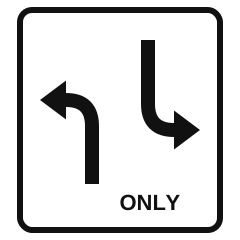
- Emergency vehicles only
- Left turns by traffic from both directions
- Passing slow vehicles
- Parking and deliveries during off-peak hours
How many demerit points does running a red light carry?
- 3
- 4
- 6
- 2
Why should you look for larger gaps in traffic when carrying a passenger?
- Your brakes work better with the added weight on board
- Passengers must signal for you
- The extra weight makes you accelerate more slowly
- The passenger blocks your mirrors
Your sidecar has no brake. Which way may the unit pull when you brake?
- To the right
- To the left
- Up off the ground
- Straight ahead
In Alberta, who must wear an approved motorcycle helmet?
- Both the operator and any passenger
- Only the operator
- Only riders on highways
- Only riders under 18 and their passengers
Why should your right wrist start slightly bent down, no higher than flat?
- So your arm does not get tired
- So the clutch is easy to pull
- So you can reach the horn
- So you do not apply too much throttle
At what blood alcohol level does IRS WARN apply to a fully licensed driver?
- 0.08 (80 mg per 100 mL) or more
- 0.10 (100 mg per 100 mL) or more
- 0.05 (50 mg per 100 mL) or more
- 0.02 (20 mg per 100 mL) or more
Why should you avoid following a cyclist closely?
- Cyclists must ride in the centre
- Cyclists often ride at highway speed
- Bicycles stop more slowly than motorcycles
- Bicycles have no brake lights
Which approved helmet type is the least recommended?
- Three-quarter coverage
- Full coverage
- Modular full face
- One-half coverage (shorty)
You already hold a full Class 5 licence and are learning to ride. Do you need a supervisor?
- No, a full Class 5 is enough
- Yes, until you hold a Class 6 licence
- Only for the first 30 days of riding on the road
- Only on highways
You are using high beams on a dark road. A vehicle is ahead of you in your lane. When must you dim?
- Before you are within 150 m of it
- Only if the driver flashes lights
- Before you are within 300 m of it
- Before you are within 50 m of it
What makes up total stopping distance?
- Reaction distance and braking distance only
- Perception, reaction and braking distance
- Braking distance only
- Following distance plus braking distance
What does this sign tell you about the speed limit?

- 50 km/h applies only to trucks and vehicles towing trailers
- You must ride at exactly 50 km/h
- 50 km/h is the most allowed in ideal conditions
- 50 km/h is the minimum speed
A warning sign before a signal has its own yellow lights flashing. What does this tell you?

- A school zone is starting
- The signal ahead is out of order and works as a four-way stop
- Be ready to stop; the light ahead is changing or red
- You have a green light ahead
What is the minimum age to begin learning to ride a motorcycle in Alberta?
- 15
- 18
- 14
- 16
What is the largest recommended size for a motorcycle riding group?
- Five riders
- Ten riders
- Eight riders
- Three riders
How fast should you approach a turn from one street onto another?
- At the posted speed limit
- About 40 km/h
- Less than 10 km/h
- Less than 20 to 25 km/h
A car is waiting to enter the intersection from a side road on your right. Which lane position should you use?
- The left portion of your lane
- The centre of your lane
- The shoulder
- The right portion of your lane
How should your mirrors be adjusted?
- To show only your own shoulders
- To show the sky above the traffic behind you
- To point down at the road surface
- To show the lane behind and your arm's edge
Why should you keep your feet on the pegs during emergency braking?
- You need them for the rear brake and gears
- To stop the bike sliding
- Feet down helps you stop faster and stay upright
- To help steer the front wheel
Within an urban area, may you pass safely across a single solid yellow line?
- Only on a one-way street
- Yes, if it can be done safely
- No, it is always illegal
- Only to pass a cyclist
Can a rider become hypothermic on a warm day?
- Only if it is raining
- No, only when the air is below freezing
- Yes, from constant exposure to wind
- Only at night
When must a motorcycle's headlight be on?
- Only at night
- Only on highways
- Whenever the motor is running
- Only in rain, fog or after sunset
On a highway with two lanes in your direction, which lane should a group normally use?
- The left lane, with the leader in its left portion
- The right lane, with the leader in its left portion
- The right lane, with the leader near the shoulder
- Both lanes, side by side
Is the front brake still useful on a slippery surface?
- Yes, if you squeeze it gradually
- No, use only the rear brake
- Yes, if you grab it hard
- No, use only engine braking
A large truck is coming toward you on a two-lane highway. What should you do?
- Move to the right portion and hold the grips firmly
- Release the grips to stay relaxed
- Speed up to pass it quickly
- Move to the left portion so the truck driver can see you
Which is a sign that a parked car may pull out into your lane?
- A parking ticket on the windshield
- Exhaust coming from the tailpipe
- A roof rack on top
- A dirty licence plate
An obstacle appears and you will swerve right around it. How do you start the swerve?
- Turn the bars sharply left
- Brake hard and lean right
- Push on the right hand grip
- Push on the left hand grip
All Alberta Class 6 practice tests
- Alberta Class 6 Mock Exam 1 – 30 QuestionsUntimed practice · answers explained
- Alberta Class 6 Mock Exam 2 – 30 QuestionsUntimed practice · answers explained
- Alberta Class 6 Mock Exam 3 – 30 QuestionsUntimed practice · answers explained
- Alberta Class 6 Mock Exam 4 – 30 QuestionsUntimed practice · answers explained
- Alberta Class 6 Mock Exam 5 – 30 QuestionsUntimed practice · answers explained
- Road signsSign shapes and colours, regulatory, permissive and prohibitive signs, warning signs, school and playground zones, and construction signs.
- Traffic lights and signalsSolid, flashing and arrow lights, turns on a red light, pedestrian signals, lane reversal signals and flashing yellow beacons.
- Pavement markingsYellow and white lines, passing zones, two-way left-turn lanes, diamonds, painted islands, bicycle lanes, crosswalks and stop lines.
- Class 6 licensing and GDLLearning to ride, supervisors, Class 7 learner riding conditions, the knowledge and road tests, Class 6-GDL conditions, exiting GDL, mopeds and power bicycles.
- Helmets and protective gearApproved helmet standards, helmet types and fit, eye and face protection, jackets, pants, boots, gloves and hearing protection.
About this practice test
How many questions are in Alberta Class 6 practice test 2?
30 original multiple-choice practice questions covering intersections and passing, sharing the road, pavement markings, demerits, impaired riding and penalties, passengers, cargo and three-wheelers, helmets and protective gear, riding position, gears and parking, class 6 licensing and gdl, night, weather and road surfaces, braking, traction and stopping distance, road signs, traffic lights and signals, group riding, turns, curves and skids, riding emergencies, rider fitness and distractions, controls and pre-ride inspection, lane position, space and being seen. Each answer includes an explanation. This mixed practice set does not reproduce the official exam format or predict an official score.
Are the questions the same every time?
Yes. Practice test 2 always has the same 30 questions, so you can repeat it until you get them all right. The other 10 sets use different questions.
Are these real test questions?
No. The official question bank is not published. These are original questions written from the official handbook, which is what the real Alberta Class 6 test is based on.