You need to make a call with your hands-free phone. What does the Rider's Guide advise?
Alberta Class 6 overview
Alberta Class 6 Practice Test 3
30 questions on rider fitness and distractions, night, weather and road surfaces, pavement markings, demerits, impaired riding and penalties, passengers, cargo and three-wheelers and more.
- No sign-up
- Every answer explained
- Independent · not a government site
- Set 3 of 11
- 30 questions
- Instant feedback
0/30
All 30 questions in this test
Every question and its answer choices. The correct answers and explanations appear when you take the test above.
You need to make a call with your hands-free phone. What does the Rider's Guide advise?
- Stop at a safe spot at the side of the road first
- Slow down while you talk
- Keep the call under one minute
- Use voice commands only, while riding at a steady speed
Railway tracks cross the road at an angle. How should you ride over them?
- Turn to cross them at a right angle
- Speed up to get across quickly
- Straight ahead, keeping your speed even
- Brake while crossing the rails
A lane is marked with white diamond symbols. What does that mean?
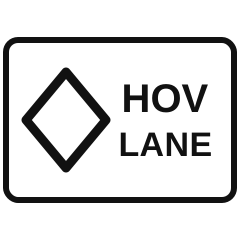
- The lane is for passing slower vehicles only
- Railway tracks are ahead
- The lane is reserved for certain vehicles
- The lane ends soon
A Class 7 learner is convicted of driving between midnight and 5 a.m. How many demerit points apply?
- 4
- 3
- 6
- 2
When should the passenger get on the motorcycle?
- Before you take it off the stand
- While the bike is on the centre stand
- Before you start the engine
- After you take the bike off the sidestand
You want to make your helmet more visible at night. What does the guide recommend?
- Clean it with a solvent to brighten it
- Paint it a bright colour
- Buy a helmet with built-in reflective features
- Add any reflective stickers you like
What helps you keep balance while riding?
- Sitting on the back of the seat
- Pressing your knees lightly against the motorcycle
- Holding the grips very tightly with both arms locked
- Looking down at the front wheel
Which change happens when you exit the GDL program?
- The zero alcohol and drug condition is removed
- You may ride without a helmet
- You no longer collect demerit points for any offence
- You may carry two passengers
Where should your passenger keep their feet when you stop at a light?
- Tucked under the seat
- On the passenger foot pegs
- On the ground to help balance
- On the exhaust pipe
In which season is loose gravel and sand along roadsides usually worst?
- Fall
- Spring
- Midsummer after rain
- Summer
You are approaching the crest of a hill on a two-lane road. Which lane position is best?
- The centre of your lane
- Straddling the centre line
- The right portion of your lane
- The left portion of your lane
You check your engine oil and it is black. What does the Rider's Guide suggest?
- Add coolant to thin it
- It is at its best
- It should be changed
- It only needs topping up
During your inspection you notice uneven tread wear on a tire. What can it indicate?
- The brakes are working well
- The tire is new and still wearing in after installation
- An alignment problem or that the tire needs replacing
- The tire pressure is perfect
Why should you brake lightly between downshifts when slowing?
- It is required to change gears
- Downshifting alone damages the clutch and the gearbox
- It keeps the engine from stalling
- Downshifting alone does not turn on the brake light
A pedestrian is carrying a white cane. What does this tell you?
- The person is a crossing guard
- The person may be visually impaired
- The person is injured
- The person wants a ride
When is a left turn on a red light permitted?
- From a one-way street onto a one-way street, after a stop
- From any street when no one is coming
- Only from a two-way street onto a one-way street
- Never, under any circumstances
Your front tire suddenly goes flat. Which brake should you use to stop once you are off the road?
- Both brakes, firmly
- The rear brake, carefully
- The front brake, carefully
- Neither; let it roll to a stop
Above your lane, a lane reversal signal shows a red X. What does it mean?
- You may use the lane with care
- The lane is closed for 1 km
- Do not ride in that lane
- The lane is for turning only
What is a common mistake inexperienced riders make with curves?
- Slowing before the curve
- Entering the curve too fast
- Downshifting before the curve
- Looking through the curve
What is threshold braking?
- Braking to the point just before the wheels lock
- Braking only with the rear brake to keep the bike stable
- Pumping the brakes rapidly
- Braking after the wheels lock
On a school day at 3:15 p.m. you enter a school zone with no other times posted. What is the speed limit?
- 30 km/h
- 20 km/h
- 40 km/h
- 50 km/h
Why does riding without a jacket in hot weather raise the risk of dehydration?
- Wind dries moisture from exposed skin quickly
- A jacket stores water for you
- Jackets block the sun completely and keep skin cool
- Bare arms absorb more oxygen
Starting on an uphill slope, what can happen if you release the clutch too quickly?
- The engine may stall or the front wheel may lift
- The headlight will turn off
- The rear brake will lock
- The motorcycle will pop out of gear and into neutral
On a rural highway you see a large X painted across your lane. What does it warn of?
- An intersection with no signs
- A railway crossing ahead
- A lane closed ahead
- A no-stopping zone
Why must motorcycle riders ride with extra caution in traffic?
- Many drivers do not see or expect motorcycles
- Motorcycles always have the right-of-way
- Motorcycles stop more slowly than cars
- Drivers must give motorcycles a full lane
Who should ride in the lead position of a group?
- Whoever arrives first
- The rider with the biggest motorcycle
- The least experienced rider
- An experienced rider
What do these striped boards placed at a sharp bend tell you?
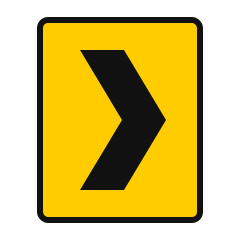
- The road ends at a gate
- The lane is closed to motorcycles
- There is a sharp bend or obstruction
- A parking lot entrance is ahead
You lose rear traction because you accelerated too hard. What should you do?
- Lean the motorcycle further over into the slide
- Ease off the throttle and steer your path
- Open the throttle even further
- Squeeze the front brake firmly
Before starting to pass on a two-lane highway, what following distance should you keep?
- Half a car length
- Less than one second
- At least two seconds
- Three car lengths
Vehicles are waiting to enter from both sides of the intersection ahead. Where should you ride?
- Next to the curb
- In the left portion of your lane
- In the right portion of your lane
- In the oncoming lane
All Alberta Class 6 practice tests
- Alberta Class 6 Mock Exam 1 – 30 QuestionsUntimed practice · answers explained
- Alberta Class 6 Mock Exam 2 – 30 QuestionsUntimed practice · answers explained
- Alberta Class 6 Mock Exam 3 – 30 QuestionsUntimed practice · answers explained
- Alberta Class 6 Mock Exam 4 – 30 QuestionsUntimed practice · answers explained
- Alberta Class 6 Mock Exam 5 – 30 QuestionsUntimed practice · answers explained
- Road signsSign shapes and colours, regulatory, permissive and prohibitive signs, warning signs, school and playground zones, and construction signs.
- Traffic lights and signalsSolid, flashing and arrow lights, turns on a red light, pedestrian signals, lane reversal signals and flashing yellow beacons.
- Pavement markingsYellow and white lines, passing zones, two-way left-turn lanes, diamonds, painted islands, bicycle lanes, crosswalks and stop lines.
- Class 6 licensing and GDLLearning to ride, supervisors, Class 7 learner riding conditions, the knowledge and road tests, Class 6-GDL conditions, exiting GDL, mopeds and power bicycles.
- Helmets and protective gearApproved helmet standards, helmet types and fit, eye and face protection, jackets, pants, boots, gloves and hearing protection.
About this practice test
How many questions are in Alberta Class 6 practice test 3?
30 original multiple-choice practice questions covering rider fitness and distractions, night, weather and road surfaces, pavement markings, demerits, impaired riding and penalties, passengers, cargo and three-wheelers, helmets and protective gear, riding position, gears and parking, class 6 licensing and gdl, lane position, space and being seen, controls and pre-ride inspection, braking, traction and stopping distance, sharing the road, traffic lights and signals, riding emergencies, turns, curves and skids, road signs, group riding, intersections and passing. Each answer includes an explanation. This mixed practice set does not reproduce the official exam format or predict an official score.
Are the questions the same every time?
Yes. Practice test 3 always has the same 30 questions, so you can repeat it until you get them all right. The other 10 sets use different questions.
Are these real test questions?
No. The official question bank is not published. These are original questions written from the official handbook, which is what the real Alberta Class 6 test is based on.