What must you do at a flashing red light?
NL Class 5 overview
NL Class 5 Practice Test 5
30 questions on traffic lights and pedestrian signals, night driving and bad weather, right-of-way and intersections, parking and backing up, speed limits and following distance and more.
- No sign-up
- Every answer explained
- Independent · not a government site
- Set 5 of 11
- 30 questions
- Instant feedback
0/30
All 30 questions in this test
Every question and its answer choices. The correct answers and explanations appear when you take the test above.
What must you do at a flashing red light?
- Yield only to vehicles on the left
- Slow down without stopping
- Wait for it to turn green
- Stop completely, then go when safe
You are following another vehicle at night. Within what distance of its rear must you use low beams?
- 200 metres
- 60 metres
- 150 metres
- 30 metres
You are not sure whether you or another driver has the right-of-way. What should you do?
- Yield to the other driver
- Speed up to clear quickly
- Sound your horn and go
- Go, since you arrived first
How far from a bus stop must you park?
- At least 30 metres
- At least 20 metres
- At least 10 metres
- At least 5 metres
There is no speed sign on a paved section of the Trans-Canada Highway. What is the speed limit?
- 100 km/h
- 110 km/h
- 80 km/h
- 90 km/h
A pedestrian is halfway across when the don't walk signal comes on. You now have a green light. Who has the right-of-way?
- You, because your light is green
- The pedestrian
- The vehicle turning right
- Whoever moves first
Signs show two lanes may turn left. You are in the right-hand turn lane. Where should you finish the turn?
- In the corresponding (right-hand) lane
- In the curb lane
- In the left-hand lane
- In any lane of the new road that is clear
A digital sign with orange lettering on black says the highway ahead is closed because of winter weather. What should you do?
- Ignore it if the road looks clear
- Drive on with hazard lights on
- Treat it as advice only
- Follow its directions strictly
How should pedestrians cross at a roundabout?
- One way at a time, using splitter islands
- Only when a car waves them on
- Through the centre island
- Diagonally across the circle, the shortest route
You are ticketed for driving 51 km/h or more over the posted limit. What else happens?
- Your vehicle is seized for a year
- You get a warning letter
- Your licence is suspended for seven days
- Your licence is suspended 90 days
What does this sign warn you of?
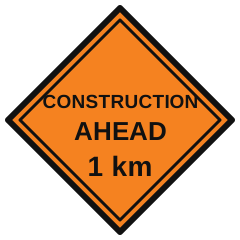
- Construction ahead
- A tourist site ahead
- A detour has ended
- A school zone ahead
When do more than half of moose-vehicle collisions happen?
- On sunny spring afternoons, mostly on weekends
- During morning rush hour
- Between dusk and dawn in summer and fall
- At midday in winter
What is the minimum safe following distance for a passenger vehicle, in vehicle lengths?
- Two lengths at any speed
- One length for every 10 km/h
- One length for every 15 km/h
- One length for every 30 km/h
What does this sign require you to do?

- Stop every time
- Speed up to merge
- Proceed without checking
- Slow down and be ready to stop
In winter driving, what is black ice?
- Ice that forms only at night on bridges
- Ice mixed with road salt
- Dirty snow on the shoulder
- Clear ice that looks like bare pavement
Your turn signals must be visible from what distance to the rear?
- 500 metres
- 90 metres
- 150 metres
- 250 metres
At an intersection with a marked crosswalk, where must you stop?
- At the far curb
- In the crosswalk
- Before entering the crosswalk
- Beside the traffic light pole
A school bus ahead is stopped with red lights flashing and its stop sign out. You are coming from the opposite direction on a two-lane road. What must you do?
- Continue, since you are oncoming
- Slow down and pass with care
- Stop and stay stopped
- Stop only if you see children
An arrow painted in your lane near an intersection points left. What does it mean?
- You may go any direction from that lane
- Traffic in that lane must turn left
- Left turns are prohibited
- The lane ends on the left
What happens to the fine if you speed through a road construction zone?
- It is replaced by a warning
- It is doubled
- It is tripled
- It stays the same
How many demerit points can a novice driver build up in one year before being suspended?
- 8
- 4
- 12
- 6
Your mirrors are adjusted correctly. Where can a vehicle still be hidden?
- Near your rear left and right corners
- Only on the passenger side, near the front
- Directly behind your trunk
- Directly in front of you
What is the minimum tire tread depth allowed?
- 1.5 mm
- 4 mm
- 3 mm
- 1 mm
Who must sign consent when a 17-year-old applies for a first driver's licence?
- A driving instructor
- A parent or legal guardian
- Any adult relative
- A school principal
Under the Highway Traffic Act, which of these counts as a pedestrian?
- A person on an e-scooter at 30 km/h
- A cyclist walking beside the road on a bike
- A person riding a horse
- A child being pulled in a sleigh
An interlock is installed in a car shared by two family members. Who must use it?
- Only drivers under 22
- Only the convicted driver
- No one on short trips
- Anyone who drives that vehicle
Which of these is a sign of fatigue while driving?
- Checking your mirrors often as you drive
- Scanning the road ahead
- Keeping a steady speed
- Not remembering the last few kilometres
How should the lap part of a seatbelt be worn?
- Low on the hips and snug
- Loose for comfort
- Above the waist
- Across the stomach
You knock over a parking meter while parking. What must you do?
- Report it to the police immediately
- Report it to the city within 30 days
- Leave a note on the meter
- Nothing if no one saw it
Which of these is a place where passing is not permitted?
- In a marked passing lane
- On a straight road with a broken line
- On a one-way street with two lanes
- On a narrow bridge
All NL Class 5 practice tests
- NL Class 5 Mock Exam 1 – 30 QuestionsUntimed practice · answers explained
- NL Class 5 Mock Exam 2 – 30 QuestionsUntimed practice · answers explained
- NL Class 5 Mock Exam 3 – 30 QuestionsUntimed practice · answers explained
- NL Class 5 Mock Exam 4 – 30 QuestionsUntimed practice · answers explained
- NL Class 5 Mock Exam 5 – 30 QuestionsUntimed practice · answers explained
- Sign shapes and regulatory signsWhat each sign shape and colour means, the stop, yield, crossbuck and school signs, red-slash and green-circle signs, speed, turn, parking, one-way, keep-right and accessible parking signs.
- Warning signsYellow diamond warning signs for curves, hills, bumps, merges, lane endings, narrow bridges, divided highways, railway crossings, moose and falling rocks, plus the slow-moving vehicle sign and weather hazard signs.
- Construction zone signsOrange road construction signs, flag persons, survey and maintenance crews, doubled fines, hazard markers, over-dimensional load signs and zipper merge signs.
- Traffic lights and pedestrian signalsSolid and flashing lights, green arrows, right turns on red, police directions, walk and don't walk signals, and pedestrians who are blind or partially sighted.
- Pavement markingsStop lines and crosswalks, yellow and white lane lines, solid and broken lines for passing, lane arrows, painted islands and shared left-turn lanes.
About this practice test
How many questions are in NL Class 5 practice test 5?
30 original multiple-choice practice questions covering traffic lights and pedestrian signals, night driving and bad weather, right-of-way and intersections, parking and backing up, speed limits and following distance, turns and roundabouts, warning signs, demerit points and suspensions, construction zone signs, emergencies, collisions and moose, sign shapes and regulatory signs, registration, insurance and vehicle equipment, pavement markings, sharing the road, passing, lane changes and highways, licensing and graduated licensing, impaired driving, seatbelts, distraction and fatigue. Each answer includes an explanation. This mixed practice set does not reproduce the official exam format or predict an official score.
Are the questions the same every time?
Yes. Practice test 5 always has the same 30 questions, so you can repeat it until you get them all right. The other 10 sets use different questions.
Are these real test questions?
No. The official question bank is not published. These are original questions written from the official handbook, which is what the real NL Class 5 test is based on.