Newfoundland and Labrador Road Signs and Their Meanings
Every road sign in our NL learner's permit bank on one page, from stop and yield to falling rock, roundabout and construction signs, with what each means.
- No sign-up
- Every answer explained
- Independent · not a government site
- 36 signs
- Free, no sign-up
Road sign recognition is one of the three things Motor Registration says the Class 5 written test checks, along with traffic laws and safe driving practices, and the 85 per cent pass mark leaves little room for guessing. This chart gathers every sign drawing from our Newfoundland and Labrador question bank on one page, in the handbook's order: sign shapes and regulatory signs first, then yellow warning signs, then orange construction signs. Each entry shows what the sign means and the action the Driver's Handbook expects from you.
The handbook teaches shape before anything else. An octagon is always stop and an upside-down triangle always yield, a crossbuck marks a railway crossing, a diamond warns of a hazard, and a five-sided sign means school children may be present. In this province a school sign can be blue with white figures as well as fluorescent yellow. Colours fill in the rest: a red circle with a slash forbids what it shows, a green circle permits or requires it, green rectangles give distances and directions, and brown ones point to tourist sites. In construction zones, the handbook notes that speeding fines are doubled. Our drawings are simplified originals, so learn the shape, colour and symbol.
Sign shapes and regulatory signs
Practise: Sign shapes and regulatory signs
Come to a full stop, then go when it is clear
A stop sign means a complete stop every time, at the stop line or crosswalk, and you continue only once the way is clear.

Slow down and be ready to stop
At a yield sign you slow down, give the right-of-way to other traffic and stop if needed. A full stop is not always required.

A railway crossing
The crossbuck marks a railway crossing. Be ready to stop, and no other sign uses this X shape.

Slow down and watch for children
This five-sided sign means you are entering a school zone, so slow down and drive with extra caution.

You must not enter this street
The red circle with a white bar warns drivers not to enter the street, usually because traffic comes the other way.

Do not make a U-turn
The U-shaped arrow crossed by a red circle and slash means U-turns are not allowed here.

Keep to the right of the island
This regulatory sign is placed at an island or median to show you must pass on its right side.
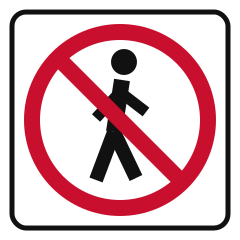
Pedestrians
The walking figure crossed by a red circle and slash means pedestrians are not permitted on that highway.
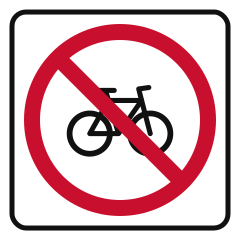
No bicycles on this highway
A bicycle inside a red circle and slash means bicycles may not use the highway.
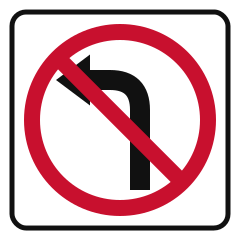
Left turns are not allowed
The left-turn arrow crossed by a red circle and slash means you may not make a left turn at this intersection.

Traffic moves in one direction only
The one-way sign shows that all traffic on the street travels in the direction of the arrow.

The legal maximum speed
A white vertical speed sign is regulatory: it states the legal limit you must not exceed.
Warning signs
Practise: Warning signs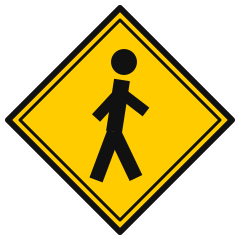
Pedestrians may be crossing
This yellow warning sign tells you to watch for people crossing the road ahead and be ready to yield.

It winds back and forth
The wavy arrow warns of a winding road, so slow down and keep to your lane through the curves.

A bump or rough road ahead
The raised humps mean a bump or rough section of road, so slow down before you reach it.

Prepare to merge left; right lane ends
This sign warns that the right lane is ending, so check traffic and merge left safely before it runs out.

Shift to a lower gear to help with braking
On a steep hill you may need a lower gear so the engine helps slow the vehicle instead of relying only on the brakes.

Traffic lights ahead
The signal symbol warns that there are traffic lights ahead, so be ready to stop.

Traffic merging into your lane
A merge sign warns that two lanes of traffic join ahead, so adjust your speed and let traffic merge smoothly.
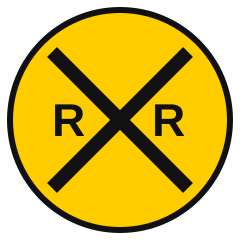
A railway crossing ahead
This round yellow advance sign tells you a railway crossing is coming, so slow down, look and listen for trains.
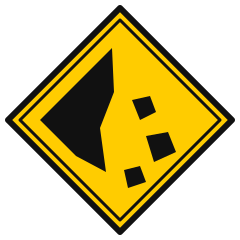
Falling rocks
The falling rock sign means rocks may be on the road or falling from a slope, so stay alert and slow down.

A narrow bridge or underpass ahead
The lines that pinch in mean the road narrows at a bridge or underpass, so slow down and watch for oncoming traffic.

Traffic ahead travels in both directions
This sign warns of two-way traffic ahead, so drivers going in opposite directions must share the highway.

The road is slippery when wet
This sign means the surface can become slippery when wet, so reduce speed and avoid sudden braking in rain.

Be prepared to stop at a stop sign ahead
This sign warns that a stop sign is coming up, often where it is hard to see, so begin slowing early.
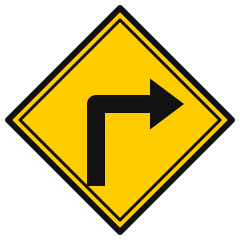
A sharp curve to the right
This sign warns of a sudden turn in the direction of the arrow. Slow down before the curve and proceed with caution.

It becomes divided by a median
A divided highway begins ahead. Keep to the right and change lanes only after signalling and when it is safe.
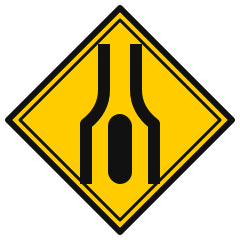
It becomes one roadway with two-way traffic
This sign means the divided highway ends and traffic in both directions will share one roadway, so keep to the right.
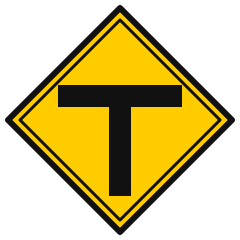
A T-intersection ahead
The T shape means the road ends ahead at a T-intersection, so you will have to turn right or left.

The road ahead is narrower
This sign warns that the road ahead is not as wide as the one you are on, so keep right and watch for oncoming traffic.
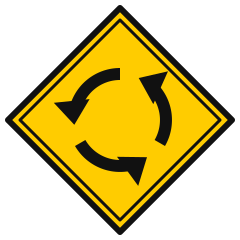
A roundabout is ahead; slow down
This sign warns of a roundabout ahead and may also show a recommended speed for it.

On the rear of a slow vehicle on the highway
The slow-moving vehicle sign must be mounted on the back of the vehicle whenever it is driven on the highway.
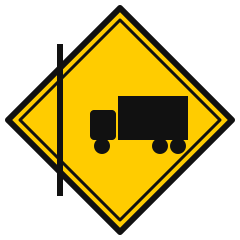
Trucks may enter the highway from the side
This sign warns that trucks enter the highway from the side of the road, so be ready for slow vehicles pulling in.
Construction zone signs
Practise: Construction zone signs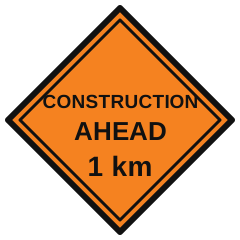
Construction ahead
An orange diamond like this warns of road construction ahead, where speeds are usually reduced.

A crew is working on the road ahead
This orange sign means a road maintenance crew is working ahead, so slow down and watch for workers.

Stop for a flag person's instructions
This sign warns of a flag person ahead. Be ready to stop and follow their directions.
FAQ
NL road signs chart: common questions
How many road sign questions are on the NL learner's test?
Motor Registration does not publish a number of questions or a signs-only section. It says the multiple-choice test covers traffic laws, safe driving practices and road sign recognition, and you need 85 per cent overall.
What colour are school zone signs in Newfoundland and Labrador?
The handbook shows the school ahead sign as a blue pentagon with white student figures and says it may also be fluorescent yellow. Some versions also show the school zone speed limit.
What should I do at a railway crossbuck?
Be ready to stop. If a signal device or a flag person warns that a train is coming, stop no less than 5 metres from the nearest rail and go only when it is safe.
Keep practising
- NL learner's permit practice test (printable PDF)100 Newfoundland and Labrador Class 5 practice questions with a separate answer key citing the Driver's Handbook page. Print it or save it as a PDF. Free.
- NL Class 5 study guide
- NL Class 5 Mock Exam 1 – 30 QuestionsUntimed practice · answers explained
- NL Class 5 Mock Exam 2 – 30 QuestionsUntimed practice · answers explained
- NL Class 5 Practice Test 130 questions with explanations
- NL Class 5 Practice Test 230 questions with explanations
- NL Class 5 Practice Test 330 questions with explanations
Practice by topic
- Sign shapes and regulatory signsWhat each sign shape and colour means, the stop, yield, crossbuck and school signs, red-slash and green-circle signs, speed, turn, parking, one-way, keep-right and accessible parking signs.
- Warning signsYellow diamond warning signs for curves, hills, bumps, merges, lane endings, narrow bridges, divided highways, railway crossings, moose and falling rocks, plus the slow-moving vehicle sign and weather hazard signs.
- Construction zone signsOrange road construction signs, flag persons, survey and maintenance crews, doubled fines, hazard markers, over-dimensional load signs and zipper merge signs.
- Traffic lights and pedestrian signalsSolid and flashing lights, green arrows, right turns on red, police directions, walk and don't walk signals, and pedestrians who are blind or partially sighted.
- Pavement markingsStop lines and crosswalks, yellow and white lane lines, solid and broken lines for passing, lane arrows, painted islands and shared left-turn lanes.
- Licensing and graduated licensingWho can apply, the written test and 85% pass mark, Class 5I learner and Class 5II novice conditions, the novice driver sign, parental consent, road test timing, renewals and licence changes.
- Registration, insurance and vehicle equipmentRegistering, insuring and transferring a vehicle, penalties for driving uninsured, and the lights, tires, brakes, mirrors and windows the law requires.
- Seatbelts, distraction and fatigueSeatbelts and child car seats, trip planning, aggressive driving, cell phones and other distractions, driver fatigue, fitness to drive and fuel-efficient habits.
- Impaired drivingBlood alcohol limits for learners, novices and full licence holders, what raises BAC, drugs and cannabis, roadside suspensions, Criminal Code penalties, ignition interlock and education programs.
- Demerit points and suspensionsHow demerit points work, the 12-point and 6-point limits, high-risk speeding and stunting suspensions, the driving record, and courses that remove points or are needed for reinstatement.
- Speed limits and following distanceDefault speed limits when no sign is posted, school zone speeds, stopping, reaction and braking distance, the danger zone and the three-second rule.
- Right-of-way and intersectionsUncontrolled intersections, left turns, side roads and driveways, four-way stops, traffic lights that are out, passing-lane merges and yielding to emergency vehicles.
- Turns and roundaboutsLane choice for right and left turns on one-way and two-way streets, double left-turn lanes, two-point, three-point and U-turns, and how to enter, drive and exit a roundabout.
- Passing, lane changes and highwaysSafe passing and where it is not allowed, signalling, lane changes and blind spots, entering and leaving divided highways, cloverleafs, weave lanes, zipper merges, added lanes and shared left-turn lanes.
- Parking and backing upBacking safely, where you may not park and the distances from stop signs, crosswalks, hydrants, bus stops and railway crossings, parking on hills, parallel and angle parking.
- Sharing the roadVulnerable road users, the one-metre rule for cyclists and pedestrians, dooring, construction workers, school buses, emergency vehicles and the slow down, move over law.
- Night driving and bad weatherWhen headlights are required, dimming high beams, glare, overdriving your headlights, rain and hydroplaning, fog, ice, black ice, snow, winter skids and slow driving.
- Emergencies, collisions and mooseEmergency braking with and without ABS, skids, leaving the pavement, collisions and when to report them, avoiding head-on crashes, vehicles in water, breakdowns, equipment failures and moose on the road.