PEI Class 7 overview

PEI Class 7 Practice Test 9

30 questions on regulatory signs and lane arrows, impaired and distracted driving, right of way and pedestrians, demerit points and suspensions, class 7 permit and graduated licensing and more.

  • Set 9 of 10
  • 30 questions
  • Instant feedback
0/30
Practice test 9 · Question 1Score 0/0
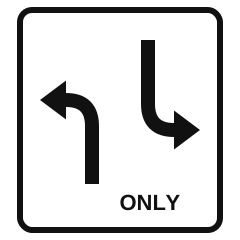
A white sign with two curved arrows pointing in opposite directions and a word below

What does this sign over the centre lane mean?

All 30 questions in this test

Every question and its answer choices. The correct answers and explanations appear when you take the test above.

  1. What does this sign over the centre lane mean?

    A white sign with two curved arrows pointing in opposite directions and a word below
    1. It is a two-way left-turn lane
    2. It is for passing in either direction
    3. It is a bus-only lane
    4. It is a reversible express lane
  2. When does a 90-day Administrative Driving Prohibition issued at an impaired driving charge take effect?

    1. Immediately
    2. Seven days after the charge
    3. 30 days after the charge
    4. After the court conviction
  3. The car ahead of you in the next lane has stopped at a crosswalk. What should you do?

    1. Pass slowly on its left
    2. Stop; never pass a vehicle stopped for a pedestrian
    3. Pass on its left if you see no one crossing in front
    4. Sound your horn and pass
  4. You are caught driving 40 km/h over the posted limit. How many points does the handbook list?

    1. 3
    2. 9
    3. 6
    4. 12
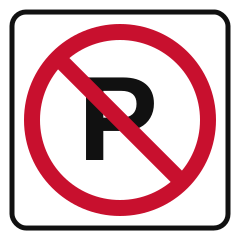
  5. What does this sign mean?

    A white square with a black letter P inside a red circle with a red diagonal slash
    1. No stopping for any reason
    2. No parking
    3. Parking for permit holders only
    4. Pay parking ahead
  6. You are 18 with a Class 7 permit. During which hours may you not drive?

    1. 1 a.m. to 5 a.m.
    2. Midnight to 5 a.m.
    3. 11 p.m. to 6 a.m.
    4. 2 a.m. to 6 a.m.
  7. What does this sign warn of?

    A yellow diamond with a small red octagon above a black upward arrow
    1. A school zone ahead
    2. A stop sign ahead
    3. A railway crossing ahead
    4. A traffic signal ahead
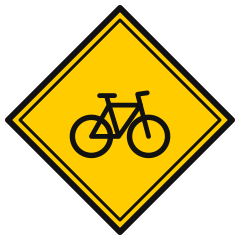
  8. What does this sign warn of?

    A yellow diamond with a black bicycle symbol
    1. A bicycle crossing
    2. A bicycle route begins
    3. A reserved bicycle lane
    4. Cycling is prohibited
  9. You are first to arrive at a serious collision. Where should you park?

    1. Off the road, a safe distance from the scene
    2. In the lane behind the crash
    3. Right beside the damaged cars
    4. On the opposite shoulder facing traffic
  10. You must stop and there is a crosswalk but no stop line. Where do you stop?

    1. Before any part of your car enters the crosswalk
    2. Just past the crosswalk
    3. With your front bumper in the crosswalk
    4. At the stop sign post itself
  11. Your car starts skidding after you slam on the brakes. What should you do?

    1. Steer the opposite way from the skid
    2. Brake harder and hold the steering wheel perfectly straight
    3. Accelerate hard to regain grip
    4. Ease off the brakes and steer where the rear is sliding
  12. On a highway, how far ahead should you signal before turning or stopping?

    1. At least 150 metres
    2. At least 30 metres
    3. At least 300 metres
    4. At least 60 metres
  13. You are about to pass a cyclist. What does the handbook say about your horn?

    1. Honk only at night
    2. Don't blow it, as it may startle them
    3. Honk twice as you pull alongside
    4. Always give a long blast
  14. What does this sign mean?

    An orange rectangle reading DETOUR
    1. The road ahead is one-way
    2. Trucks must exit here
    3. Construction has ended
    4. Follow a detour route
  15. Which shape does the handbook say is always used for speed limit signs?

    1. A horizontal rectangle
    2. A square
    3. A vertical rectangle
    4. A diamond
  16. You are driving out of a driveway in a 50 km/h town zone. Where must you stop?

    1. At the edge of the roadway only
    2. After crossing the sidewalk
    3. You need not stop if no one is near
    4. Before driving onto the crosswalk area
  17. You pass a playground warning sign. What should you do?

    1. Change lanes away from the curb
    2. Reduce speed and be ready to stop suddenly
    3. Keep your speed and sound your horn
    4. Stop and wait for a crossing guard
  18. What does this sign warn of?

    An orange diamond with a black person holding a flag
    1. A traffic control person ahead
    2. A parade route ahead
    3. A police check ahead
    4. A school crossing guard just ahead
  19. By how much does the handbook say alcohol slows the reaction of a driver who is impaired but not drunk?

    1. About 75%
    2. About 5%
    3. About 20%
    4. About 50%
  20. When are roads especially slippery in rain?

    1. After several hours of rain
    2. Just after it begins to rain
    3. When the rain has stopped
    4. Only during a downpour
  21. The car ahead of you pulls out to pass a truck. What should you do?

    1. Flash your lights so it speeds up
    2. Pass the car on the right
    3. Follow it out and pass both
    4. Wait until it has completely passed
  22. Which call may a driver make on a hand-held phone while driving?

    1. A call to report being late
    2. A call to a tow truck
    3. A call to 911
    4. A short call home
  23. You are in a funeral procession and come to a red light. When may you go through it?

    1. Only when a police officer present directs you
    2. When your headlights are on
    3. After a full stop if clear
    4. Whenever the lead car goes through with its lights on
  24. What does this sign tell you about the street?

    A black rectangle with a white arrow pointing right
    1. You must turn in the arrow's direction at the corner
    2. Traffic may travel only in the arrow's direction
    3. A detour follows the arrow
    4. The lane ahead ends on that side
  25. What does this sign warn you about?

    A yellow diamond with two black lines that pinch inward in the middle
    1. A divided highway ahead
    2. A low underpass ahead
    3. Road work ahead
    4. A narrow bridge ahead
  26. A driver is caught in the .05 to .08 range for the third time within 24 months. How long is the suspension?

    1. 30 days
    2. One year
    3. 90 days
    4. 24 hours
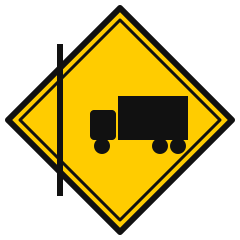
  27. What does this sign warn of?

    A yellow diamond with a black truck on the right half and a vertical line on the left
    1. Trucks entering the road
    2. A truck route begins
    3. A truck inspection station
    4. Trucks prohibited ahead
  28. A parent who signed the consent form for a 16-year-old withdraws it in writing to the registrar. What happens?

    1. The permit stays valid until it expires
    2. The teen must retake the written test
    3. The permit is cancelled at once
    4. The teen may drive only with that parent
  29. A 14-year-old passenger is not wearing a seat belt. Who is responsible?

    1. The driver
    2. No one under age 16
    3. The passenger's parent
    4. The passenger
  30. What is the minimum time to complete PEI's GDL program without certified driver education?

    1. Three years
    2. 18 months
    3. Four years
    4. Two years

All PEI Class 7 practice tests

About this practice test

How many questions are in PEI Class 7 practice test 9?

30 original multiple-choice practice questions covering regulatory signs and lane arrows, impaired and distracted driving, right of way and pedestrians, demerit points and suspensions, class 7 permit and graduated licensing, warning signs, seat belts, child seats and collisions, pavement markings and crosswalks, night, winter and bad weather, turning, signalling and passing, school buses, trucks and cyclists, construction zones and railway crossings, sign shapes and colours. Each answer includes an explanation. This mixed practice set does not reproduce the official exam format or predict an official score.

Are the questions the same every time?

Yes. Practice test 9 always has the same 30 questions, so you can repeat it until you get them all right. The other 9 sets use different questions.

Are these real test questions?

No. The official question bank is not published. These are original questions written from the official handbook, which is what the real PEI Class 7 test is based on.