You are on a two-lane-each-way highway approaching a ramp where cars are merging. What should you do if it is safe?
PEI Class 7 overview
PEI Class 7 Practice Test 8
30 questions on highways, town driving and roundabouts, class 7 permit and graduated licensing, night, winter and bad weather, regulatory signs and lane arrows, demerit points and suspensions and more.
- No sign-up
- Every answer explained
- Independent · not a government site
- Set 8 of 10
- 30 questions
- Instant feedback
0/30
All 30 questions in this test
Every question and its answer choices. The correct answers and explanations appear when you take the test above.
You are on a two-lane-each-way highway approaching a ramp where cars are merging. What should you do if it is safe?
- Move to the left lane to leave room
- Stay right and hold your speed
- Speed up to close the gap
- Sound your horn to warn them
Where must a Stage 1 driver display the yellow L decal?
- On the driver's side window
- On the windshield, above the inspection sticker
- On the rear bumper
- On the back window, in the lower right-hand corner
How should you start moving on an icy road?
- In first gear at high revs
- Gently, without spinning the wheels
- By spinning the tires to melt the ice
- With quick bursts of gas
You want to drop off a friend beside this sign. What does it tell you?
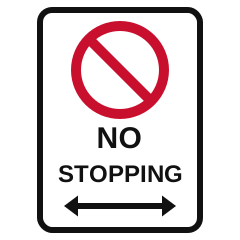
- Stopping is not permitted in this area
- You may stop for up to five minutes
- Only parking overnight is forbidden
- You may stop if your hazard lights are on
How many demerit points are given for failing to stop for a school bus with flashing red lights?
- 3
- 12
- 9
- 6
What do white arrows painted in a lane before an intersection tell you?
- That passing is allowed
- The direction of one-way traffic
- Which lane to use for a manoeuvre
- Where to park
You are following another vehicle at night. Within what distance should you use low beams?
- 150 metres
- 100 metres
- 60 metres
- 30 metres
At an intersection without signals, a pedestrian steps into the crosswalk on your side of the road. What must you do?
- Sound your horn
- Slow down and pass behind
- Stop
- Continue if you got there first
Your car breaks down at night on a highway and you can't move it off the road. What should you do?
- Leave it with lights off
- Stand behind the car on the road to wave traffic around it
- Stop in the left lane
- Pull as far right as possible and turn on hazard lights
What is the fine range for using a hand-held cell phone while driving in PEI?
- $250 to $400
- $50 to $150
- $100 to $200
- $500 to $1,000
Your load sticks out 1.5 metres past the back of your truck during the day. What must you display?
- Your hazard lights only
- A slow-moving vehicle sign on the load
- A red flag at the end of the load
- Nothing in daylight
What colour are the flashing lights on funeral vehicles in PEI?
- Green
- Purple
- Blue
- White
What happens to speeding fines in a signed school zone in PEI?
- They are tripled
- They are doubled
- They stay the same
- Only demerit points increase
You are stopped waiting to turn left across traffic. Why keep your front wheels straight?
- It shows others behind you that you are not turning yet
- A rear-end hit won't push you into oncoming traffic
- It is easier to see pedestrians
- It saves wear on your tires
You meet a stopped school bus with flashing red lights coming toward you. What must you do?
- Slow down and pass with care
- Pull onto the shoulder and continue
- Stop only if children are on your side
- Stop, as traffic from both directions must
What does the number on the tab under this sign tell you?

- The new speed limit for the highway
- The safe speed for the turn
- The distance to the curve in metres
- The minimum speed on the curve
A railway crossing has a stop sign. Within what distance from the nearest rail must you stop?
- Between 10 and 30 metres
- Between 2 and 10 metres
- Between 5 and 15 metres
- Within 3 metres
A flashing red light can appear in several forms. Which is one the handbook mentions?
- A strobe on a construction sign
- A light built into the pavement
- A beacon directly above a stop sign
- A light on top of a school bus
According to the handbook, two drinks plus one light dose of marijuana can equal the impairment of how many drinks?
- Two
- Five
- Three
- Eight
After slowing on a low shoulder, at what angle should you return to the pavement?
- About 5 degrees
- About 90 degrees
- About 45 degrees
- About 10 degrees
A truck ahead is signalling right but swinging wide to the left. What should you do?
- Pass quickly on the right
- Drive between it and the curb
- Sound your horn and stay close behind its bumper
- Give it room and don't pass on its right
What does this sign tell you?
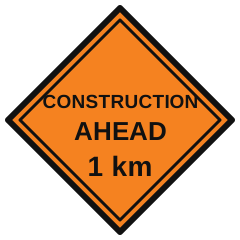
- Detour ahead
- Road closed ahead
- Construction ahead
- Survey crew ahead
How must an infant weighing under 10 kg travel?
- In a lap belt in the back seat
- On an adult's lap with a belt
- In a forward-facing booster
- In a rear-facing child seat
A driver with 8 demerit points completes the Defensive Driving Course and exam. What can they earn?
- Three merit points
- Removal of all points
- Six merit points
- A shorter suspension
You are leaving a farm lane onto a rural highway. What must you do?
- Stop and yield to traffic on the highway
- Turn on hazard lights and enter
- Slow down and merge with traffic as on a ramp
- Sound your horn and pull out
What do square information signs along PEI roads usually show?
- A hazard such as a sharp curve
- Nearby services like gas, food or lodging
- The legal speed limit for that stretch of road
- Where passing is not allowed
What does this sign warn of?

- A steep incline ahead
- Loose gravel on the shoulder
- Trucks entering the highway
- A runaway lane ahead
What does a sign showing only certain arrows at an intersection tell you?
- The arrows show the safest route
- Only the turns shown are permitted
- Turns shown are allowed only at night
- Turns not shown need a signal first
What must a Class 7 holder complete before becoming eligible for a road test?
- The Novice Driver Course
- A second written test
- A first aid course
- A defensive driving course
A pedestrian is halfway across when your signal turns green. What must you do?
- Sound your horn to hurry them
- Go, since your light is now green
- Drive around behind the pedestrian
- Wait until the pedestrian is safely across
All PEI Class 7 practice tests
- PEI Class 7 Mock Exam 1 – 30 QuestionsUntimed practice · answers explained
- PEI Class 7 Mock Exam 2 – 30 QuestionsUntimed practice · answers explained
- PEI Class 7 Mock Exam 3 – 30 QuestionsUntimed practice · answers explained
- PEI Class 7 Mock Exam 4 – 30 QuestionsUntimed practice · answers explained
- PEI Class 7 Mock Exam 5 – 30 QuestionsUntimed practice · answers explained
- Sign shapes and coloursThe stop, yield and speed limit shapes, what red and green mean on a sign, regulatory, school zone and slow-moving vehicle shapes, wrong-way and playground signs, and square information signs.
- Regulatory signs and lane arrowsDo not enter, no turn and no U-turn signs, one-way and keep right signs, no stopping and no parking, lane arrow signs, the hazard warning marker, school bus stop ahead lights and pedestrian and cycling prohibitions.
- Warning signsNarrow bridges, divided highways, lane endings, stop and signal ahead, chevrons and curve speeds, merges, hills, slippery roads, trucks, T intersections, bicycles, snowmobiles and bridges that freeze first.
- Construction zones and railway crossingsOrange construction signs, flagpersons, the 60 km/h construction zone limit, and railway crossing signs, lights and stopping distances for driving outside PEI, which has no railways.
- Traffic lights and signalsGreen, amber and red lights, green arrows, right turns on red, flashing red and amber lights, school signal lights, pedestrians at signals and police directions.
About this practice test
How many questions are in PEI Class 7 practice test 8?
30 original multiple-choice practice questions covering highways, town driving and roundabouts, class 7 permit and graduated licensing, night, winter and bad weather, regulatory signs and lane arrows, demerit points and suspensions, pavement markings and crosswalks, parking, stopping and backing, impaired and distracted driving, vehicle registration and equipment, right of way and pedestrians, speed limits and following distance, turning, signalling and passing, school buses, trucks and cyclists, warning signs, construction zones and railway crossings, traffic lights and signals, seat belts, child seats and collisions, sign shapes and colours. Each answer includes an explanation. This mixed practice set does not reproduce the official exam format or predict an official score.
Are the questions the same every time?
Yes. Practice test 8 always has the same 30 questions, so you can repeat it until you get them all right. The other 9 sets use different questions.
Are these real test questions?
No. The official question bank is not published. These are original questions written from the official handbook, which is what the real PEI Class 7 test is based on.