Which shape is always used for a yield sign?
PEI Class 7 overview
PEI Class 7 Practice Test 5
30 questions on sign shapes and colours, school buses, trucks and cyclists, night, winter and bad weather, speed limits and following distance, construction zones and railway crossings and more.
- No sign-up
- Every answer explained
- Independent · not a government site
- Set 5 of 10
- 30 questions
- Instant feedback
0/30
All 30 questions in this test
Every question and its answer choices. The correct answers and explanations appear when you take the test above.
Which shape is always used for a yield sign?
- Diamond
- Triangular
- Vertical rectangle
- Eight-sided
A school bus is stopped with its red lights flashing. How close may you stop to it?
- No closer than 3 metres
- No closer than 10 metres
- No closer than 20 metres
- No closer than 6 metres
At about what speed does partial hydroplaning start for a standard car on a wet road?
- About 60 km/h
- About 110 km/h
- About 30 km/h
- About 90 km/h
Car trouble forces you to drive well below the speed of traffic on a two-lane road. What should you do?
- Turn on high beams and continue
- Drive on the centre line
- Pull off the road to let traffic pass
- Speed up on downhill stretches
Signal lights are flashing at a railway crossing. How close may you stop to the nearest rail?
- No closer than 10 metres
- No closer than 2 metres
- No closer than 30 metres
- No closer than 5 metres
What should you expect after passing this sign?
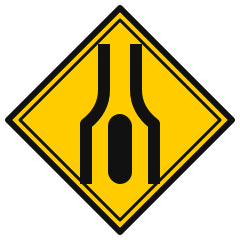
- A divided highway begins ahead
- The divided highway ends ahead
- A merge from the right
- The road narrows to one lane
What happens if you lend your driver's licence to someone else to use?
- 3 points and a warning letter from the Registrar
- A one-month suspension only
- 12 points and a three-month suspension
- A $100 fine and no points
What is the purpose of the amber light?
- To tell drivers to speed up
- To allow turning vehicles to go first
- To warn that the light is about to turn green
- To let vehicles already in the intersection clear it
Your aunt is supervising you on your Class 7 permit. Who else may ride with you?
- Only members of your aunt's immediate family
- Up to three passengers of any age, with seat belts
- Any one friend of your choice
- Only adults with a full licence
Driving in town, you must go slower than the flow of traffic. Which lane should you use?
- The centre turning lane
- Whichever lane is emptier
- The left lane
- The right lane
The light turns amber as you approach, and you could stop safely. What does the law require?
- Speed up and go through
- Stop only if pedestrians are waiting
- Go through if no police are present
- Stop before the intersection
Below what tread depth must a tire be replaced?
- 0.5 mm
- 5 mm
- 3 mm
- 1.6 mm
How should you control your speed through a turn?
- Speed up as you begin the turn
- Slow before the turn, then hold that speed
- Brake hard in the middle of the turn, not before
- Shift gears as you turn
Where should you never install a rear-facing infant seat?
- In the centre rear seat, away from the doors
- In the back seat
- Behind the driver
- In a seat with an active air bag
What does a solid white line between two lanes going the same direction mean?
- Lane changes should not be made
- The lanes carry opposite traffic
- The right lane is for buses
- Lane changes are allowed with caution
You see a warning sign for a fire truck entrance ahead. What should you be ready to do?
- Move into the oncoming lane
- Stop at the entrance every time, even if it's clear
- Speed up to clear the entrance
- Slow down and yield to a fire truck pulling out
A school bus ahead has its alternating amber lights flashing. What does this mean?
- It is about to stop; slow down and be alert
- It is safe to pass quickly
- You must stop immediately
- It has finished unloading and is about to pull away
To begin parallel parking, how far from the car ahead should you stop alongside it?
- About 0.45 metres
- About 2 metres
- About 0.1 metres
- About 1.5 metres
In a two-lane roundabout, which lane must you use to turn left?
- The right-hand lane
- Either lane
- The lane with fewer cars
- The left-hand lane
You are approaching a funeral procession. How fast may you drive?
- 30 km/h at most
- 10 km/h under the posted limit
- The posted limit
- Half the posted speed limit
Which phone use is allowed for a fully licensed driver while driving?
- Holding the phone on speaker
- Texting while stopped at a red light
- Reading email at low speed
- Hands-free activated by a single touch
You and another car reach a four-way stop at the same time. The other car is on your right. Who goes first?
- Whichever car is larger
- You, since you are on the left
- The driver who signals first
- The car on your right
Who must sit beside a Stage 1 driver?
- A driver licensed for at least four years
- Any licensed adult
- A driver licensed for at least two years
- A parent or guardian only
An oncoming car approaches at night. Within what distance must you dim your high beams?
- 60 metres
- 300 metres
- 30 metres
- 150 metres
You are in a lane marked with this sign. Which way may you go?
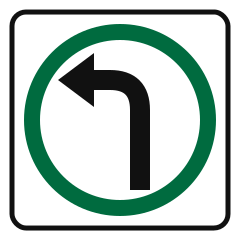
- Straight through only
- Left only
- Any direction
- Left or straight through
How is refusing to take a blood alcohol test treated in PEI?
- As a minor offence with a fine and no suspension
- As a 24-hour suspension only
- As a warning on your record
- The same as an impaired conviction over .08
You see diagonal crosshatch markings before a traffic island. What should you do?
- Drive over them to pass
- Park on them in an emergency only
- Use them as a turning lane
- Keep off them; they are not a travel lane
What does this sign tell you?
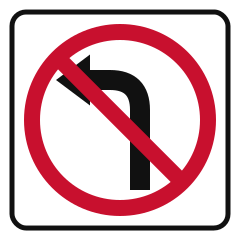
- Turn left only
- Left turns are not permitted
- Sharp curve to the left
- Left lane ends ahead
An experienced PEI driver reaches 12 demerit points within two years. What happens?
- An interview with Highway Safety
- A three-month licence suspension
- A one-month suspension
- A warning letter
What does this sign tell you?

- Railway station ahead
- Yield to all trains
- Stop at every crossing
- Trains have stopped running
All PEI Class 7 practice tests
- PEI Class 7 Mock Exam 1 – 30 QuestionsUntimed practice · answers explained
- PEI Class 7 Mock Exam 2 – 30 QuestionsUntimed practice · answers explained
- PEI Class 7 Mock Exam 3 – 30 QuestionsUntimed practice · answers explained
- PEI Class 7 Mock Exam 4 – 30 QuestionsUntimed practice · answers explained
- PEI Class 7 Mock Exam 5 – 30 QuestionsUntimed practice · answers explained
- Sign shapes and coloursThe stop, yield and speed limit shapes, what red and green mean on a sign, regulatory, school zone and slow-moving vehicle shapes, wrong-way and playground signs, and square information signs.
- Regulatory signs and lane arrowsDo not enter, no turn and no U-turn signs, one-way and keep right signs, no stopping and no parking, lane arrow signs, the hazard warning marker, school bus stop ahead lights and pedestrian and cycling prohibitions.
- Warning signsNarrow bridges, divided highways, lane endings, stop and signal ahead, chevrons and curve speeds, merges, hills, slippery roads, trucks, T intersections, bicycles, snowmobiles and bridges that freeze first.
- Construction zones and railway crossingsOrange construction signs, flagpersons, the 60 km/h construction zone limit, and railway crossing signs, lights and stopping distances for driving outside PEI, which has no railways.
- Traffic lights and signalsGreen, amber and red lights, green arrows, right turns on red, flashing red and amber lights, school signal lights, pedestrians at signals and police directions.
About this practice test
How many questions are in PEI Class 7 practice test 5?
30 original multiple-choice practice questions covering sign shapes and colours, school buses, trucks and cyclists, night, winter and bad weather, speed limits and following distance, construction zones and railway crossings, warning signs, demerit points and suspensions, traffic lights and signals, class 7 permit and graduated licensing, highways, town driving and roundabouts, vehicle registration and equipment, turning, signalling and passing, seat belts, child seats and collisions, pavement markings and crosswalks, parking, stopping and backing, right of way and pedestrians, impaired and distracted driving, regulatory signs and lane arrows. Each answer includes an explanation. This mixed practice set does not reproduce the official exam format or predict an official score.
Are the questions the same every time?
Yes. Practice test 5 always has the same 30 questions, so you can repeat it until you get them all right. The other 9 sets use different questions.
Are these real test questions?
No. The official question bank is not published. These are original questions written from the official handbook, which is what the real PEI Class 7 test is based on.