Why should you leave an extra second or two when following a motorcycle?
PEI Class 7 overview
PEI Class 7 Practice Test 7
30 questions on speed limits and following distance, parking, stopping and backing, night, winter and bad weather, class 7 permit and graduated licensing, highways, town driving and roundabouts and more.
- No sign-up
- Every answer explained
- Independent · not a government site
- Set 7 of 10
- 30 questions
- Instant feedback
0/30
All 30 questions in this test
Every question and its answer choices. The correct answers and explanations appear when you take the test above.
Why should you leave an extra second or two when following a motorcycle?
- Motorcycles always ride in the centre
- Motorcycles often stall at lights
- Motorcycles cannot use brake lights
- Motorcycles can stop very quickly
When parallel parked, how close to the curb must your wheels be?
- Touching the curb
- Within 0.5 metres
- Within 1 metre
- Within 0.3 metres
Which headlights should you use in fog or falling snow?
- Parking lights only
- Low beams
- Hazard lights only
- High beams
What blood alcohol level must a driver in PEI's GDL program have?
- Under 0.02
- Zero
- Under 0.08
- Under 0.05
Why should you avoid stopping at the end of an acceleration lane?
- It is only allowed for large trucks and buses
- It wears out your brakes
- It blocks the shoulder
- Drivers behind expect you to keep going
Is it legal to drive with only parking lights on when headlights are required?
- Yes, in town only
- Yes, in light fog
- No, it is illegal
- Yes, at dusk
What should you do when you see this sign before a crossing?
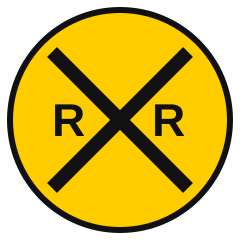
- Speed up to cross quickly
- Look, listen and slow down
- Sound your horn twice
- Stop at the sign itself
How often must an ignition interlock device be serviced?
- Every 90 days
- Once a year
- At least every 30 days
- At least every 60 days
Besides sunset to sunrise, when must your headlights be on?
- When you can't see a vehicle or person 150 m ahead
- Only when it is raining heavily
- Only on highways where the speed limit is over 80 km/h
- Whenever the radio is on
Traffic is backed up beyond the intersection and your light is green. What should you do?
- Turn on hazard lights and enter
- Enter and wait in the intersection
- Wait until you can clear the intersection
- Go since your light is green
Who is not allowed on a road with this sign?
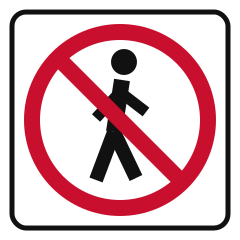
- Cyclists
- Pedestrians
- Farm tractors
- Snowmobiles
What does this sign tell you to do?

- Give way to pedestrians but not to cross traffic
- Merge without changing speed
- Slow down and give way, stopping if needed
- Stop completely every time
What does this warning sign tell you?
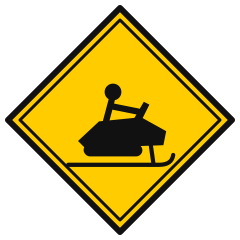
- Snowmobiles may ride on this road
- The road is closed in winter
- Snowmobiles may enter or cross the road
- Snow removal vehicles ahead
You plan to turn left at a roundabout. How should you signal?
- No signal until you exit
- Left the whole way through, until you exit
- Left on entry, right before exiting
- Right on entry only
When must you give a signal besides before turning or changing lanes?
- When stopping at a red light already stopped
- When slowing for a speed bump
- When pulling out from a parked position
- When following a curve in the road
Why should a child never ride on an adult's lap?
- A crash can tear the child from the adult's arms
- Children are safer on laps at low speed
- It distracts the driver's mirrors
- It is only illegal on highways
At a special crosswalk, a pedestrian has activated the flashing amber beacons. What must you do?
- Stop only if the pedestrian is in your lane
- Sound your horn and proceed
- Stop before entering the crosswalk
- Slow down and continue carefully
Your car has no ABS and you must slow down on an icy road. How should you brake?
- Pull the parking brake
- Pump the brakes quickly but gently
- Press hard and hold the pedal
- Shift into neutral and coast
How many demerit points does the handbook list for racing another motor vehicle?
- 6
- 12
- 3
- 9
What does this sign mean?
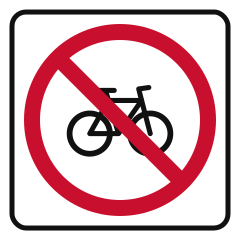
- Bicycles must keep right
- Bicycle crossing ahead
- Cycling is prohibited
- Bicycle lane ahead
How close to the nearest rail of a railway crossing may you park?
- No closer than 6 metres
- No closer than 5 metres
- No closer than 15 metres
- No closer than 30 metres
After checking your mirrors and signalling, what is the last check before changing lanes?
- Glance at the speedometer
- Look over your shoulder at the blind spot
- Tap the brakes
- Check the inside rear-view mirror one more time
You are stranded in your car during a blizzard. What does the handbook advise?
- Leave the car and flag down traffic
- Run the engine nonstop with windows shut
- Walk to the nearest house
- Stay with the car and open a window slightly
What does an experienced driver receive at 6, 7 or 8 demerit points?
- A three-month suspension
- A warning letter
- An interview
- A fine only
At a red light with no stop line, where must you stop first?
- At the nearest crosswalk
- Beside the traffic light pole
- Past the crosswalk, at the corner
- Halfway into the intersection
There is a solid yellow line on your side of the centre. What does it tell you?
- Parking is not allowed
- The lane ends ahead
- Passing is allowed with caution
- Passing is not safe here
Where should pedestrians walk on a highway with no sidewalk?
- On the left, facing traffic
- On the right, with traffic
- In the centre of the lane
- On whichever side is smoother
Which vehicles must display this sign at the rear?

- Those that cannot keep a speed over 40 km/h
- Only trucks carrying dangerous goods
- Those that cannot keep a speed over 60 km/h
- Any vehicle towing a trailer
You are parked at the curb and about to open your door. Whose responsibility is it to avoid hitting a cyclist?
- No one's if the door opens slowly
- The driver's
- Shared equally
- The cyclist's
A 7-year-old weighs 25 kg and is 125 cm tall. What restraint does the handbook require?
- The adult seat belt alone
- A rear-facing infant seat
- A booster seat with the lap and shoulder belt
- A lap belt in the front seat, with the air bag off
All PEI Class 7 practice tests
- PEI Class 7 Mock Exam 1 – 30 QuestionsUntimed practice · answers explained
- PEI Class 7 Mock Exam 2 – 30 QuestionsUntimed practice · answers explained
- PEI Class 7 Mock Exam 3 – 30 QuestionsUntimed practice · answers explained
- PEI Class 7 Mock Exam 4 – 30 QuestionsUntimed practice · answers explained
- PEI Class 7 Mock Exam 5 – 30 QuestionsUntimed practice · answers explained
- Sign shapes and coloursThe stop, yield and speed limit shapes, what red and green mean on a sign, regulatory, school zone and slow-moving vehicle shapes, wrong-way and playground signs, and square information signs.
- Regulatory signs and lane arrowsDo not enter, no turn and no U-turn signs, one-way and keep right signs, no stopping and no parking, lane arrow signs, the hazard warning marker, school bus stop ahead lights and pedestrian and cycling prohibitions.
- Warning signsNarrow bridges, divided highways, lane endings, stop and signal ahead, chevrons and curve speeds, merges, hills, slippery roads, trucks, T intersections, bicycles, snowmobiles and bridges that freeze first.
- Construction zones and railway crossingsOrange construction signs, flagpersons, the 60 km/h construction zone limit, and railway crossing signs, lights and stopping distances for driving outside PEI, which has no railways.
- Traffic lights and signalsGreen, amber and red lights, green arrows, right turns on red, flashing red and amber lights, school signal lights, pedestrians at signals and police directions.
About this practice test
How many questions are in PEI Class 7 practice test 7?
30 original multiple-choice practice questions covering speed limits and following distance, parking, stopping and backing, night, winter and bad weather, class 7 permit and graduated licensing, highways, town driving and roundabouts, vehicle registration and equipment, construction zones and railway crossings, impaired and distracted driving, traffic lights and signals, regulatory signs and lane arrows, sign shapes and colours, warning signs, turning, signalling and passing, seat belts, child seats and collisions, pavement markings and crosswalks, demerit points and suspensions, right of way and pedestrians, school buses, trucks and cyclists. Each answer includes an explanation. This mixed practice set does not reproduce the official exam format or predict an official score.
Are the questions the same every time?
Yes. Practice test 7 always has the same 30 questions, so you can repeat it until you get them all right. The other 9 sets use different questions.
Are these real test questions?
No. The official question bank is not published. These are original questions written from the official handbook, which is what the real PEI Class 7 test is based on.