What does this sign tell you about the street?
PEI Class 7: Regulatory signs and lane arrows
Do not enter, no turn and no U-turn signs, one-way and keep right signs, no stopping and no parking, lane arrow signs, the hazard warning marker, school bus stop ahead lights and pedestrian and cycling prohibitions.
- No sign-up
- Every answer explained
- Independent · not a government site
- 17 questions
- Topic drill
Study reference: PEI Driver's Handbook (2022 PDF edition), Ch. 3 Signs, Pavement Markings and Work Zones — Regulatory signs, Lane arrows, Additional signs, pp. 70, 73–75, 78–79, 81
All 17 questions in this test
Every question and its answer choices. The correct answers and explanations appear when you take the test above.
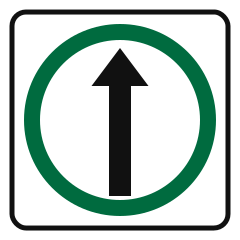
What does this sign tell you about the street?
- You must turn in the arrow's direction at the corner
- Traffic may travel only in the arrow's direction
- A detour follows the arrow
- The lane ahead ends on that side
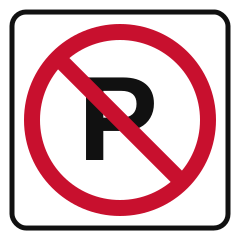
What does this sign mean?
- No stopping for any reason
- No parking
- Parking for permit holders only
- Pay parking ahead
What does this sign require?
- Keep to the right of the island ahead
- Merge into the right lane now
- Right lane ends ahead
- Turn right at the next corner or driveway
What does this sign mean?
- Winding road ahead
- Two-way traffic ahead
- Turn around at the next exit
- U-turns are not permitted
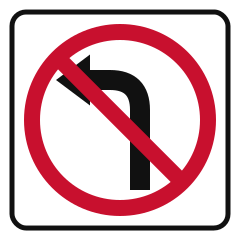
What does this sign tell you?
- Turn left only
- Left turns are not permitted
- Sharp curve to the left
- Left lane ends ahead
You want to drop off a friend beside this sign. What does it tell you?
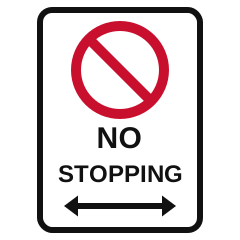
- Stopping is not permitted in this area
- You may stop for up to five minutes
- Only parking overnight is forbidden
- You may stop if your hazard lights are on
What does this sign over the centre lane mean?
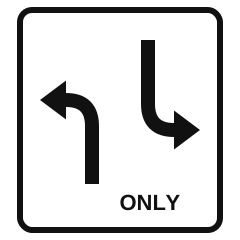
- It is a two-way left-turn lane
- It is for passing in either direction
- It is a bus-only lane
- It is a reversible express lane
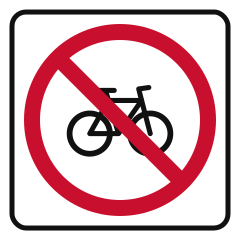
What does this sign mean?
- Bicycles must keep right
- Bicycle crossing ahead
- Cycling is prohibited
- Bicycle lane ahead
What does this lane sign mean?
- Traffic in this lane may turn either left or right
- Traffic in this lane must go straight through
- Passing permitted in this lane
- One-way street ahead
Which way should you pass the object marked by this sign?

- Do not pass it; stop and wait
- On the side the stripes slope up toward
- On whichever side has less traffic
- On the side the stripes slope down toward
A school bus stop ahead sign has its amber lights activated. What should you do?
- Stop and wait for the lights to go off
- Speed up to pass before the bus stops
- Change lanes and keep your speed
- Slow down and be prepared to stop
You stop at a red light and see a NO RIGHT ON RED sign. What must you do to turn right?
- Turn only if a police officer is absent
- Wait for the green light
- Turn once the way is clear
- Turn after waiting 30 seconds
What does a sign showing only certain arrows at an intersection tell you?
- The arrows show the safest route
- Only the turns shown are permitted
- Turns shown are allowed only at night
- Turns not shown need a signal first
Who is not allowed on a road with this sign?
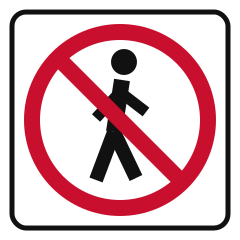
- Cyclists
- Pedestrians
- Farm tractors
- Snowmobiles
You are in a lane marked with this sign. Which way may you go?
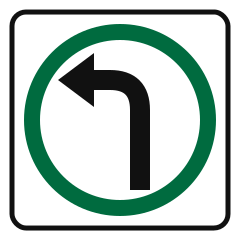
- Straight through only
- Left only
- Any direction
- Left or straight through
The school bus stop ahead sign is flashing red. What is required?
- Only traffic behind the bus must stop
- Yield to children, then continue
- Slow to half the posted speed
- All traffic must stop
What does this sign mean?
- Stop, then proceed
- Do not enter
- No parking at any time
- Road closed ahead, use detour
Regulatory signs and lane arrows: key rules to remember
Our summary of what the official handbook says on this topic, in our own words. Read it before or after the practice questions above, then check the original chapter. Read the official chapter ↗
Regulatory signs (pp. 70, 73–75)
- One-way sign: traffic allowed in one direction only on that street or highway.
- Keep right sign: the road is divided by an island and drivers must keep to the right.
- Do not enter sign: placed on the right side facing traffic that would enter a road or ramp the wrong way.
- Signs shown: no left turn, no U-turn, do not enter, no stopping, passing permitted, do not litter, police post, route markers (Trans-Canada, PEI highway), PEI place name.
- Further signs: keep right of traffic island; sign showing only the turns permitted; maximum speed limit ahead; truck route; no turns; no right on red signal; hazard warning (drive in the direction the slopes point); school zone; access for the physically challenged; no parking in either direction; one way; do not enter.
- Further signs: snowmobile route; snowmobile restricted; parking; dangerous goods route; dangerous goods prohibited; cul-de-sac; weight limit.
- School bus stop ahead sign with lights: amber lights activated = slow down and be prepared to stop; red lights flashing = all traffic must stop.
Lane arrows (pp. 78–79)
- Overhead/side-mounted lane signs: left turn only; right turn only; straight through or left; straight through or right; right or left only; all movements permitted; straight through only; two-way left-turn lane.
Additional signs (p. 81)
- Wide load/oversized; pedestrians prohibited; slow-moving vehicle; pedestrian pushbutton; cycling prohibited; littering prohibited; reserved bicycle lane.
Right turns at red light (p. 63)
- A right turn on red after a full stop is allowed only if no sign prohibits it.
Study the Regulatory signs and lane arrows rules as flashcards →
Other topics
- Sign shapes and coloursThe stop, yield and speed limit shapes, what red and green mean on a sign, regulatory, school zone and slow-moving vehicle shapes, wrong-way and playground signs, and square information signs.
- Warning signsNarrow bridges, divided highways, lane endings, stop and signal ahead, chevrons and curve speeds, merges, hills, slippery roads, trucks, T intersections, bicycles, snowmobiles and bridges that freeze first.
- Construction zones and railway crossingsOrange construction signs, flagpersons, the 60 km/h construction zone limit, and railway crossing signs, lights and stopping distances for driving outside PEI, which has no railways.
- Traffic lights and signalsGreen, amber and red lights, green arrows, right turns on red, flashing red and amber lights, school signal lights, pedestrians at signals and police directions.
- Pavement markings and crosswalksYellow and white lines, solid and broken lines, crosshatch markings, stop lines, crosswalk lines, intersection arrows, school crosswalks and special crosswalks with flashing beacons.
- Class 7 permit and graduated licensingWho may apply, documents, the knowledge and vision tests, Stage 1 supervision, passenger and night-time rules, the L decal, waiting periods, the Novice Driver Course and Stages 2 and 3.
- Demerit points and suspensionsWarning, interview and suspension thresholds, new-driver point limits in Stages 2 and 3, point values for common offences, probation, courses that affect points and impoundment.
- Impaired and distracted drivingZero BAC for GDL drivers, the .05 to .08 range, 24-hour and 90-day suspensions, cancellations for convictions, rehabilitation and ignition interlock, alcohol and drug effects, and the hand-held phone ban.
- Speed limits and following distancePEI's basic urban, construction zone and unpaved road limits, the 60 km/h school zone and its hours, doubled fines, slow driving, the three-second rule and stopping distance.
- Right of way and pedestriansFour-way stops, left turns, driveways, stop and yield signs, emergency vehicles, funeral processions with purple lights, crosswalks, white canes and walking on highways.
- Turning, signalling and passingLane changes and blind spots, signalling distances, safe turns, waiting to turn left, right on red, U-turn rules, where passing is forbidden and being passed.
- School buses, trucks and cyclistsAmber and red school bus lights and the 6-metre rule, truck and bus No-Zones, wide right turns, sharing the road with cyclists, bicycle equipment and e-bikes.
- Parking, stopping and backingNo-parking distances from hydrants, crosswalks, stop signs and railway tracks, parallel and angle parking, leaving a vehicle, breakdowns and safe backing.
- Highways, town driving and roundaboutsAcceleration and deceleration lanes, merging, low shoulders, lane use on four-lane highways, town driving, and signalling and lane choice in single- and dual-lane roundabouts.
- Night, winter and bad weatherDimming headlights, over-driving headlights, studded tire dates, winter stopping distances, ABS, black ice, being stranded, skids, wet roads, hydroplaning and fog.
- Seat belts, child seats and collisionsWho must buckle up, infant, toddler and booster seats, belt fit and air bags, when to report a collision, what to report and what to do first at a crash scene.
- Vehicle registration and equipmentRegistration, ownership transfer and inspection, rejected vehicles, headlights and daytime running lights, horn, mirrors, window tint, loads, tires and non-resident vehicles.